In recent years, whenever you hear about China, you hear about its booming economy and increasing political weight on the world arena. However, you also hear about its environmental problems such as highly polluted air quality, which most of the time, exceeds the allowed level.
For the local population, as well as for expats residing in China, it is one of the primary concerns and complaints to the government. So where does this highly polluted air come from? Well, as in any other country, all production activities of humans have an adverse impact on the surrounding environment. China is the same, except for the fact that it is much bigger and much more populated. Of course, its size contributes to a much greater amount of the waste that industrial enterprises produce and release as air emissions or as a sewage and solid waste. And let’s not forget about vehicles, which emit lead and its compounds through the exhaust gases.
 In this photo: Discharge of smog into the air in Beijing – Photo credit to Jens Schott Knudsen
Discussing every source of pollution would be too long and complicated, so in this article I would like to talk about the plastic waste, which is one of the main sources of the bad air quality. What is plastic’s fate here in China? How does it contribute to the polluted air? And what can be done about it?
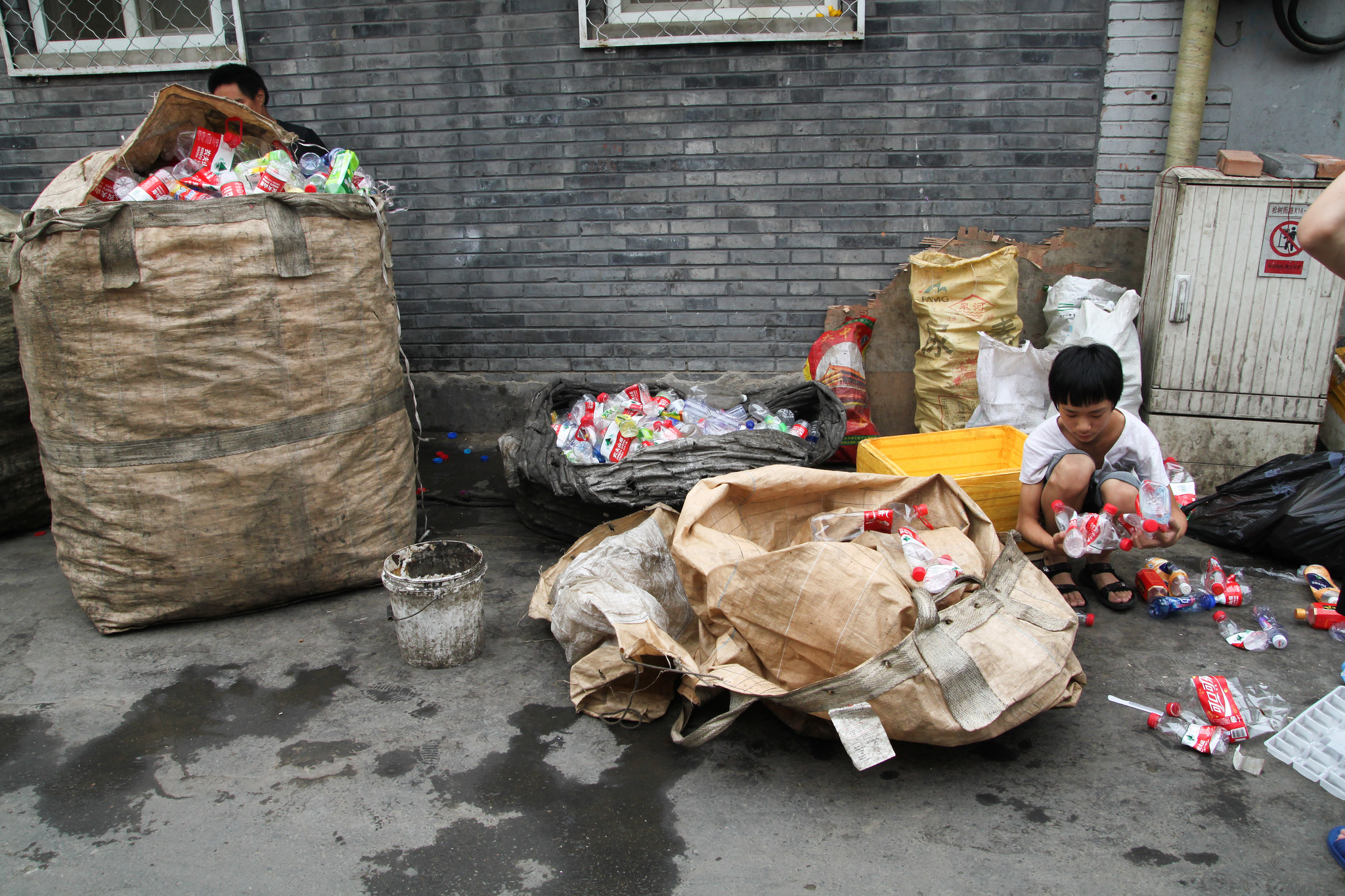
First of all, plastic is a non-biodegradable material and as a waste, it can remain in our environment for many, many years causing damage to everything around: land, water, air. China, by becoming a world power, also became one of the top consumers of plastic. It undoubtedly produces its own plastic, but the domestic supply cannot meet the demand due to the shortage of the plastic raw material. Therefore, to fill the gap, the only option left is to import. So every year, China imports around 12 million metric tonnes of plastic waste, making it the biggest importer of plastic waste in the world. By controlling the large part of the world’s recycling market, it boosts its own plastic manufacturing production, exports remade plastic products worldwide, and in this way, helps the country’s further financial progress.
So what happens to all that domestic and imported plastic waste? Ideally, it gets recycled and manufactured into the plastic things that we use all around the world. It starts with the necessary parts for machinery and technologies and goes all the way down to household appliances and plastic bags. Not ideally, higher quality and cleaner imported plastic waste is getting recycled and lower quality and mainly domestic waste is getting recovered as energy rather than actually recycled. This is due to its low value as manufacturers are most likely to add fluorine substances or additives, thus further reducing its value.
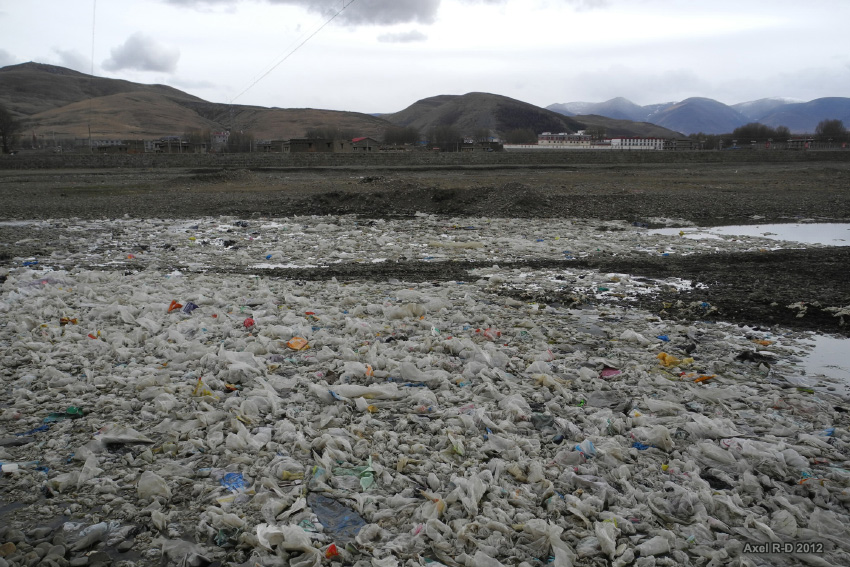 In this photo: The plastic bags dump at Daocheng, Sichuan Province – Photo credit to Axel Drainville
The fact that only half of the total plastic waste gets recycled or recovered already gives us a hint that the rest of the waste is just dumped as litter, disposed of in the landfills or even burnt. Discarded plastic waste not only ruins the scenery but also causes a block up of the sewerage and poses a potential risk to the wildlife. Plastic waste in the landfills just stays there, produces carbon dioxide and methane, and slowly poisons everything around. And China’s very widespread practice of burning the plastic waste, especially during the winter period, produces toxic pollutants that are also causing deterioration of the air quality.
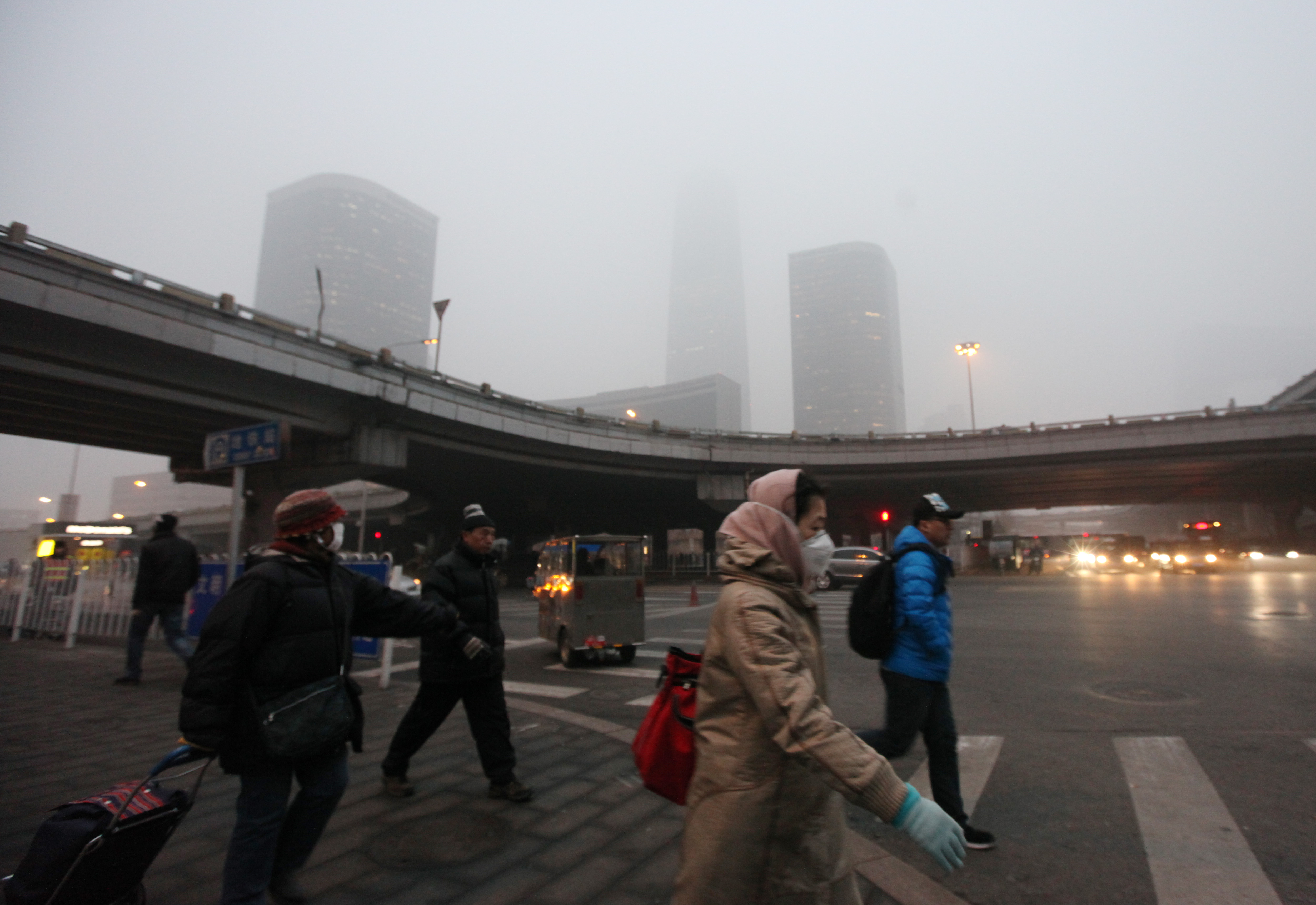 In this photo: Air pollution in Beijing requires a mask – Photo credit to 大杨
In reality, it can be as scary as it sounds. How do we survive and what do we do? We survive by wearing masks and using air purifiers, sometimes making jokes like “we’re all going to die” and most of the times complaining. And when the air quality index reaches “beyond index” level we stay home and call it “airpocalypse”.
What does the government do? Of course, the government is very concerned and has been trying to figure out a way to reduce the impact of plastic waste on the environment. In 2013 “Green Fence” operation was launched. It aimed at importing higher quality plastic waste and not accepting badly sorted and unclean shipments of the plastic waste. During this operation, which lasted from February 2013 to November 2013, around 1 million metric tonnes of plastic waste was not allowed to enter the country. Compared to the usual 12m tonnes of the imported plastic waste, it does not actually make any difference and the level of the plastic waste problem is still high. Of course, the root of the problem is not the amount of the plastic that has been imported, but the way this plastic waste is being regulated and managed here in China. There are about 3000 companies that are officially registered to import and further process the plastic waste. But then there are more than 10,000 unofficial recyclers, which are mainly low-scale and frequently, family-run little firms that have a lack of regulations, control, technology and equipment.
So this is it. This is the issue that the Chinese government has to tackle in the first place. As we all know “Law is order.” So, China can overcome this problem and enjoy a better environment by following three steps. Bringing order within their own system is the first one. Enforcing their own regulations is the second one. The third one is to develop an actual understanding among its people that order is necessary to protect from the danger that the plastic waste causes.
I would like to end on a more positive note and say that we also get clear and blue sky and excellent air quality here in China. It happens less often during winter, but when we get it, we really do appreciate it. We maybe even treasure it a little bit more than the rest of the world. We actually know how hard it is to breath through the mask and stay home during the highly polluted days, when instead you have to run so many errands.
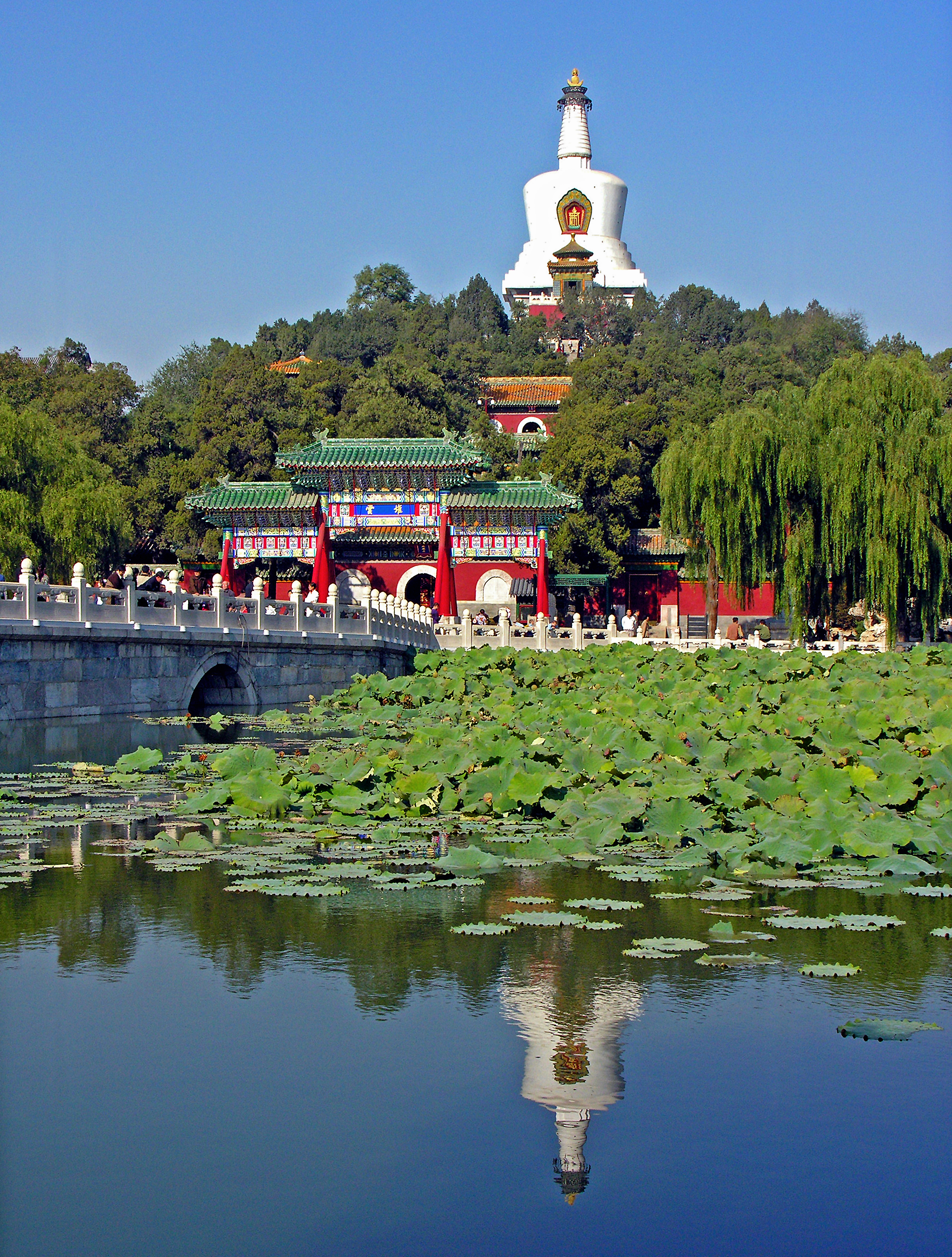 In this photo: White Pagoda at Beihai Park, Beijing – Photo credit to Dennis Jarvis
Let’s keep raising awareness; let’s keep our environment clean.