
In the United States today, democracy is under siege. The Executive Branch of our government, led by the President, is systematically gutting federal agencies by laying off their staffs, slashing their budgets, invading their data bases, and demoralizing the surviving staff of offices like the Department of Agriculture, the Department of Education, the General Services Administration, the Office of Personnel Management, the Small Business Administration, the Centers for Disease Control and Prevention, the Federal Aviation Administration, and even the National Nuclear Security Administration.
This vast, institutional destruction has already led to some predictably horrific outcomes: the understaffing of FAA air traffic controllers has been connected to a spike in airplane accidents, children have died from measles and even the flu as vaccine centers closed, hungry people endured food bank closures, old people lost access to Social Security phone lines and service centers, while farmers realized that cutbacks in Federal Agriculture Agency funding had lost them their markets.
Every Friday night, two brilliant journalists — David Brooks and Jonathan Capehart — are interviewed on PBS TV (our Public Broadcasting System which is also under threat of demolition).
Last week, asked what stage our constitutional crisis has reached, Brooks said he could feel his feet pulled down to a waterfall, while Capehart asserted that we are already in a barrel, tilting precariously over the edge.
Is there any hope? Are we going over?
What we are learning about democracy while our government is torn to pieces
Paradoxically, the more detailed news reports of their destruction we are exposed to, the more we understand the vessels of democracy and the light they contain. Who knew about the networks of clinics and food banks conducted by USAID until they were shattered? Who knew that, without its HIV medications, thousands of patients in African countries would get full-blown AIDS? Who knew how USAID not only serves the needs of our global neighbors but also benefits American farmers as a market for their crops?
Who knew that Federal Agencies operate in efficient partnerships within a complex web of services including non-governmental agencies and voluntary organizations? Our local foodbank here in the Detroit Metropolitan region, Forgotten Harvest, participates in federally funded, state-administered programs such as the Child and Adult Care Food Program (CACFP) and the Summer Food Service Program (SFSP) in cooperation with community, faith, and volunteer groups; now, it scrambles for private donations to offset federal cutbacks.
We had not realized the importance to Veterans of their hospitals and clinics until we heard fired employees and veterans deploring cuts to intensive care units, surgical operations and mental health services. One tearful VA worker disclosed that her dangerously understaffed unit was a Crisis Line counselling veterans who are considering suicide.
These civil servants radiated a dazzling civic altruism, having accepted lower salaries than they would have earned in the private sector in order to provide governmental service. One of the fired VA workers told Patricia Kime from Military.com that he had “planned to spend his career as a civil servant and specifically wanted to work at the VA to help veterans — ‘service after service’.”
“I still want to be a federal employee. … It really brought a lot of joy, especially working for veterans and Veterans Affairs,” the veteran said.
Federal workers did not exit their offices carrying their pathetic boxes of personal possessions onto empty streets, but into the arms of good-hearted crowds of protesting sympathizers who rushed over to give them great big hugs.
Tikkun olam: The healing of the world…And of our democracy?
As we watch the destruction of these virtuous agencies by the despotically vicious Republican administration, we realize the care taken in their construction and levels of virtue in federal workers we have not expected. This shattering of containers and pouring out of light reminds me of a very old story about the creation of the world.
After the expulsion of Jews from Spain in 1492, a new Jewish mysticism sprang up in sixteenth-century Palestine: the Lurianic Kabbalah taught how the world, though seeped in suffering and evil, might, nonetheless, be redeemed. The founder, Rabbi Isaac Luria, liked to tell the creation story of how God took a deep breath to make room for creation, but, in doing so, broke the vessels of divine light which spilled out over the whole universe. We live among those shattered vessels, which are ours to repair, and the scattered light, which is ours to gather in.
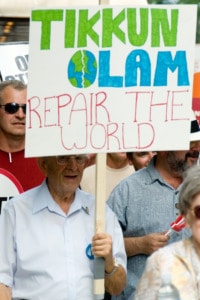
This teaching is called “Tikkun Olam,” the Healing of the world. (תיקון עולם). From Naomi Newman‘s version:
“Though it is hard to believe,
the perfect world is all around us,
but broken into jagged pieces,
Like a puzzle thrown to the floor, the picture lost,
each piece without meaning
until someone puts them back together again
We are that someone.
there is no one else.”
Virtuous and vicious cycles:
In taking “Tikkun Olam” as a metaphor for our American political situation, I am (perhaps heretically?) mixing sacred apples with secular oranges. I know, I know, democracy has never been perfect (certainly not divine) but a set of ideal propositions about the Rule of Law and about civic virtue that we keep trying to live up to.
When they are up and running, networks combining federal, non-governmental, faith and community agencies create a virtuous cycle, each element contributing in its way to outcomes for the common good. The Merriam Webster dictionary defines a virtuous cycle as “a chain of events in which one desirable occurrence leads to another which further promotes the first occurrence and so on, resulting in a continuous process of improvement.”
In contrast, when you cut a key element, such as federal funding for food distribution, you set a vicious cycle in motion that detracts from, and may ultimately destroy, the previous civic good.
“We the people”: What it takes to “form a perfect Union”
“We the people of the United States, in Order to form a more perfect Union,” begins the Constitution: we can get so preoccupied with what is going on in the government that we forget what is going on among those who ordain it in the first place.
The impact of our administration’s vicious cycles has certainly not escaped the notice of everyday Americans, who are upset by economically illiterate tariff fatwas which, as they (and the stock market) are perfectly aware, raise the cost of living. That is why there have been marches, protests, boycotts, and die-ins (as of HIV patients denied their medicine and terminal cancer patients thrown from clinical trials) almost every day since the inauguration, with good-hearted folk turning out in unprecedented numbers.
Democracy on the march:
- In the streets: When, on April 5, a “hands-off” day (re our Social Security, our Medicare, etc.) was called for, 3.5 million marchers poured into the streets not only in big cities, but in small towns, rural villages and in Red (Republican) and in Blue (Democratic) states alike.
- In Town Halls: Since Republican constituents are as upset as anyone else about their tax incentives, stock portfolios, and household expenses, they expressed their displeasure at Town Halls that their Members of Congress conducted, making such a fuss that Republicans decided not to hold them anymore. So, their constituents held them anyway, addressing their worries to photos of their Senators and Representatives propped up on chairs or to (cowardly) rubber chickens perched on stools.
The result, as Substack editor Robert Hubbell puts it, is that “the persistence, strength, and scale of the resistance create the ether in which members of Congress and the Supreme Court make their decisions.”
Flourishing fascism in our streets
I remain most deeply disturbed by the squads with ICE (Immigration and Customs Enforcement) emblems on their jackets or in quasi-military garb and masks who grab people off the street and whisk them away to inaccessible compounds in this country and abroad. Their similarity to Hitler’s Brown Shirted thugs and of their compounds to his concentration camps convince me that fascism is gaining a foothold in America.
Media posts have appeared asking, “Whatever you wished good Germans had done under Hitler, do it now.” Sure enough, when ICE squads bang on doors, good people have “poured into the streets to defend their neighbors, protesting on their behalf with posters and chants of “These are our neighbors! These are our Friends!’”
That is what happened in Sackett’s Harbor, NY, in a town of 1,300 inhabitants when 1,000 of them marched to demand that a neighbor woman and her three children be released from ICE custody after being seized at a dairy farm. It was “The Sackets Harbor community’s steadfast concern, care and love for their neighbors is what brought this family home,” said Murad Awawdeh, president of the New York Immigration Coalition.
Similarly, when ICE stormed a hospital to seize a woman in labor, neighbors spontaneously broke into protests around the building and hired a lawyer to keep her from being separated from her newborn.
The marches, town halls, and disgruntled constituents bombarding their legislators are evidence that the light of civic virtue yet shines brightly in America.
Legions of lawyers to the rescue
Fortunately, platoons of lawyers have joined forces to file hundreds of court cases against the administration, creating a virtuous cycle that has blocked firings, freed detainees, and restored federal funding, while publicizing the unconstitutionality of executive overreach.
The Constitution of the United States mandates a separation of powers among the Executive, Congress, and the Supreme Court. The Supreme Court’s key role is to maintain the separation of powers should the Administration or Congress get out of hand.
The Congress (not the Executive) has sole power over setting up, staffing, funding, or dismantling Federal Agencies, as well as the establishment of tariffs.
That is why legal advocacy organizations like Democracy Forward have sprung into action against multiple Executive Orders. Democracy Forward resources Democracy 2025, comprising more than 280 legal organizations backed by over 600 litigators, community activists, academics, policy experts, faith leaders, and funding experts who have collectively raised millions of dollars to finance legal actions.
That’s a lot of light!
Nevertheless, given the virulence with which the administration is defying both Federal and Supreme Court orders and Congressional prerogatives, can our Rule of Law survive?
Democracy teetering on the brink
In the Senate and the House of Representatives (which comprise the Congress), Democrats lack enough votes to pass or halt legislation, though they are organizing an effective oratorical resistance. Republicans are afraid that if they vote against their would-be dictator, he will threaten bodily harm to them and their families and/or “primary” them in the next election by funding a more loyal Republican candidate for their office.
However, his unpopularity among their constituents has produced a few wisps of resistance, with several Republican Senators refusing the draconian cuts to Medicaid (health services for the poor) in his latest tax bill. While they are (feebly) upholding the Separation of Powers by responding to their constituents’ needs, the Supreme Court is (tentatively) enforcing the Constitution by decrying illegal Executive Orders.
There is no question that we are teetering on the brink of disaster, but there are Democratic institutions that may yet throw out their constitutional hooks to draw us back. Franciscan Richard Rohr reminds us that “the word disaster comes from the Latin word meaning ‘to be disconnected from the stars.” The stars represented the great story, the universal story. Our lives are usually a disaster unless we live under these stars. We live our little story under the great story.”
The Founders who constructed the vessels of our civic democracy believed the story that our universe consists of “self-evident truths” of morality and reason, or, as David Brooks puts it, “the hidden reality of things,” which is that “we are embraced by a moral order.”
I persist in hope that we live and have our being in a good and great universe, which is why Rabbi Luria’s 16th-century creation story makes so much sense for me:
“We are the ones who can find the broken pieces,
Remember how they fit together
And rejoin them.
And we call this repair of the world
Tikkun Olam.”
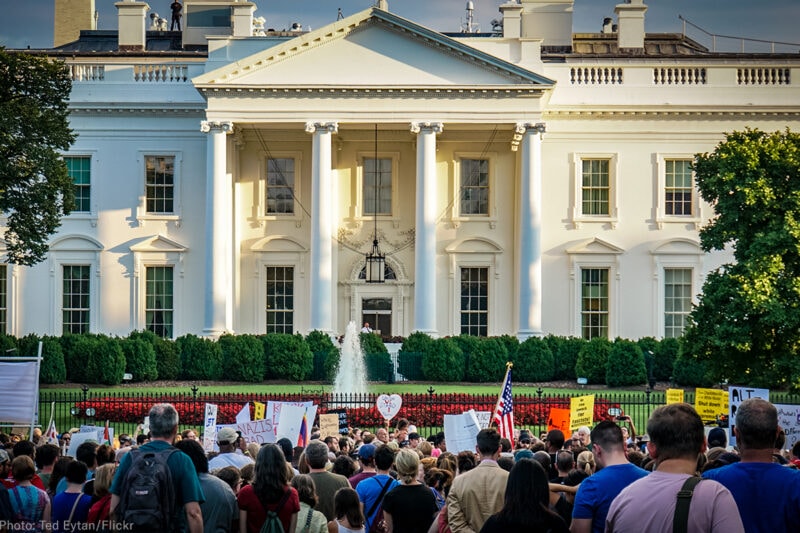
Editor’s Note: The opinions expressed here by Impakter.com columnists are their own, not those of Impakter.com — Cover Photo Credit: Protests in front of the White House in 2018: History is repeating itself Source: ACLU article published October 9, 2018, in response