When the ancient city of Bukhara is mentioned, many immediately think of the Silk Road, caravanserais, and UNESCO-listed architecture. In September 2025, however, the Uzbek city became known for something different: the Bukhara Biennial, a new international platform positioning Central Asia as a serious player on the global cultural map.
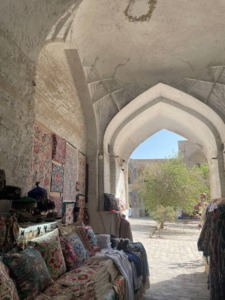
The initiative is taking place from September 5 to November 20, 2025, across newly restored historic landmarks in the city of Bukhara, a UNESCO Creative City of Craft & Folk Art.In the words of Gayane Umerova, Director of the Art and Culture Development Foundation:
“The Biennale was born out of a broader vision. Years ago, we began an ambitious programme to revitalise the heart of the Old City — not only through preservation but through activation. Working with international experts, we set out to ensure that our most treasured sites would no longer remain dormant but become platforms for contemporary creation and learning.”
This vision aligns with a wider cultural renaissance championed by President Shavkat Mirziyoyev, who places culture and heritage at the core of national development.
For European readers accustomed to following Venice, Berlin, or Documenta in Kassel, the idea of a biennial in Central Asia may sound unusual. Yet this year’s edition showed that Bukhara has both the ambition and the infrastructure to attract artists, curators, and investors from far beyond the region.
Context and Ambition

The Biennial was founded with a dual aim: to preserve local heritage and to open the region to contemporary artistic dialogue. Supported by the Uzbek government and international cultural partners, it leverages Bukhara’s unique historical setting. Exhibitions took place not only in galleries but in madrassas, caravanserais, and public squares — spaces that for centuries embodied cross-cultural exchange.
Unlike many emerging festivals that struggle to define themselves, Bukhara has a clear narrative: positioning Central Asia as both a custodian of tradition and a laboratory of modern ideas.
Recipes for Broken Hearts

The curatorial theme — “Recipes for Broken Hearts” — reframed Bukhara not only as a historic trading hub but as a contemporary site of healing. As Artistic Director Diana Campbell noted: “Learning from cultures of gathering from Uzbekistan and around the world, this edition is imagined as a free and open-to-all forum that builds meaningful bonds between people, relying on art’s power to connect across vastly different backgrounds.”
This metaphor resonates with Bukhara’s history. Once home to polymath Ibn Sina, the city was a hub where philosophy, medicine, Sufi traditions, and crafts converged. Legends even link Ibn Sina to the national dish palov, imagined as nourishment and a remedy for heartbreak.
As one of the mediators said in an interview:
“When you travel around the historical areas, you feel like youentered another world in past period. You can see, and you can watch everywhere, the part of the thing is art…This is modern and historical collaboration…The art is feeling the time when creating, when planning it. It’s not just a simple art. It’s the feeling of the story of the artist…Art could be our new ethical system uniting the world…Our project is called “Recipes for broken hearts” because everybody has their heart broken and every artists shares their stories and recipes how to heal it with their art. It’s so hard to show your own story and let others fell your heartbreak.”
The Biennale drew on this legacy, weaving visual arts, design, music, and cuisine into collective rituals of care. Inspired by the idea of shared meals as emotional medicine, artists collaborated with chefs, artisans, and musicians to create new “recipes” — acts of resilience and belonging. The project was not confined to exhibition halls but spilled into everyday life: performances, textiles, architectural forms, and even culinary gestures.

Far from treating Bukhara as an open-air museum, the Biennale presented the city as a living system where ancient knowledge merges with contemporary values. Every gesture — whether a line of poetry, a carpet pattern, or a plate of plov — became an act of healing.
A Contemporary View of an Ancient Tradition
Over 200 artists and craftsmen from different countries presented their projects, combining contemporary art and regional traditions. With 39 participating countries, the biennale became a bridge for the whole world, from Uzbekistan to Japan, Brazil and the United Kingdom. Seventy art objects were created, including performances, installations, and architectural experiments, which brought a spark to the historical space, transforming the city into an open gallery.

European artist Anna Lublina staged a participatory performance on the fragility of memory and language, resonating with both local and international audiences.
Speaking to Impakter, Lublina said: “It’s really important tproject that we all need to engage in and reentering the art centers away from the western white world. And now looking around, it had to be here. And we have to celebrating this kind histories and cultures, because we need to learn more from them. I think the special focus on collaborating with local artists is really amazing and unique, and it creates a kind of all of the art pieces speak so specifically to this place because of that, which is super unique. You never going to get that in Venice or other place.”
Meanwhile, Uzbek artisans collaborated with designers from Italy and France to reinterpret traditional weaving and ceramics for contemporary markets. This mix of high-tech experimentation and heritage-based practice gave the Biennale a distinctive profile at the crossroads of old and new, local and global.
ESG and Authentic Partnerships
One striking feature of the 2025 edition was its emphasis on sustainability and authenticity. Organisers avoided the trap of cultural “greenwashing” by ensuring projects were developed with local communities and produced tangible benefits on the ground.
Installations were integrated into the city’s infrastructure with respect for residents and historic sites. Visitors praised the professional organisation and sustainable approach — from accessible guides and maps to recycling facilities and low-impact transport.

Collaboration between Western artists and local craftsmen paid tribute to Uzbekistan’s traditions while stimulating economic activity. Restaurants and hotels filled to capacity, merchants saw their revenues multiply, and interest in cultural tourism spread from Tashkent across Central Asia.
Looking Forward
The Bukhara Biennial 2025 was more than an art event; it was a statement of intent. Central Asia is no longer simply receiving global culture but contributing actively to it. For Europe, this means engaging with a region that is both ancient and future-oriented, rooted in heritage yet eager for innovation.
In a moment when cultural diplomacy is regaining importance, Bukhara provides a vital bridge. For European cultural institutions, creative businesses, and policymakers, the message is clear: the Silk Road is not a metaphor of the past. It is a living route into the future.
All photos made by editor: Ada Omar