Hydrogen is going to be the main energy source for the global economy in the future. Experts, organizations, companies and entire countries are starting to consider it as a long-term alternative to fossil fuels. The scope of hydrogen is very wide: from industrial applications (chemistry and metallurgy) to power generation for households and transport.
According to the 2017 Hydrogen Council Report, the share of hydrogen in the global energy balance can reach about 18% of the final energy demand by the year 2050, which will reduce CO2 emissions by 6 gigatons per year.
Today, Impakter is interviewing Alexey Ivanenko, Co-founder and Business Development Director, at BMPower a Russian startup focused on the production of hydrogen fuel cells for drones and robots.
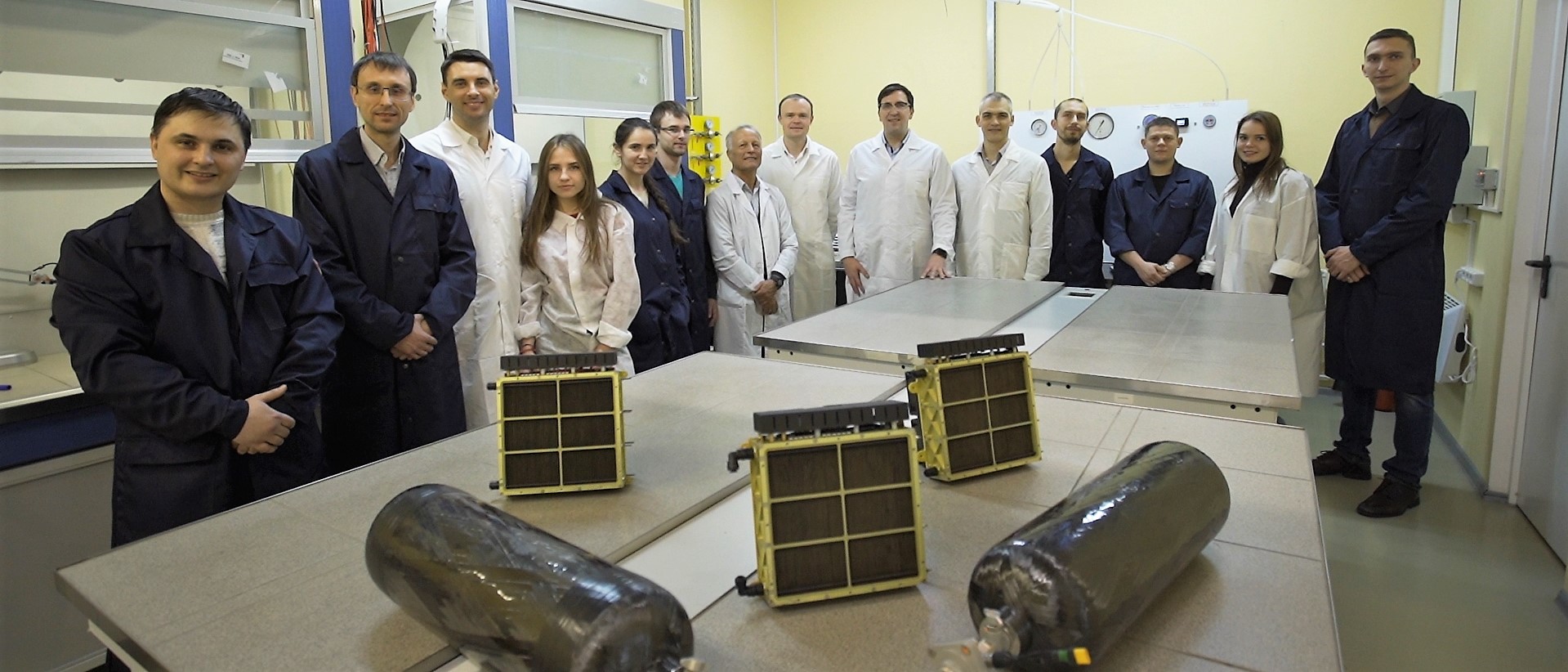
In the photo: The BMPower Team Photo Credit: BMPower
What are the main adavantages of using hydrogen as a energy source?
Alexey Ivanenko: Hydrogen is known to be the most common element in the universe. It has a record energy intensity (120 MJ / kg) compared with other fuel gases. The only byproduct of the oxidation-reduction reaction of hydrogen fuel cells is water. Because of this, hydrogen is really environmentally friendly compared with other traditional energy sources that have a detrimental effect on the environment due to carbon dioxide emissions, as well as nitrogen and sulfur oxides.

What are the challenges for hydrogen fuel cells producers like you?
A. I. : There are several challenges: there is a basic misconception about the safety of hydrogen, and many people think that hydrogen is an explosive gas – they think about the hydrogen bombs too!
According to the safety classification, hydrogen, oxygen, propane, natural gas are in the same category of gases, therefore, the same standards that, for example, are applicable to a propane tank, are also set for an hydrogen tank with the same level of safety.
In practical terms, hydrogen is a safe gas, because it is very light and volatile and does not create explosive concentrations. Propane, for instance, is heavy, accumulates at the bottom when it leaks, and quickly ignites when there is a spark. Hydrogen, on the contrary, is very difficult to keep in a confined space. It cannot reach the right concentration in order for it to ignite which is between 4 and 75 %.
Imagine you have emptied a 7-liter hydrogen tank under pressure of 350 atmospheres in an apartment. If we take a flat of 60 square meters with a ceiling height of 3 meters, the hydrogen concentration will be about 2%. That’s assuming, all windows, doors and ventilation are perfectly sealed in the room. Even with such concentration in the apartment it will be possible to light a match without fear. In reality, you will not be able to achieve this concentration.
The second limitation for the growth of hydrogen is the lack of a developed hydrogen refueling infrastructure. We found two solutions for this. BMPower has signed an agreement with an industrial gas manufacturing company called Linde gas. Our customers can refill their tanks by contacting Linde. BMPower also recommends its customers to use a portable autonomous filling station based on hydrogen, which allows you to generate fuel directly in the areas where their drones perform any tasks.
The third limitation to the growth of hydrogen is the cost of acquiring hydrogen fuel cells. BMPower’s fuel cell will cost around $ 12,000, – the price of a lithium-ion battery is about $ 500. With our system, a drone can fly 2.5 hours, while the battery powered one has only a limited 30-40 minutes flying time.
In most applications, a hydrogen-powered drone can perform the same tasks, which are performed by 2-3 battery-powered drones, which means it can save on the cost of drones and on the salary of people who control them.
Regular lithium-ion batteries are also not so cheap, considering that after 200 cycles their capacity is greatly reduced and they have to be changed. If you consider these the cost of a drone using fuel cells throughout its life cycle is much more profitable than a battery-powered drone, even taking into account the fact that hydrogen costs more than electricity for now.
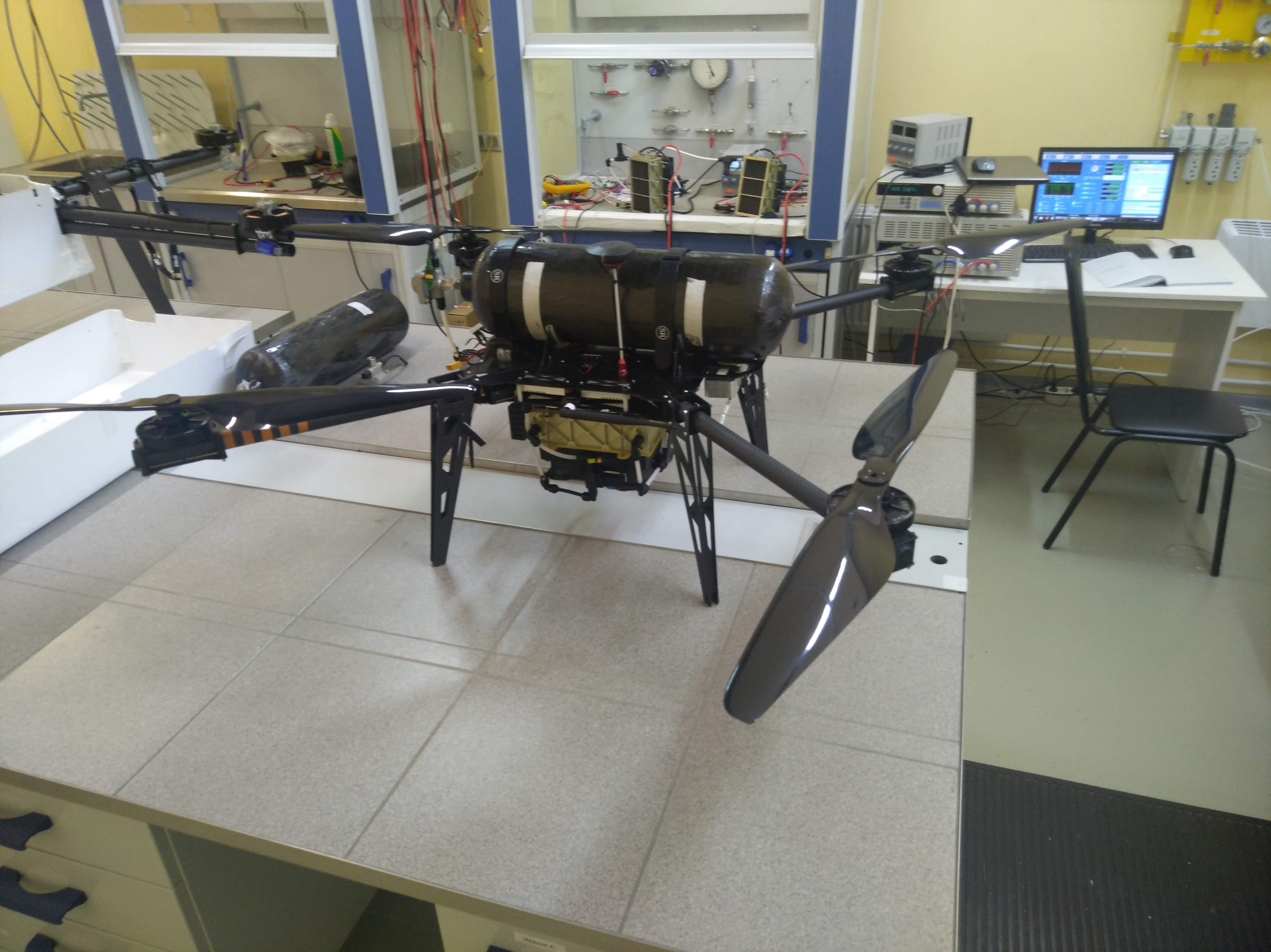
 In the photo: Hydrogen-powered drone is standing on the work bench Photo credit: Evgeny Bazhan
What are the reasons for producing hydrogen fuel cells for hydrogen-powered drones and robots in particular?
A.I. : BMPower has very different competencies. We chose this segment, because our investors are asking for a fairly quick return on investment. Drones are a fairly young product and a fast-growing market. Drone developers are interested in new technologies. The short operational range of drones is the main barrier to their entry into the market. Fuel cells increase these characteristics by several times and open up new applications for drones. Nevertheless, the company has competencies to develop in other markets, and we are ready for the global competition.
How are you planning to improve your product?
A. I. : The first development is an improved fuel cell manufacturing process. The type of fuel cell we use is called polymer membrane. We have learned how to produce fuel cells without using a finished membrane. This reduces the cost of the process. Most importantly, it allows the necessary additives to be introduced into the membrane, which allow fuel cells to operate, for example, in a hot or vice versa, a frosty climate.
Secondly, we found effective coatings and the technology for applying them to bipolar fuel cell plates. Bipolar plates are a very important component of a fuel cell. Increased requirements are applied to them referring to thermal and electrical conductivity, corrosion resistance, weight and size. BMPower produces light titanium coated bipolar circuit plates, which are very efficient and which no one makes in the market.
We also know how to make a catalyst with a lower platinum content, but providing the same fuel cell power as standard catalysts. Consequently, it is possible to optimize the cost of our product.
Our hydrogen fuel cells also contain a whole set of unique engineering solutions, such as a reducer, an automatic voltage regulator, and others systems. This allow us to offer a complex fuel system into almost a boxed product. Our customers can use hydrogen fuel cells in Plug and Play mode: they are easy to install, connect and manage. Customers can even provide quick maintenance on his own. Our systems are easily assembled and disassembled, and we supply a repair kit and an assembly tool.
Need more hydrogen for your fuel cells?
 Joi Scientific, Harvesting Hydrogen from Seawater. Interview with Chairman and CEO, Traver Kennedy
 Element One – World’s First Hydrogen-Electric Passenger Plane Powered by HES
 Hydrogen: a sustainable newcomer for the transportation industry
What do you think about using fuel cells in buses and in freight transport?
A. I. : Buses already use them. From a urban development perspective, it is important to have sustainable transport. Local authorities are trying to improve the situation.
There are difficulties in terms of the production of trucks, but I think that over time they will appear having the same propulsion system as on buses.
How can hydrogen satisfy energy needs of developing countries?
A. I. : To quote Lewis Carroll’s Alice in Wonderland, “We must run as fast as we can, just to stay in place. And if you wish to go anywhere you must run twice as fast as that”. The problem of developing countries, including Russia, is that there is an opportunity to make a technological breakthrough through the use of innovative technologies and new ways of generating energy. Hydrogen is one of such niches for creating a progressive economy because it contributes to the development of a whole country’s innovation ecosystem and this is what we want to achieve.