Looking beyond Gender Binary issues in an effort to move from Black Lives Matter to Black Life Matters.

I’ve been long dissatisfied with common critiques. These critiques often simply point out that which is missing. That is, I have long been dissatisfied—and quite frankly, bored—with criticism that ultimately amounts to “You forgot X demographic.”
It isn’t that we should not be attentive to the excluded. We should, for the excluded are often indices for what more needs to be done. Rather, this “what about…?” move is, as Kyla Wazana Tompkins writes, “not really a sophisticated question because it doesn’t open up conversation. The only answer to ‘what about,’” Tompkins concludes, is “they aren’t there.”
I am not here, then, to further the rhetorical gesture. I am not here to bring my own blackness and non-binariness, my own “expertise” in transgender studies and black feminism, to the table and simply say “BLM does not do a good job at centering black women/femmes/trans people.”
Whether or not that is actually true can be quibbled over. Although, from the amount of documented “herstory”, it strikes me as thoroughly false. BLM co-founder Alicia Garza, for one, is quite clear about the inclusion of black people all along the gender spectrum; although at the level of practice, perhaps this does not happen so much.
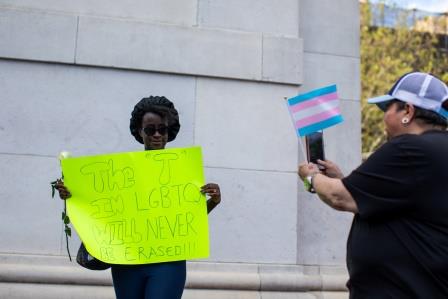
The aim here instead is to urge all of us to think about how trans and non-normative genders are part and parcel of blackness itself, as ways of being a subject and ways of moving through the world, disruptive of the gender binary.
I certainly have no real beef with the work that BLM is doing. I am in full support of its overall project of justice for black people, abolition, and the like. I do, however, wish to think more critically and deeply about the “black” part, and about all that might be harbored in that “black.” So if BLM is about being attentive to the state of marginality and oppression, it is not simply how black people have been violated and historically (and contemporarily) maligned but, more robustly, about blackness and its effects on the world itself.
It is necessary to begin thinking not only that black lives matter—individuated, specific, case by case instances subject to the arbitrary criteria for deservingness and culpability—but, as Fred Moten has remarked, that black life matters. All that blackness entails, its very fundamental disruptive effect on Western civilization, is what is to matter, is what is to be loved.
Furthermore, this means something often not given much thought: that is, disruption’s reach and breach of the gender binary. It is overwhelmingly assumed that some things are just the way they are. That, sure, blackness and the black radical tradition pose a critique of white supremacy and some of the bad stuff that has happened, but, still, some things are just natural facts. One of those things, of course, is that there are men and there are women, no ifs, ands, or buts.
But…
As numerous scholars have detailed—from Hortense Spillers to C. Riley Snorton to Che Gossett to L.H. Stallings and so many more—blackness is necessarily gender non-normative.
In other words, one of the disruptive effects of blackness as a racialized identity and, too, a mode of relating subversively to power, is that “man” and “woman” lose coherency. As Hortense Spillers would say, there has been an ungendering of blackness.
From the collapse of gender in proximity to blackness during Jim Crow, when bathroom signs read “Men,” “Women,” and “Colored,” to the fact that black women have long been disallowed womanhood and femininity (see black trans woman Shaadi Devereaux’s argument here that black womanhood is inherently viewed as drag and merely imitative of “true” womanhood)—we see how blackness necessarily troubles the stability and utility of gender as a category capable of mapping neatly onto blackness.
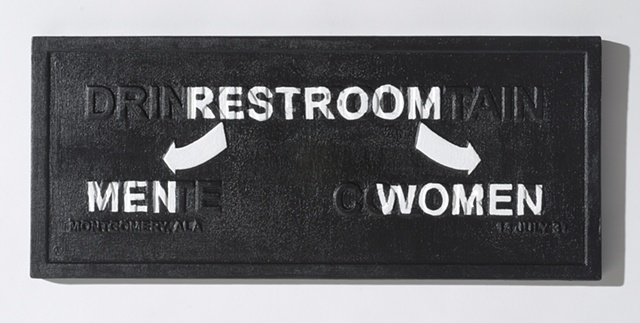
To overlook this impossibility of a seamless connection between blackness and normative gender not only risks obfuscating transgender and gender nonconforming black people but also overlooks how the history of blackness has never manifested in a way that comfortably holds a “both” of any nature, gendered or not.
As I’ve written elsewhere, if blackness troubles gender, and if there is a stentorian silence regarding black folks of trans experience, then it is imperative that the specificities of gender and the ways gender is generatively irrevered must always bear very explicitly on any meditation on the black radical work of BLM.
Related Articles: Pride | Intersectionality Within the LGBT Community | Transcendent
We can arrive here when we understand “trans” and “gender non-normative” in a more robust way than popularly conceived. This isn’t just about a specific, presumptively numerically small demographic of people who are androgynous or feminine men/masculine women. Nor is it about people who have undergone “the surgery.”
These are diluted definitions of transgender identity; a bit trans-antagonistic in that they buttress the naturalness of the gender binary, and are genitally-focused. They fail to consider that trans and non-normative gender have as their very aim a marked interrogation of the gender categories available to us.
We need to understand that the trans and gender non-normative are less about adhering to specific corporeal criteria that sufficiently mark one as the “opposite” gender and more about a concerted sustained socio-political engendering of other ways to be or become.
And this is the work, in part, among other areas through which this work is done, of blackness.
Blackness, as understood here as racialized positionality and “experimentalization” of the violence of ontology, of being, of the very ways we know ourselves as ourselves, exceeds normativity’s ability to rest comfortably. And normativity is chiefly carried out through gender. Thus, I submit that blackness is not, and is never, properly, gender-conforming; blackness must always be understood in proximity to the trans and gender non-normative.
So I’m not here for the shallow inclusion of, say, black trans women in calls for justice for black people. That’s fine, of course. However, what I am calling for is more radical than this.
I am not calling for trans people to be added to the already-operating mechanisms in place, stirred in so that the concoction gets a little more seasoning.
I am calling for a reconfiguration project, one that is resoundingly about how black life matters—unequivocally and unindividuated—and in which that life of blackness cannot and does not, by definition, abide the violence of the gender binary
I am calling for a reconfiguration project, one that is resoundingly about how black life matters—unequivocally and unindividuated—and in which that life of blackness cannot and does not, by definition, abide the violence of the gender binary. And in that is a glorious aperture into what might be deemed salvation.
EDITOR’S NOTE: THE OPINIONS EXPRESSED HERE BY IMPAKTER.COM COLUMNISTS ARE THEIR OWN, NOT THOSE OF IMPAKTER.COM
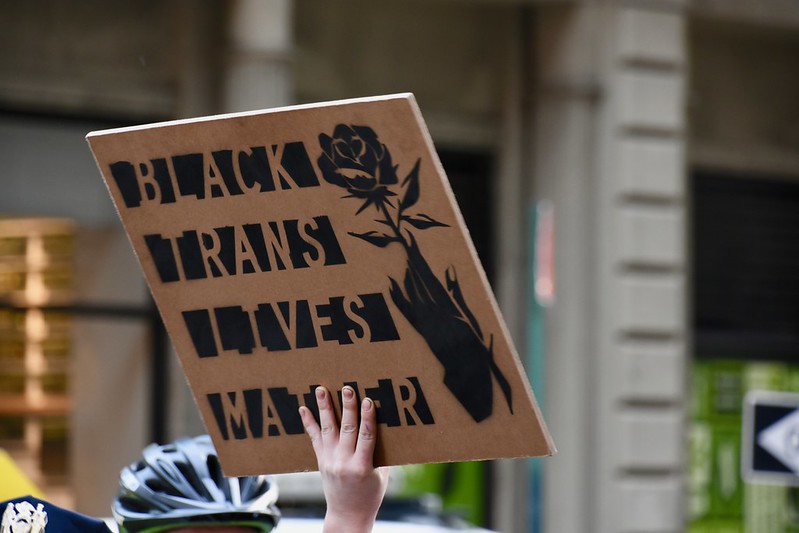
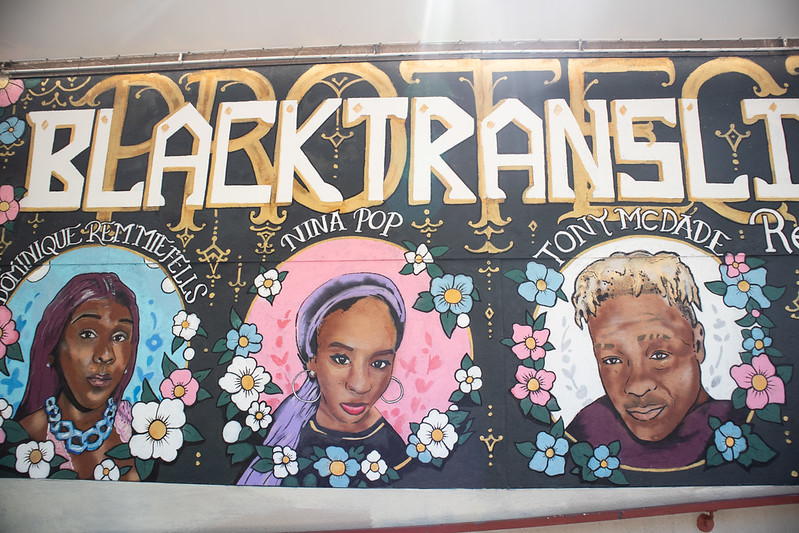
In the Featured Photo: A Placard for Black Trans Life Matter. Photo Credit: Alec Perkins