
Cryptocurrency mining requires highly specialised computers and is very energy intensive, with most of the electricity consumed generated by burning fossil fuels.
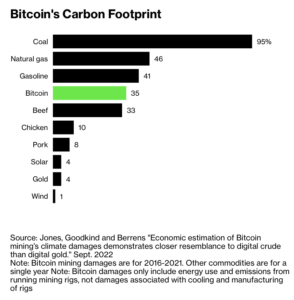
According to new research from the University of New Mexico in Albuquerque, mining of Bitcoin, the world’s biggest cryptocurrency, almost has the same climatic impact as cattle farming or burning gasoline when calculated as a percentage of market value.
What exactly is cryptocurrency and how is it mined?
Cryptocurrency is a sort of digital money that is protected by encryption in a publicly visible and ostensibly unalterable manner. People can conduct direct financial transactions with these currencies without the use of a bank or other financial middlemen.
They function on systems known as blockchains, which are collections of records of digitally signed transactions that show each time a cryptocurrency is moved or spent.
Due to the synchronised copies that are kept on computers all over the world, which also make it incredibly impossible to change, add, or remove blockchain entries, blockchains are sometimes referred to as distributed ledgers.
As an example, Bitcoin operates on a distributed ledger or decentralised computer network that keeps track of bitcoin transactions. New bitcoins are produced, or mined when computers on the network verify and execute transactions.
The transaction is processed by these networked computers, or miners, in return for a Bitcoin payment.
How bad is cryptocurrency for the environment?
The new University of New Mexico research, published in Scientific Reports at the end of last month, found that Bitcoin mining resulted in economic losses connected to climate change on 6.4% of the days that it was traded between 2016 and 2021.
The study compared the climatic cost of mining Bitcoin to other commodities such as crude oil, gold, and meat. This implies that the results do not reflect the overall emissions of these businesses, which would be much higher, but rather their relative effect.
Mining gold, to which Bitcoin is sometimes compared, has a climatic effect of just 4% of its average market price each year, compared to 35% for the world’s most popular cryptocurrency between 2016 and 2021.
By 2020, the energy needed to mine Bitcoin, which accounts for around 41% of the global cryptocurrency market, would have been sufficient to power Austria or Portugal.
According to other studies mentioned in the research, between January 2016 and June 2018, emissions of carbon dioxide from mining Bitcoin, Ether, Litecoin, and Monero currency ranged from 3 to 15 million metric tonnes. That is comparable to the emissions of Afghanistan, Slovenia, or Uruguay in 2018.
Because several miners compete to validate transactions on the blockchain in order to mine new coins, Bitcoin’s carbon footprint increases over time. The total amount of energy used climbs as more miners strive to complete increasingly challenging activities.
A Bitcoin produced in 2021 would have generated 113 metric tonnes of CO2 equivalent, which is 126 times more than one mined in 2016. According to the University of New Mexico researchers, the economic cost of that harm for a single Bitcoin mined last year was $11,314, while the cost of all climate harm caused by all Bitcoins mined between 2016 and 2021 may have reached $12 billion.
Dropping profit margins from Bitcoin mining have encouraged miners to operate more efficient equipment in recent months, resulting in a decrease in greenhouse gas emissions from the industry, according to a separate analysis earlier this week. Emissions are expected to be 14.1% lower this year than in 2021, accounting for around 0.1% of global human emissions and roughly half of what gold miners emit in absolute terms.
To the dismay of gamers, demand for computer graphic cards skyrocketed prior to the collapse in cryptocurrency values earlier this year, driving up prices and evaporating shop shelves. These GPUs proved to be perfect for cryptocurrency mining setups which could result in unanticipated external impacts.

Will the elimination of Ethereum ‘mining’ help the environment?
A significant software modification to the cryptocurrency Ethereum has the potential to significantly lower its energy use and the associated climate impacts.
The software upgrade mostly renders miner labour unnecessary. Whereas Ethereum once pitted rival miners against one another to solve difficult cryptographic problems and earn new coins as rewards, it now asks parties who wish to assist in transaction validation to put some skin in the game by “staking” a particular quantity of Ether, the Ethereum token.
Randomly selected parties from this pool validate a block of transactions; their work is then verified by a larger set of ether holders. Successful validators receive an Ether payout that is often inversely correlated to the quantity of their stake and the amount of time they’ve held it.
Although the Ethereum merging may not seem like much, it might have significant impacts.
Calculations made by economist and creator of the Digiconomist consultancy, Alex de Vries, show that Ethereum will save between 99% and 99.99% of its current energy use as a result of the change (De Vries underlines that no peers have yet reviewed his work).
De Vries also calculated the annual carbon dioxide emissions caused by Ethereum: 44 million metric tonnes. If he’s correct, these will now be significantly lowered.
However, compared to Ethereum, Bitcoin uses substantially more energy and emits more greenhouse gases, and there doesn’t appear to be much interest in abandoning bitcoin mining.
According to Lena Klaassen, co-founder of the Crypto Carbon Ratings Institute, a German organisation that specialises in evaluating crypto environmental consequences, Ethereum’s merger was long anticipated and included years of planning by its developer teams. As she said:
“Such ambitions never existed for Bitcoin and thus I don’t expect that Bitcoin will transition [away from mining] any time soon.”
Editor’s Note: The opinions expressed here by the authors are their own, not those of Impakter.com — In the Featured Photo: Bitcoin symbol. Featured Photo Credit: Marco Verch.