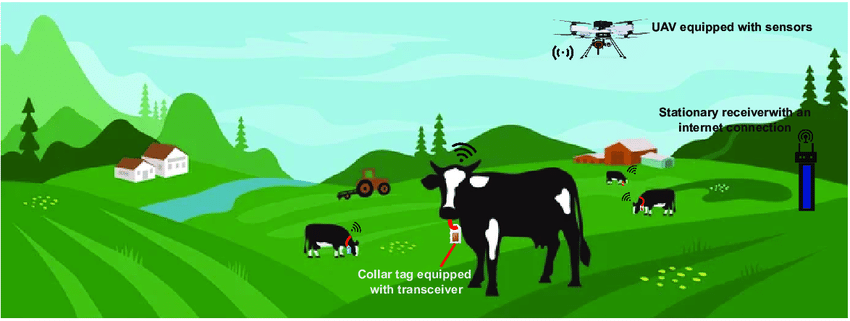
If you have a cat, dog, turtle, or other pet, or if you are a livestock owner — of cattle, sheep, or other — then you know how important veterinary professionals are to you and your animal’s wellbeing. The good news is that advancements on multiple technological fronts are improving such care, two of which are dealt with here.
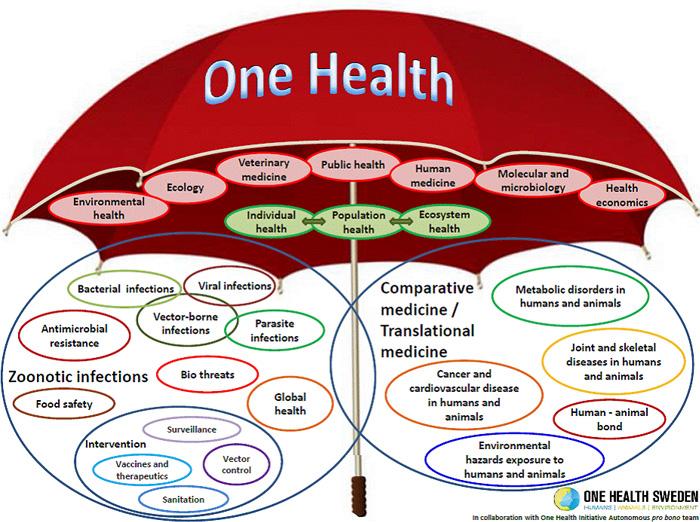
It is worth a moment to get a sense of the big picture. The links between animal, plant, and human health, and the environment are defined by UN quadripartite experts as “an integrated, unifying approach that aims to sustainably balance and optimize the health of people, animals, and ecosystems. It recognizes that the health of humans, domestic and wild animals, plants, and the wider environment (including ecosystems) are closely linked and interdependent.”
The graphic below, developed by the One Health Sweden and the One Health Initiative team, captures its many aspects and linkages:
Making it a priority has been advocated for many years, but it is turning the corner in 2024. And it is happening at an increasingly fast pace thanks to the emergence of two new technologies: AI, especially in its Generative Artificial Intelligence (GAI) form, and the expanded use of drones. This is the case for human health, as has been amply documented.
But in parallel, and in line with the One Health concept, it is also happening in the realm of animals. How this works out for animal health is explored in this article.
Applying AI and drones, two new technologies to animal health
Both artificial intelligence and drones have exploded into the modern-day scene. Both depend on user acceptance, training, and the wherewithal to make good use of the technology and systems.
Such tools can be invaluable for veterinary researchers, clinicians, urban and rural professionals, and their assistants.
Both large and small animal practices can look to AI to assist in diagnosing animal health conditions and identifying infectious diseases or possible outbreaks.
Drones, on the other hand, are principally of the greatest effect in addressing livestock, wildlife, and their environments.
The role of Generative Artificial Intelligence (GAI) in veterinary medicine
Generative Artificial Intelligence” (GAI) is defined as “any type of artificial intelligence (AI) that can produce new text, images, video, or audio clips….learns patterns from training data and generates new, unique outputs with the same statistical properties.” It is rapidly increasing possible multidisciplinary applications, whether for machine learning or for its users.
For the veterinary profession, it has the potential to help with:
- Prevention: identifying animals that are at risk of developing diseases by analyzing data from electronic health records, environmental sensors, and other sources, and reducing the risk of disease transmission and improving animal health outcomes;
- Surveillance: monitoring animal populations for signs of disease outbreaks by analyzing data from various sources such as social media, satellite imagery, and electronic health records;
- Diagnosis: diagnosing diseases more accurately and quickly by analyzing medical images, such as X-rays and MRIs, and other diagnostic tests;
- Treatment: developing personalized animal treatment plans by analyzing data from electronic health records, genetic tests, and other sources;
- Administration: assisting with veterinary practice paperwork of one kind and another, allowing for much more “face-to-face” interactions.
For those veterinarians whose practice is primarily pets, and particularly those in developed countries, AI is already a factor in veterinary medicine. As Alex Douzet, CEO of Pumpkin, a pet insurance and wellness care provider, noted:
“As tools like AgentGPT and newly created VetGPT evolve, the industry faces a future where pet owners will demand that AI software analyze their pet’s results in addition to the veterinarian. Just as we once considered the stethoscope experimental but now consider it standard practice, pet owners will expect AI to be used as a tool that veterinarians leverage to assess their pet’s health or symptoms.”
While certainly equally valuable for veterinarians with small animal practices everywhere, the advantages for low- and middle-income country (LMICs) veterinarians who deal either with small or large animals are especially great.
Many LMICs have significant shortages of veterinary workers, limited clinic facilities, and problems of accessibility, especially in rural areas. With expanding internet connectivity in most countries, AI is positioned to provide virtual support through telemedicine platforms, enabling consultations with AI-powered virtual assistants for diagnosis and disease management, extending the reach of expert advice to remote areas.
Furthermore, AI can assist in disease surveillance in both urban and rural areas with the early detection of outbreaks and identify patterns and trends indicative of potential endemic disease outbreaks. For some LMICs, it may be some time in the future until operability becomes more reliable, but it will happen!
Drones for delivery and surveillance
Drone delivery systems have rapidly become increasingly sophisticated, with the potential to significantly improve animal health, particularly in remote or inaccessible areas. Drone networks can deliver essential medical supplies, and vaccines, transported to remote regions with greater speed and efficiency than on the ground. According to the World Organization for Animal Health report, drones can: limit human risks associated with aggressive animals or insects; help wildlife ecologists protect and differentiate species of birds and marine animal populations; allow examination of herds without direct contact and risk of pathogen transmission; and are useful in detecting illegal waste in fields, wildfire outbreaks, or damage to agriculture from wild animals.
For the livestock producer or rancher, drones can monitor and track animal day-to-day processes, help identify any sick or lost animals early, help monitor animal behavior, observe emerging livestock diseases, and detect conditions that enable ranchers to isolate defective animals from the rest of the herd.
Concerning animal habitats, drone technology has many advantages and has increasingly become of interest, and utilized by, developing countries to address environmental impact concerns.
An international conference in 2022 Chennai, India, discussed how “drone detection alerts the wildlife authorities immediately” with the location of the spotted injured animal and authorities can reach the spot as soon as possible to treat the wounded animal. In a different but related context for example, in Bangladesh, drones are helping monitor protected but not readily accessible forest areas, to prevent illegal poachers from decimating rare Bengal tigers.
And AI applications described above for livestock management and the environment can be augmented with drone information using thermal and infrared scans to determine the extent of plant disease in a farmer’s field: The four pillars of the One Health approach can be mutually reinforcing: it’s not just animal health, it’s plant health too.
Looking forward: Potential benefits from these two technologies
Both AI and drone technologies have potential for both good and ill. We often are more aware of and concerned about the abuses.
With AI concerns range from multiple safety concerns, as well as plagiarism and wrong or mistaken sources, to the use of AI to access passwords and even AI cyber-attacks.
As for drones, they have been known to be used for malicious purposes such as privacy invasion, trespassing, nuisances such as spoofing, or creating serious risks that are either intentional or unintentional to general aviation and flight safety.
These are not insignificant downsides, of course. But we need to keep in mind that there are risks with virtually all new technologies and that there are huge pluses from both generative AI and drones, assuredly in dealing with animals, plants, and environmental health, as well as our own.
Editor’s Note: The opinions expressed here by the authors are their own, not those of Impakter.com — Featured Photo: Conceptual framework of UAV-based farm monitoring system. Credit: Research Gate article by Mohammed A. Alanezi, Abdullahi Mohammad, Yusuf Shaaban, Mohammad Shoaib Shahriar/Ceative commons attribution 4.0