Tesla, AirBnB and Intel have become some of the latest companies to come under criticism for complicity in human right atrocities in China’s Xinjiang region, where it is estimated almost 2 million Uyghurs have been detained, as part of what experts consider a genocide.
AirBnB has been questioned by US Democratic Senators in recent days over the hosting of rental properties in Xinjiang. An Axios report found that the listed properties are owned by the Xinjiang Production and Construction Corps (XPCC), a paramilitary group who owns many of the internment camps where Uyghurs are subjected to forced labour, torture, sexual abuse and indoctrination.
On December 31, 2021, Elon Musk’s electric car company opened a showroom in Urumqi, the capital of Xinjiang. It is the 211th Tesla showroom in China.
The move has drawn criticism from human rights activists, as well as members of the US senate. Tesla currently operates 7 supercharger stations in Xinjiang, and two in Urumqi, according to Bloomberg (citing Cnevpost).
WH Press Sec. Jen Psaki when asked about Tesla’s new showroom in Xinjiang, where China’s government is accused of detaining an estimated 1 million Muslim minority people:
“We’ve been clear about our views on the ongoing genocide and crimes against humanity in Xinjiang.” pic.twitter.com/B7F1uk2kYF
— The Recount (@therecount) January 4, 2022
In July 2021, Tesla revealed its plans to install superchargers across the silk road, in a video proudly featuring footage of Xinjiang’s natural landscapes. The idyllic representation of the region bore unsettling similarities to nature-focused propaganda videos distributed as part of the CCP’s effort to whitewash the operation of detention camps in Xinjiang, where Uyghurs and other Turkic Muslim minorities are forced into slave labour.
The opening of the showroom, and the installation of superchargers in the region, the site of what Human Rights Watch describes as “crimes against humanity,” helps facilitate the CCP’s effort to normalise business operations in Xinjiang.
Tesla is no stranger to issues related to labour abuses
The National Labor Relations Board, the US’s labour law enforcement agency, found the company guilty in March last year of labour law violations, after the company attempted to obstruct workers from organising to discuss working conditions.
As pointed out by the Associated Press, Tesla and Elon Musk’s continued compliance and complicity with the CCP is in contrast to the company’s repeated conflicts with US government agencies, over issues such as the unsafe re-opening of a factory during the start of the pandemic. Following the re-opening, hundreds of Covid cases were recorded amongst Tesla workers.
Video: We call on Elon Musk to close the #Tesla showroom in China's #Xinjiang Province pic.twitter.com/8RKLB0k5vz
— CAIR National (@CAIRNational) January 5, 2022
Intel, an American Chip-making company, whose technology has been weaponised against Uyghurs in Xinjiang, accused of pandering to the CCP
The Weibo platform, a social media site heavily controlled by the Chinese Communist Party (CCP) has been the site of many apologies and retractions on behalf of companies and high profile individuals, seeking to assuage claims that they have strayed from the official CCP line.
Weibo is where Tesla made the announcement and also where Intel recently issued an apology, after it has released a letter, which it says was intended for suppliers, in which it announced that it would be avoiding the use of Xinjiang labour in its supply chain. In its apology Intel said the announcement was an effort to comply with US law (likely the Forced Labour Bill which passed through congress in December 2021), and not a political stance.
Intel’s refusal to take a “political stance” on China comes after the company’s technology was revealed in a New York Times investigation in 2020 to have facilitated the construction of a supercomputing centre in Urumqi.
Related articles: A Record Number of Journalists Still Detained in 2021 | China’s Debt-Trap Diplomacy
The centre is used to further China’s dominance over minorities in the Xinjiang region, subjecting them to unprecedented levels of surveillance. Intel’s technology helped China develop one of the world’s fastest supercomputers, used for the purpose of processing camera footage.
The technology tracked patterns of behaviour, using facial recognition and phone tracking amongst other invasive methods in order to enable the predictive policing program used to imprison members of minorities that have committed no crime.
Intel described the use of its chips in Urumqi as an abuse of its technology (although their unawareness of the situation is doubted), in what seemed like an acknowledgement of the oppression the Chinese government was enacting through the technology. This makes its recent refusal to explicitly condemn the forced labour in Xinjiang, which it has had a hand in enabling, even more disappointing.
Tesla’s move comes amidst bipartisan condemnation in the US of China’s abuse of minorities and growing international recognition of a genocide
The Uyghur Forced Labor Prevention Act was signed into law on the 23rd of December, receiving virtually unanimous support from the House of Representatives and the Senate, with only one member of the House voting against it.
Although current US law already prohibits the knowing importation of goods produced through slave labour, the new law makes it illegal to import all goods made from “mined, produced, or manufactured wholly or in part in the Xinjiang Uyghur Autonomous Region of China.” Companies can only do so if they proactively prove that their products are produced under voluntary conditions.
Yes, politics and relationships shouldn’t stop us from the pursuit of justice.
China is carrying out enslavement, torture, rape, forced sterilization and mass detention of Uyghurs.
Now is the time for full accountability and justice. https://t.co/89UuCk5DOB
— Ilhan Omar (@IlhanMN) February 17, 2021
A report that was published in March of 2021 by the US State department, labelled the situation as a case of genocide. It found evidence for the mass-detention of more than a million Uyghurs in “internment camps,” and “an additional two million subjected to daytime-only “re-education” training.”
Amongst other rights violations like the suppression of journalists, torture and arbitrary killings, the report documented “severe restrictions and suppression of religious freedom… forced sterilization and coerced abortions; forced labor and trafficking in persons.”
The report, which was completed in 2020, confirmed the findings of extensive investigations by human rights organisations like Human Rights Watch and Amnesty, research institutes and multiple news outlets. A harrowing example is the BBC’s report on the systematic rape and torture of Uyghurs in internment camps, based on interviews conducted with those formerly detained.
Recently, an independent tribunal published a report finding the Chinese government to have committed a genocide in Xinjiang. The tribunal heard distressing testimonies from survivors, finding evidence of: “deportation or forcible transfer; imprisonment or other severe deprivation of physical liberty; torture; rape and other sexual violence; enforced sterilisation; persecution; enforced disappearance; and other inhumane acts.”
The Uyghur Tribunal was chaired by Sir Geoffrey Nice QC, a British barrister with an extensive history in International Criminal Court prosecution, and expertise in international war crimes issues.
Multinational companies have been slow to keep up with the growing condemnation of the atrocities in Xinjiang
Although politically there is much support across the US for divesting from the direct and indirect funding of atrocities in Xinjiang, American corporations have been either trying (unsuccessfully) to strike a delicate balance between access to the Chinese market and human rights commitments, or outright refusing to take any consideration of the plight of Uyghurs.
The Uyghur Forced Labor Prevention Act was lobbied against by corporations including Nike, Coca-Cola and Apple. All three companies invested in the assistance of lobbying firms to influence the bill.
Although Nike and Apple have been accused of complicity in the ongoing disaster, both companies have made statements denouncing the use of slave labour. Nike, in a statement on their website, state that they are “concerned about reports of forced labor in, and connected to, the Xinjiang Uyghur Autonomous Region (XUAR).”
Other companies accused of complicity in forced Uyghur labour have also issued tepid, carefully worded statements, distancing themselves from Xinjiang-sourced production and materials. Many of these companies were subsequently subjected to boycott campaigns in China, sparked by campaigns on Weibo, government condemnation and criticism from state-run news broadcasters.
This prompted some, like Zara to retract their statements, or contradict them like Hugo Boss. Other companies backtracking on tangential acknowledgements of the Xinjiang atrocities include Kodak. They removed and apologised for an Instagram post linking to a photographer’s page, who had called out the mass-incarceration of Uyghurs in a post caption.
.@Kodak deleted and apologized for an Instagram photo which linked to the photographer's account that mentioned "mass-incarceration" in Xinjiang. Didn't see any reporting on this. Is it because this is too common now it is no longer newsworthy? pic.twitter.com/mj3uov8Dzs
— Yaqiu Wang 王亚秋 (@Yaqiu) July 20, 2021
Yaqiu Wang, a senior China researcher at Human Rights Watch, in an interview with Quartz, spoke about the public reception to statements critical of the CCP: “I think we have got so accustomed to businesses cowering to the Chinese government for market access, we lost sense of what it should be like, so an act of integrity is being viewed as extraordinary.”
Ahead of the Beijing Winter Olympics, it remains to be seen which companies will heed the requests of Uyghurs and join a boycott of the proceedings. Likely, any public declaration of divestment from the event will be met with fierce criticism from the CCP. Sponsors like AirBnB will have to choose whether or not to join a global condemnation of an ongoing genocide, or lend credibility to a whitewashing platform in exchange for access to the Chinese market.
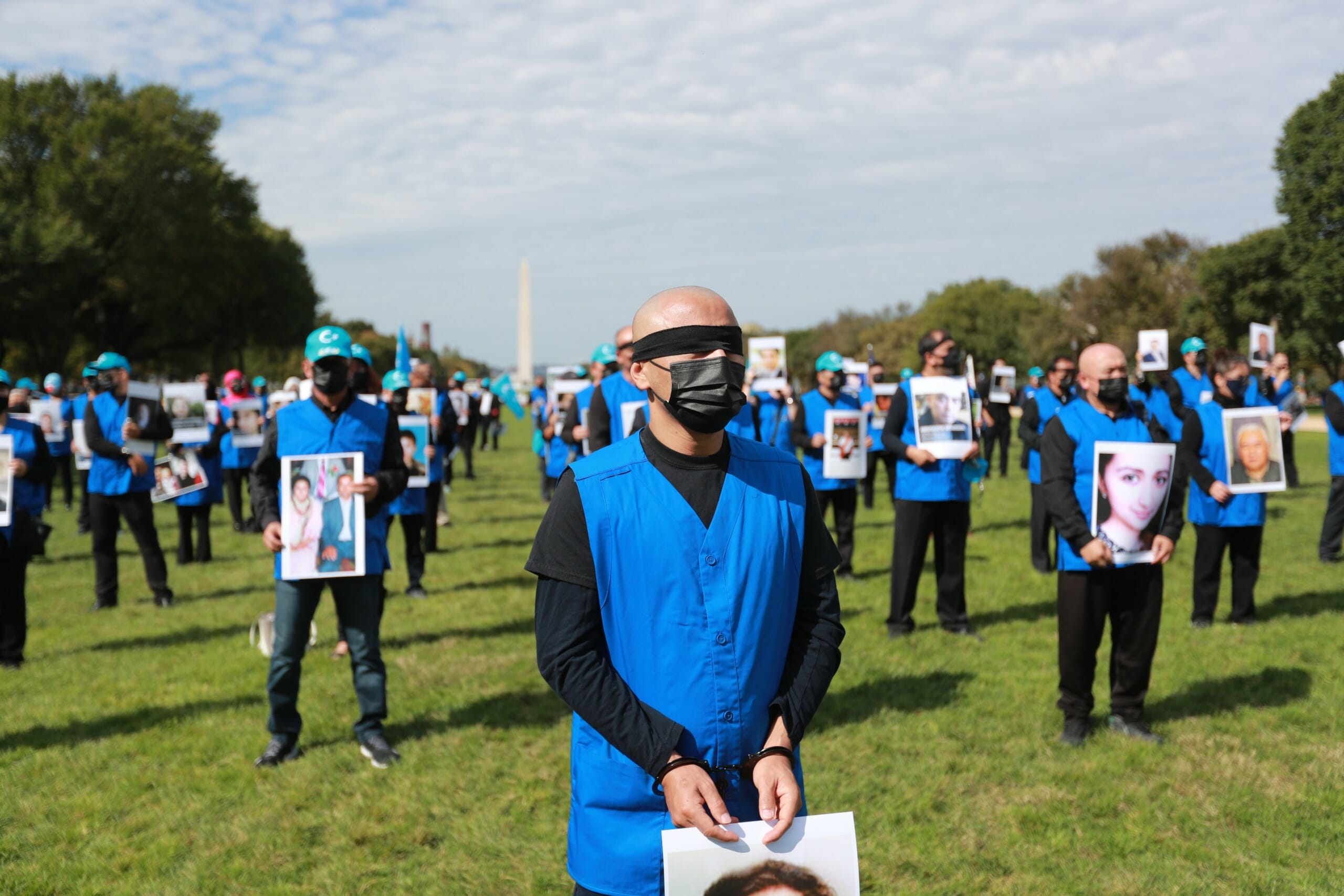
Editor’s Note: The opinions expressed here by Impakter.com columnists are their own, not those of Impakter.com. — In the Featured Photo: A demonstration in Washington DC in 2021, protesters hold photos of Uyghurs affected by the genocide. Featured Photo Credit: Kuzzat Altay.