As the year draws to a close, hundreds of journalists remain detained by regimes across the world. Those that remain free are too often surveilled, harassed, or killed, making efforts to hold state authorities accountable even harder.
Reports from the Committee to Protect Journalists (CPJ), and Reporters Without Borders (RSF), released earlier this month both revealed that for the 6th consecutive year, a record-high number of journalists have been detained worldwide. The CPJ report was published on the 9th of December, and the RSF report was published on the 14th of December.
Whilst CPJ places the current total number at 293 on their regularly updated database, RSF places the number 396, or 495 including citizen’s journalists and media assistants.
The largest offender has been China, accounting for 127 of the total 488 journalists detention at the time of the RSF report’s publication, whilst Myanmar holds the second highest number of journalists in detention, at 53.
At least 24 journalists were killed, for reasons verifiably linked to their reporting, 19 of which were a result of direct retaliation for their work, according to the CPJ report, who are investigating 6 further possible killings. This is, however, the lowest recorded number since 2002. RSF holds the death toll higher, at 48 journalists, citizens journalists and media assistants.
#Myanmar's junta has effectively criminalized independent journalism, arresting and charging journalists, closing news outlets, restricting access for international reporters, and driving journalists underground or into exile. #WhatisHappeninginMyanmar https://t.co/gvllrq8OFL
— CPJ Asia (@CPJAsia) July 28, 2021
Another recent report from RSF went into further investigative detail with regards to China’s systematic repression of journalists.
71 of China’s 127 jailed journalists are Uyghurs, part of the (Chinese Communist Party) CCP’s brutal whitewashing campaign, attempting to avert international attention from the subjection of Muslim ethnic minorities to mass detention, sexual abuse and forced labour.
Early this year, the BBC World Service was banned in China, following its coverage of the treatment of Uyghur in Xinjiang’s labour camps.
China’s detention of journalists has been facilitated partly by the application of a “national security law,” which threatens life imprisonment. The law creates a number of charges under vaguely defined categories: separatism, subversion, collusion with foreign forces and terrorism.
The vaguely definitely laws weaponised by the CCP against journalists mirrors similar usage of vague anti-terror legislation in Egypt, used to detain activists, journalists and political opposition alike. Egypt, according to the reports, holds the third-highest number of journalists in detention, with 25 in total.
Harassment of journalists is made easier with the application of new technology
Detention, although a widespread and effective means of media suppression, is however becoming increasingly supplemented with more covert means of abuse. According to the CPJ report, “Authoritarian leaders are increasingly finding more sophisticated ways to block independent reporters and outlets,” relying on “internet shutdowns and increased surveillance through high-tech spyware.”
An Impakter story published last month detailed the role of the Israeli spyware across the globe in programmes of repression, in which phones were weaponised against journalists and other civil society actors critical of oppressive regimes.
NSO sued by Apple and blacklisted by the Biden Administration.
The "notorious hackers" developed spyware that turns devices into surveillance instruments, used against journalists across the globe, and in the suppression Palestinian voices.
Read more 👇https://t.co/ZYK4oPuH7D
— impakterdotcom (@impakterdotcom) November 28, 2021
The use of the software has been extensively documented in India, where 7 journalists are currently detained, a key part of Modi’s authoritarian crackdown on dissent. The CPJ reports that 4 journalists have been killed in India this year directly in response to their news coverage. In October, the Supreme court of India ordered an inquiry into the government’s use of the software to surveil journalists.
Related articles: Apple vs. Israeli Surveillance Supplier: “Amoral 21st century mercenaries” | Egyptian Activist Patrick George Zaki Released from Jail Still faces Trial
Recently, further evidence was unearthed implicating the software in the murder of Jamal Khashoggi. The software was used to track those closest to the Washington Post journalist.
In Mexico, still the deadliest region in the world for journalists, the software has also been suspected of aiding the murder of Cecilio Pineda Birto, in 2017. Birto was one of the 26 Mexican journalists found to have been potentially targeted between 2016 and 2017 by the spyware, an insight revealed as part of a larger collaborative journalistic investigation published this year.
The suppression of journalists comes hand in hand with the promotion of government mouthpieces
Another important tool for states seeking to obfuscate the truth has been the promotion of fake news, distributed through social media profiles as well as state-run news outlets. As pointed out in the German outlet Deutsche Welle (DW), China’s crackdown on journalism has been attributed in part to an effort to increase international reliance on news outlets peddling the regime’s propaganda.
In a high-profile case in the UK earlier the year, BBC reporter John Sudworth was pressured into leaving China for Taiwan, following his coverage of the plight of Uyghurs in the Xinjiang region.
He is part of a larger tide of international journalists leaving or forced out of the country, following harassment and increased fears over surveillance and arrest. According to the BBC, “John’s reporting has exposed truths the Chinese authorities did not want the world to know.”
Louisa Lim, an Australian journalist with a decade’s worth of experience reporting from China, is recorded in DW as saying “If they (foreign media outlets) don’t have a correspondent who is able to film in China, they are more likely to use materials from China’s state-run broadcaster CGTN.”
China has followed Russia’s extensive use of online disinformation, trying to influence international conversations with the use of fake news spread through social media accounts. The prevalence of fake news, the disastrous effects of which have come under increased scrutiny, has prompted some states to create legal safeguards.
The #DigitalServicesAct and the #DigitalMarketsAct aim to tighten rules related to privacy, removal of illegal or harmful content, and gatekeeping of online markets
Europe's laws have implications for the behaviour of tech giants worldwide
Read more 👇https://t.co/1g2ikMOjdD
— impakterdotcom (@impakterdotcom) December 20, 2021
The phenomenon highlights the need for a free press, unencumbered by the threat of detention, who can provide public access to information that has become distorted through nefarious online actors. Given the speed at which false news can circulate through platforms, inciting violence and whitewashing state crimes, the need for journalistic fact-checking is made even greater.
The creation of no-go zones, whether in Xinjiang or the Poland-Belarus Border, where state-sanctioned human rights violations flourish unchecked, sets a dangerous international precedent. The strengthening of protections afforded to reporters across the globe is a necessary tool in the face of increased efforts on behalf of states to control public narratives.
Despite unwinding of the Poland-Belarus border crisis, new #EU measures bolster Poland’s strong-man tactics, banning NGOs and media from the border and holding #asylumseekers for up to 16 months in detention.
Read more👇https://t.co/WV2ciGEH8V
— impakterdotcom (@impakterdotcom) December 3, 2021
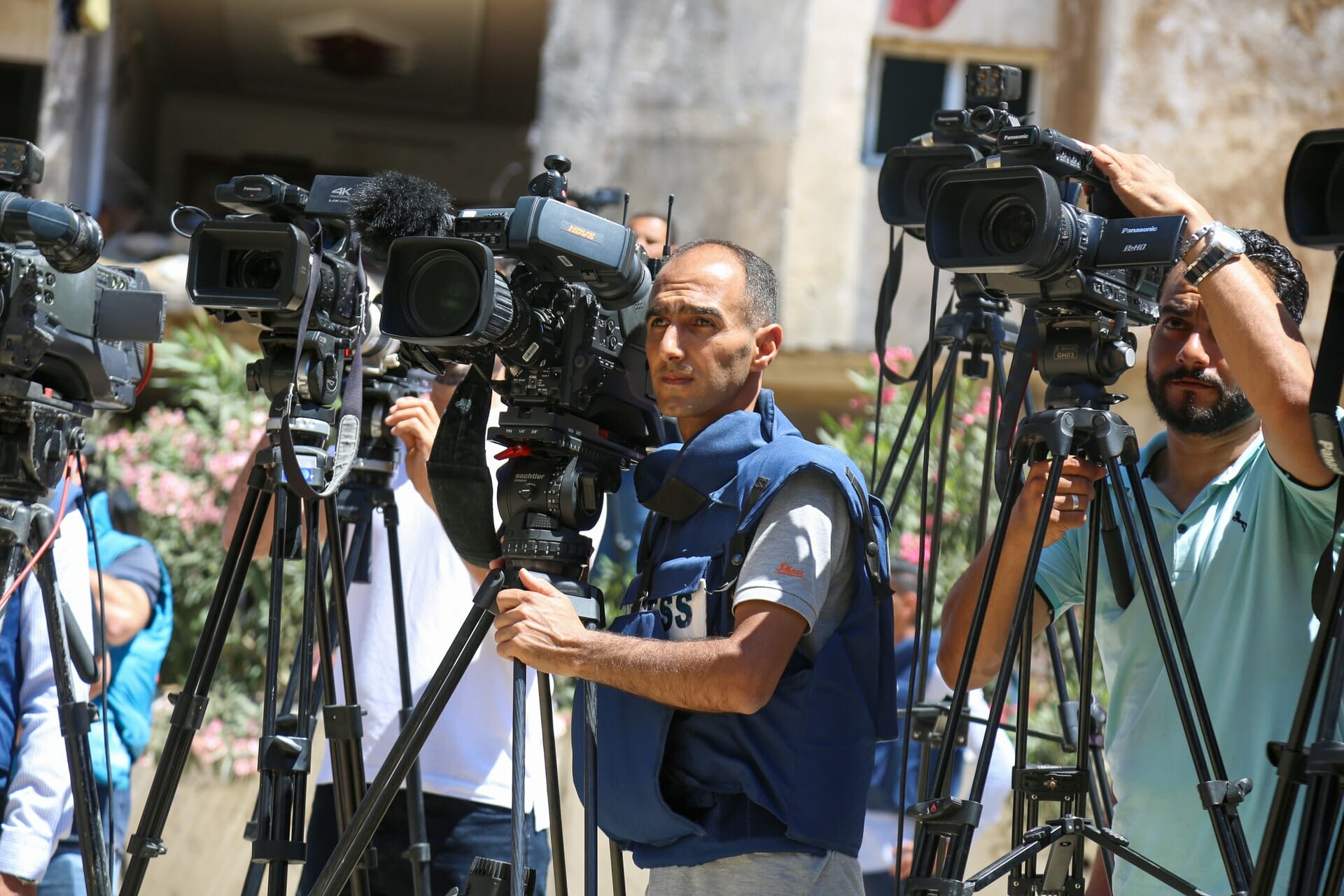
Editor’s Note: The opinions expressed here by Impakter.com columnists are their own, not those of Impakter.com. — In the Featured Photo: Press in Gaza, Palestine, where journalists face threats from the neighbouring Israeli regime. Featured Photo Credit: Musa Zanoun.