What Is Amazon Seller Metrics?
Amazon seller metrics measure how reliably an account fulfills orders and treats customers — things like late shipments, cancellations, and complaints. Amazon uses them to judge account trustworthiness, and a sustained decline can lead to warnings or even suspension. Sellers, agencies, and marketplace managers track them regularly to catch problems early, before they affect selling privileges — often alongside platforms like My Real Profit that pair this kind of monitoring with profit and inventory data in one place.
Amazon Seller Performance Metrics Transparency
Amazon seller performance metrics transparency has improved, with more detailed breakdowns now available in Seller Central, though gaps remain. Order defect rate, for instance, includes negative feedback, A-to-z claims, and chargebacks, but the exact weighting isn’t always obvious. Seeing the events behind a rate, not just the final number, lets sellers react to the actual problem instead of guessing.
The Core Metrics Worth Tracking
A smaller group of numbers tends to matter most for day-to-day account health:
| Metric | What It Measures | Typical Target |
|---|---|---|
| Order Defect Rate (ODR) | Negative feedback, A-to-z claims, and chargebacks per order | Below 1% |
| Late Shipment Rate | Orders shipped after the promised date | Below 4% |
| Cancellation Rate | Orders canceled before shipping | Below 2.5% |
| Valid Tracking Rate | Orders with valid, scannable tracking numbers | Above 95% |
| On-Time Delivery Rate | Orders delivered by the estimated date | Above 90% |
These thresholds can shift, so it’s worth checking Seller Central directly rather than treating any single number as permanent.
Tracking Amazon Seller Performance Metrics Day to Day
Most sellers keep tabs on these numbers using an amazon seller performance metrics dashboard, a single view that pulls the measurements together, usually with status indicators showing whether an account is healthy, at risk, or below Amazon’s threshold. For a single account, checking weekly is usually enough; agencies managing several accounts tend to check daily. A simplified example of how this typically looks:
| Metric | Value | Status |
|---|---|---|
| Order Defect Rate | 0.6% | Healthy |
| Late Shipment Rate | 2.1% | Healthy |
| Cancellation Rate | 3.8% | At Risk |
| Valid Tracking Rate | 97.4% | Healthy |
| On-Time Delivery Rate | 88.9% | At Risk |
Laying out metrics this way makes it easy to spot which area needs attention, rather than piecing the picture together from separate reports.
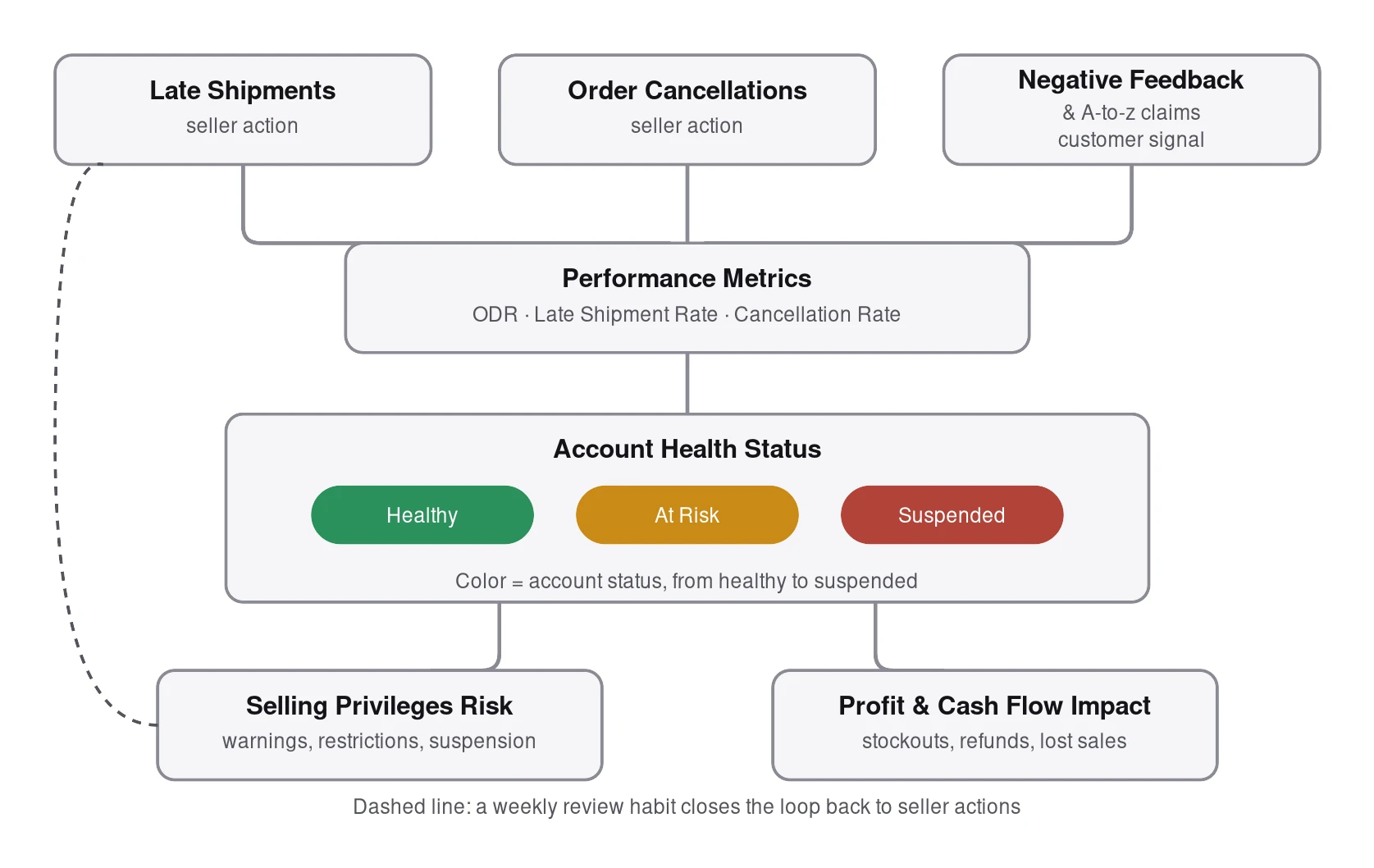
The logic is simple once mapped out: late shipments, cancellations, and negative feedback roll up into performance metrics, which set the account health status. That status drives both selling-privileges risk and profit impact — and a regular review habit closes the loop back to better decisions upstream.
How Seller Metrics Amazon Sellers Track Connect to Profit
Account health isn’t just a compliance issue, it’s closely linked to profitability. A rising late shipment rate often traces back to inventory planning, which also shows up as stockouts and lost sales. A rising cancellation rate frequently points to a pricing or listing issue that’s quietly affecting conversion too.
This is why sellers increasingly want reporting that connects operational metrics with financial ones, giving them a way to see inventory, fulfillment, and profit signals without switching between disconnected tools.
Amazon Seller Performance Metrics Over the Long Term
Taken together over time, these numbers often grouped under amazon seller account health metrics matter more than any single reading. Amazon rarely suspends an account over one late shipment it’s the sustained pattern that triggers action, so short-term dips are usually recoverable if addressed quickly. Sellers who review these numbers on a fixed weekly schedule tend to catch problems while they’re still minor.
Pairing this operational review with profit tracking for example, watching daily performance through an amazon profit dashboard often surfaces the financial impact of an account health issue before it fully shows up in monthly totals.
Practical Steps to Stay Ahead
- Set buffer stock for fast-selling products to reduce late shipments during demand spikes.
- Double-check listing accuracy on pricing and sizing to reduce avoidable cancellations and returns.
- Respond quickly to customer messages, since faster resolution often prevents a complaint from escalating.
- Audit carrier performance periodically, since one unreliable carrier can drag down tracking and delivery rates.
Efficient marketplace operations can also support more sustainable ecommerce. Accurate inventory planning, improved fulfilment performance and fewer order cancellations reduce unnecessary shipments, packaging waste and reverse logistics. By improving operational efficiency, sellers can lower costs while also reducing the environmental impact associated with excess transportation and product returns.
Final Thoughts
Amazon seller performance metrics can feel like a black box, especially for sellers who only see them during a policy warning. In practice, they reward the same habits that improve profitability accurate listings, reliable fulfillment, and responsive service. Treating them as an early warning system, not a once-a-quarter chore, produces the best outcomes.
FAQ
What happens if my performance metrics drop below Amazon’s threshold?
Amazon typically issues a warning first, giving you a window to fix the underlying issue. Repeated or sustained breaches can lead to selling restrictions or, in the most serious cases, account suspension.
Are performance metrics the same across every Amazon marketplace?
The core metrics ODR, late shipment rate, cancellation rate, and so on are consistent across marketplaces, though exact thresholds can vary slightly by region. It’s worth checking Seller Central for the specific targets that apply to each marketplace you sell in.
How often should I check my performance metrics?
Weekly is enough for most single-account sellers. Agencies or sellers managing multiple accounts typically check daily, since problems are easier to catch and fix while they’re still small.
Can one late shipment or cancellation get my account suspended?
Rarely. Amazon generally acts on a sustained pattern crossing a threshold, not an isolated incident. Short-term dips are usually recoverable if you address the root cause quickly.
Do these metrics really affect profit, or just account standing?
Both. A rising late shipment rate often traces back to inventory problems that also cause stockouts, and a rising cancellation rate frequently points to pricing or listing issues that hurt conversion so the same root causes tend to show up in both your account health and your profit numbers.
Editor’s Note: The opinions expressed here by the authors are their own, not those of Impakter.com — In the Cover Photo: View of the Amazon seller performance metrics dashboard. Cover Photo Credit: pexel.