Agroforestry techniques popularized by APAF, a network of associations specializing in the extension of agroforestry techniques to African farmers, reverse the process of land degradation by establishing economically viable and ecologically stable farming systems. Available resources are better used to ensure the long-term ecological balance of fragile soils, and the aim is to improve productivity and guarantee food security.
Many African countries are currently facing major environmental problems, notably the destruction of their forest cover through slash-and-burn farming and the uncontrolled cutting of trees for domestic and commercial production.
These practices lead to soil erosion and the consequent degradation of arable land, resulting in lower agricultural productivity and increasingly difficult supplies of firewood and timber.
African farmers practicing conventional agriculture are facing major economic problems due to the rising cost of inputs such as chemical fertilizers, synthetic pesticides, and so on. Conventional agriculture is a major consumer of fossil fuels for the manufacture, transport, and spreading of chemical fertilizers and synthetic pesticides in particular.
However, agroecological techniques that use mechanical composting (shredders) and the mechanized spreading of compost and various types of manure also rely on fossil fuels.
Agroforestry using fertilizer trees is a sustainable agricultural technique that uses no fossil fuels. Fertilizer trees fix nitrogen in their root nodules and bring up minerals (phosphorus, potassium) from deep in the soil to enrich the topsoil.
When using fertilizer trees, farmers do not need to destroy a forest front to set up new plantations.
The introduction of these trees allows for severely degraded land to be reclaimed: only three or four years after plantation, the soil quality is sufficiently improved to grow demanding crops such as cocoa or coffee.
Farmers who use fertilizer tree techniques are more resilient to the coming energy, financial, and environmental crises. Indeed, they no longer practice shifting agriculture (which uses manpower and requires the farmers to move often), but cultivate the same plots of land, year after year, from generation to generation.
In addition, farmers do not need any costly external inputs (chemical fertilizers, synthetic pesticides, etc.), which increases their economic independence and welfare. Finally, agroforestry with fertilizer trees restores local lands and improve the quality of life.
The concept, developed and popularized by APAF
The APAF concept involves farmers introducing fertilizing trees in their fields, either through plantation or farmer-managed natural regeneration. The aim is to implement a participatory and voluntary approach.
Farmers are trained in their individual or collective fields and in village nurseries. This is a “self-centered” development action based on the active participation of the beneficiaries.
According to agronomist Dupriez and bioengineer de Leener, a “fertilizer tree is a tree whose activity enriches the arable layer of a soil, improves its texture and favors its structuring. To perform its function effectively in the field, it must be user-friendly, i.e., it must not enter into strong competition with species cultivated for their domestic or commercial production.”
Fertilizer trees can also provide fruit or forage. They can be associated with all kinds of crops: fruit trees (citrus, mango, etc.), cash crops (cocoa, coffee, cashew, avocado, etc.), and food crops (bananas, taro, maize, millet, sorghum, groundnuts, etc.). In addition, they provide timber and fuelwood.
APAF currently uses over 60 species of fertilizer trees. All of them have been identified by APAF teams in old agroforestry fields following a naturalistic and empirical approach. By training farmers directly in their fields, APAF has found the methodological solution to popularize an agroforestry system, said by some to be “too complex,” with numerous fertilizer tree species.
How it works
The fertilizer tree must be sown (not grafted) to form a taproot capable of bringing up from deep in the soil (10 to 30 m) the minerals (N, P, K, etc.) and water needed to enrich the topsoil.
It should also live in symbiosis with nitrogen-fixing bacteria (rhizobium) and fungi (mycorrhizae) that bring up phosphorus, potassium, and other minerals. To this effect, all trees planted by APAF are inoculated with these rhizobium and mycorrhizae.
The selection of high-performance indigenous strains of rhizobia and mycorrhizae for fertilizer trees is carried out using a naturalistic and empirical approach.
We take soil from the root plate of healthy fertilizer trees (as identified by its owner). Ideally, this soil sample containing the high-performance mycorrhizae and rhizobia should come from the same soil type, located at the same altitude, and, if possible, be geographically close to the agroforestry field to be inoculated.
Mycorrhizal fungi live in symbiosis with cultivated plants, harvesting for them the minerals (N, P, K, etc.) redistributed by fertilizer trees. Mycorrhizae also facilitate water uptake by plants, help them acquire greater resistance to various pathogen attacks from the soil, and produce antibiotic substances and vitamins from which plants benefit directly.
Related Articles: We Must Value the Role of Forests in the Global Food System | Agroecology: A Key Piece to Climate Adaptation & Mitigation? | Building Resilient Climate Smart Agricultural Systems For Smallholder Farmers
Nutrients taken by fertilizers trees are made available for cultivated crops by two mechanisms. When the leaves fall and form litter on the soil, they enrich the topsoil.
But the fine roots of trees (which represent a third of the total root mass of trees) die every year like the leaves, forming underground litter that, as it decomposes, enriches the soil’s arable layer (this was demonstrated by ecologist and professor of botany Dr Francis Hallé).
It’s this phenomenon that explains why fertile trees are capable of recreating the arable layer of completely depleted soil in just three or four years.
In summary, APAF applies the triple symbiosis to restore agricultural soils:
 APAF has popularized the following four technical itineraries:
- Understory cultivation, commonly known as multi-story fields
This technique is closely related to that used on former African cocoa and coffee plantations since the introduction of these crops in colonial times. It consists of growing cash crops (coffee, cocoa, cashew, palm, etc.) or food crops (banana, taro, maize, millet, sorghum, etc.) under the shade of large, fertile trees of definite economic value (Iroko, Mahogany, Samanea saman, etc.).
This is an ancestral African farming method that APAF has revived in the villages of its intervention zones.
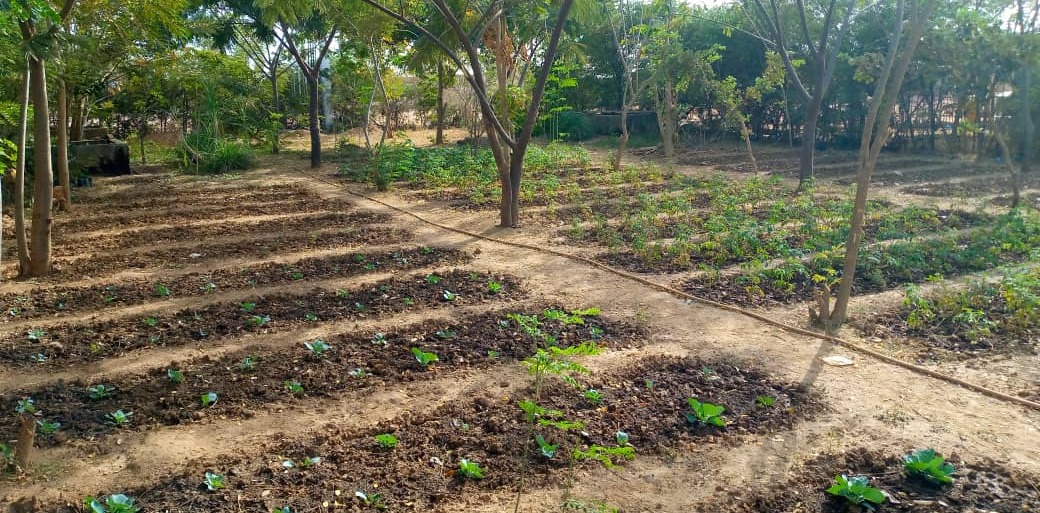
Similarly, APAF multi-story fields are closely related to the ancient Faidherbia albida parks common to the Sahelian zone. In this zone, multi-story fields enable cash crops (cotton, groundnuts), food crops (millet, millet, maize, etc.), and various market garden crops to be grown under the light shade of large fertilizer trees.
At the start of the agroforestry field, fertilizer trees are spaced 10 to 15 meters apart (i.e., 100 to 120 trees per hectare); after 30 years, a minimum of 60 fertilizer trees per hectare will be retained.
- Alley cropping with fertilizer trees grown in tree-shape
All food crops are grown between hedges of tree-planted fertilizer trees (15 to 20 meters apart). Trees are spaced seven to 10 meters apart in the hedge. The corridors are oriented East-West. This system can be used for both harnessed and motorized cultivation.
- Alley cropping with regularly pruned fertilizer trees
Cotton, maize, or food crops (all types, including vegetables) are grown between hedges of fertilizer trees that are pruned regularly. Trees are spaced about one meter apart in the hedge, with corridors about eight meters wide and oriented East-West. This system can be used for both harnessed and motorized cultivation.
- Cultivation between scattered stands of regularly pruned fertility trees
All crops can be grown using this technique. Trees should be at least ten meters apart.
In areas where animals roam freely, agroforestry fields are protected with hedges of thorny trees and shrubs.
Carbon sequestration is maximized when trees are grown in tree shape, which maximizes the amount of biomass present in the field. When trees are pruned, the pruning car be used as forage or for soil enrichment.
APAF’s agroforestry carbon offset projects generate high-quality carbon credits, both environmentally and socially.
Concrete results
Thanks to the development of its technical and methodological concept in the farming environment, African APAFs are achieving concrete, verifiable results in the field.
In countries where APAF operates (Togo, Côte d’Ivoire, Burkina-Faso, Senegal, Cameroon and Benin), the following results were achieved by the end of 2022: 81,539 ha of agroforestry fields, 6,158 ha of forests, and 29,510,965 fertilizer, forest and fruit trees planted, for 53,497 farming families.
In view of these results, potential donors, lessors, and investors wishing to combat deforestation, soil degradation, population impoverishment, rural exodus and climate change can confidently turn to APAF to implement agroforestry and forestry projects and programs.
**
About APAF
APAF (Association for the Promotion of fertilizer trees, Agroforestry and Forestry) is a network of associations specializing in the extension of agroforestry techniques to African farmers. The NGO was created up in Togo in 1992, and has developed agroforestry projects, notably with the support of Belgian cooperation and then the European Union. Its work is internationally recognized. Since the 2000s, APAF-Togo has been emulated by similar structures in Burkina-Faso, Senegal, Côte d’Ivoire, Cameroon, Benin, Switzerland, and France, the headquarters of APAF Internationale.
Editor’s Note: The opinions expressed here by the authors are their own, not those of Impakter.com — In the Featured Photo: Vegetable garden with fertilizer trees in Yagma, 2020, Burkina Faso. Featured Photo Credit: APAF.