
The most revealing outcome of the 31st United Nations Climate Change Conference (COP31) in Antalya was not simply the failure to agree on its central political package. It was the growing difficulty of sustaining a shared climate agenda when governments remain divided over who should bear the costs of change, how quickly that change should happen, and what support developing countries can realistically expect.
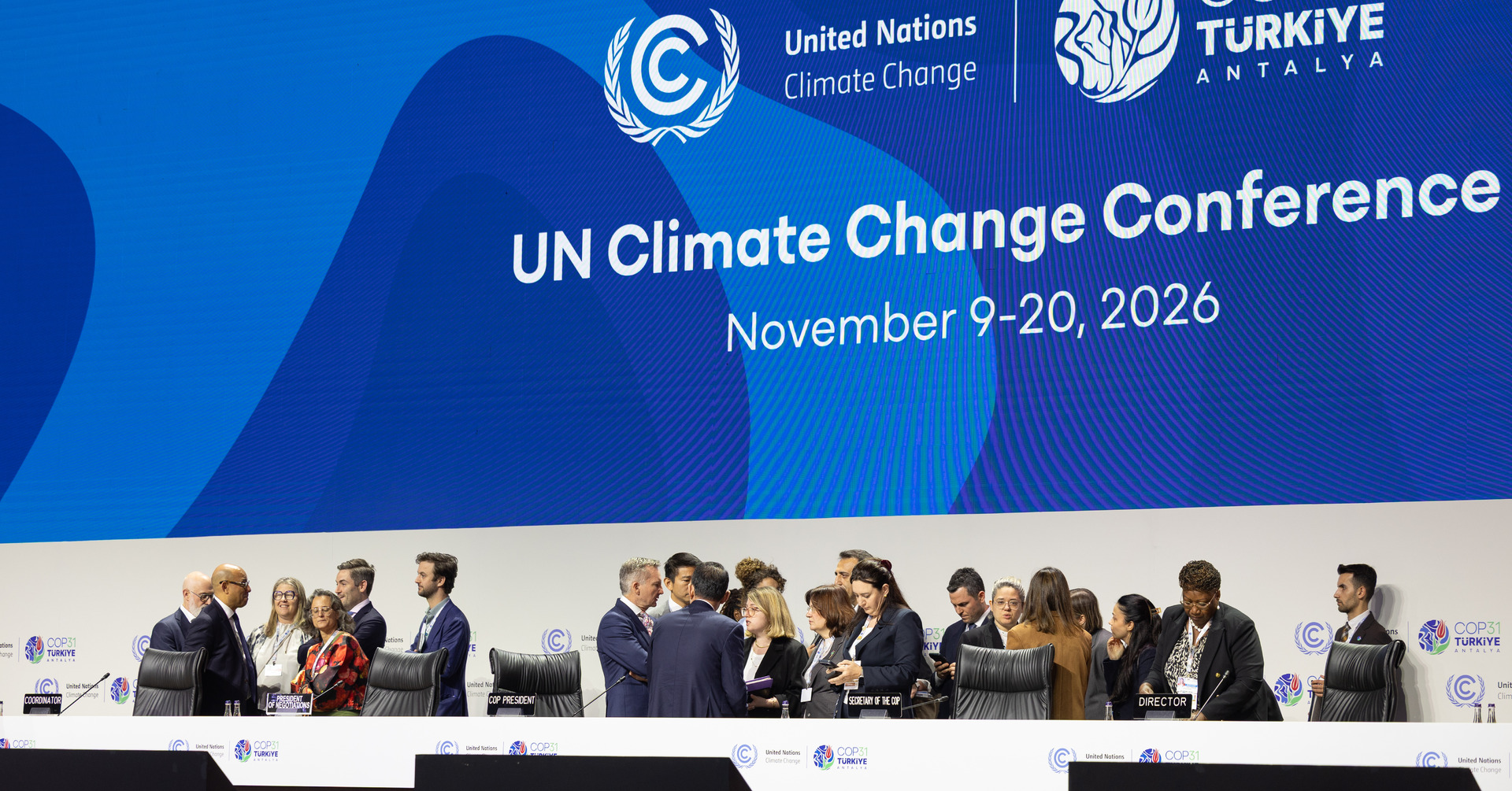
At the closing plenary on November 22, UN Climate Change Executive Secretary Simon Stiell acknowledged that agreement had not been reached on the presidency-led decisions. He also pointed to decisions adopted elsewhere in the negotiations, including on a just transition. Antalya therefore ended neither with a comprehensive political settlement nor with the complete absence of progress. Its outcome was more uncomfortable: parts of the process moved forward, but the political understanding needed to hold them together remained out of reach.
For international development, this distinction matters. Climate negotiations are not only about emissions targets or the wording of diplomatic texts. They are also negotiations over investment, livelihoods, public finances and the distribution of economic opportunity. When these dimensions are treated as separate concerns, governments may agree on individual measures while remaining unable to agree on the broader direction.
What failed and what did not
Claims that COP31 achieved “nothing” overlook the decisions that were adopted. The UN climate secretariat’s official outcomes page lists decisions covering issues including just transition, the global goal on adaptation, long-term climate finance, the Fund for Responding to Loss and Damage, technology transfer and capacity-building. Their adoption, however, does not by itself establish that the resulting provisions are sufficiently ambitious or adequately funded. That requires scrutiny of the individual texts. The opposite interpretation is equally misleading. Technical decisions and implementation initiatives cannot fully compensate for the absence of political agreement on the questions dividing governments.
The distinction is practical, not semantic. A decision may keep an institution functioning or advance a particular negotiating track without resolving the wider dispute over responsibility and resources. Governments can continue producing outcomes while losing confidence in the bargain that underpins them. Antalya’s central problem was therefore not a complete lack of activity. It was the failure to bring that activity into a credible common framework.
Fossil fuels and the politics of implementation
The dispute over fossil fuels raises a question that cannot be settled through diplomatic language alone: what would it mean, in practice, to implement a transition away from them?
Speaking in Antalya on 13 November, UN Secretary-General António Guterres called for an accelerated transition that is just, orderly and equitable. He linked the expansion of clean power, grids, storage and energy efficiency to reductions in fossil-fuel production, consumption and emissions. That connection is essential. Announcing more clean-energy investment does not, on its own, establish how dependence on high-emitting energy sources will decline. A credible transition needs evidence of change across the energy system, rather than a growing list of projects presented without reference to their wider effect.
Yet credibility also requires attention to national circumstances. The pace and design of transition cannot be identical everywhere. Governments face different fiscal constraints, institutional capacities and development priorities.
The task is to reconcile a clear global direction with workable national pathways. Flexibility should help countries implement the transition, not provide an indefinite exemption from it. Equally, greater ambition should come with a serious account of how countries with fewer resources will finance the changes expected of them.
Finance is part of the bargain
For developing countries, climate finance is not an additional benefit to be negotiated after the main agreement. It is part of what makes an agreement deliverable.
An official COP31 discussion on implementation highlighted calls for more accessible finance, stronger technical assistance and closer international cooperation to help developing countries turn their climate plans into action. Participants also stressed the need to account for differing national circumstances and capacities. This points to a weakness in the way progress is often assessed. The headline value of a financial pledge says little about when money will become available, how difficult it will be to access, or whether national institutions can use it effectively. A more useful assessment would ask whether funding reaches an implementable project, whether its terms are appropriate, and whether the receiving country has the capacity to sustain the investment.
The gap is particularly stark in adaptation. In Antalya, Guterres warned that even tripling adaptation finance would cover less than 30% of estimated needs. The relevant comparison, then, is not only with previous pledges. It is with the scale of the risks countries are being asked to manage. From a development perspective, adaptation should be treated as an investment in the continuity of essential services, livelihoods and economic activity. Leaving it underfunded weakens the foundations on which wider development plans depend.
Electrification needs a development test
Electrification featured prominently in the implementation agenda. In his closing remarks, Stiell pointed to national commitments and leaders’ announcements indicating momentum across economies representing roughly half of the global economy. He also highlighted the Electrification Implementation Package as evidence that practical work was continuing alongside the negotiations.
Such initiatives deserve attention, but their status and purpose must remain clear. An implementation initiative is not the same as a universally agreed negotiating outcome. Nor does increased electricity use automatically demonstrate a successful climate transition. Guterres’s remarks in Antalya stressed clean electrification alongside an actual reduction in fossil-fuel dependence and emissions. There is also a development test that should not be lost in the discussion of investment totals and deployment targets.
Will electrification improve the reliability of essential services? Will households and smaller businesses be able to afford it? Will investment strengthen local skills and institutions, or leave countries dependent on capabilities they cannot maintain? These questions belong at the centre of implementation. Public confidence will be difficult to sustain if the transition is visible in international announcements but not in the quality or affordability of everyday services.
Related Articles
Here is a list of articles selected by our Editorial Board that have gained significant interest from the public:
A broader Arab development agenda
For Arab countries, the lesson should not be reduced to a choice between defending existing energy interests and accepting an externally defined transition. A stronger approach would connect climate negotiations to a broader development agenda. That means placing adaptation finance, water and food security, economic diversification, technology access and workforce development within the same policy conversation. It also requires acknowledging that Arab countries do not have identical interests or capacities. A useful common position should accommodate those differences rather than conceal them behind a single defensive message.
The objective should be to secure the conditions for a manageable transition: credible support, realistic implementation pathways and protection for people whose livelihoods may be affected. At the same time, regional diplomacy should contribute practical proposals rather than focus primarily on resisting unwelcome language.The strength of a negotiating position lies partly in what it can prevent. Its longer-term value lies in what it can help deliver.
Reform must reach beyond the conference calendar
Antalya will inevitably renew calls to reform the COP process. Stiell himself acknowledged the need to improve and modernise it, stressing transparency, participation and consensus-building as the process moves further into implementation. There is a legitimate debate about whether the current format makes the best use of political attention and negotiating capacity. But changing how often conferences take place would not, by itself, resolve disagreements over finance, fossil fuels or responsibility.The more important questions concern how decisions are prepared and followed through. Are major disputes addressed early enough, or repeatedly deferred to the final hours? Do commitments identify who is responsible for delivery? Are resources and timelines attached? Can governments and the public distinguish between an announcement, an adopted decision and a funded programme?
Reform should make those distinctions clearer. It should also preserve meaningful participation by countries with smaller delegations and by communities most exposed to climate risks. A more efficient process would be of limited value if it became less representative.
What COP32 will have to prove
Stiell described COP32 as a critical milestone and stressed that the second global stocktake must build on the first rather than retreat from it. That sets a political expectation for the next conference. It does not, in itself, establish that every unresolved issue from Antalya has been formally transferred into a single negotiating package. The immediate challenge is to prevent political disappointment from becoming an excuse for delay. Confidence can begin to recover before the next summit through results that can be checked: finance reaching intended recipients, adaptation programmes moving into implementation, measurable emissions reductions, and support reaching workers and communities affected by economic change. Antalya exposed the limits of a process that can sustain considerable activity without securing agreement on its collective direction. The response should be neither to dismiss multilateral negotiations nor to excuse their shortcomings.
COP32 will need a stronger political settlement. But its credibility will depend on something less easily negotiated in a closing plenary: evidence that existing commitments are improving people’s prospects, reducing their exposure to risk and making development more secure.
Editor’s Note: The opinions expressed here by the authors are their own, not those of Impakter.com