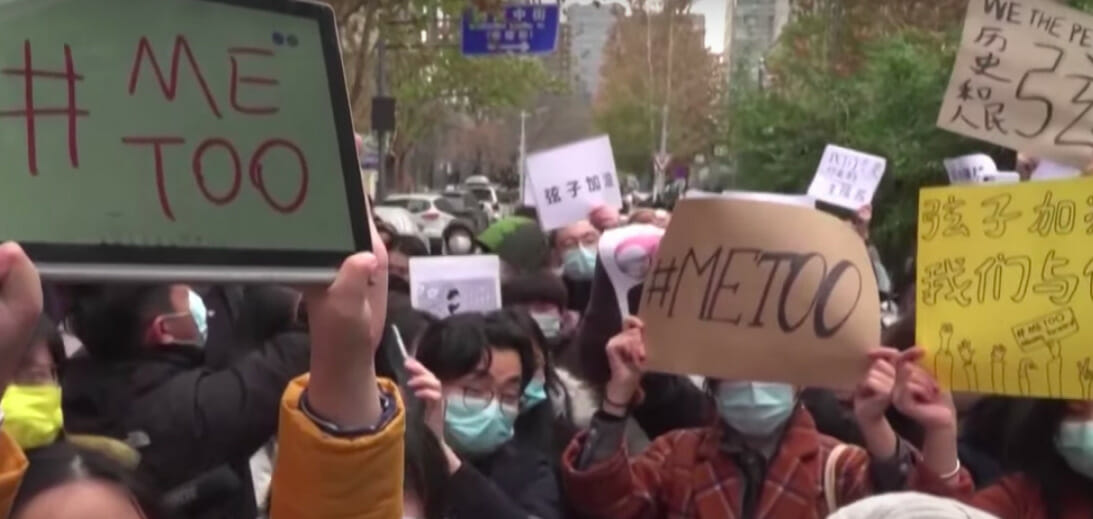
In response to the nascent #MeToo movement in China as a consequence of several women speaking up about being victims of sexual assault, harassment, and gender-based discrimination, the Chinese Communist Party (CCP) is considering strengthening its laws on women’s rights and sexual harassment in the workplace.
A draft revision of the Law on the Protection of Women’s Rights and Interests, which has been in place for three decades, was reviewed on Monday at an ongoing meeting of the National People’s Congress Standing Committee, the top law-making body.
Under the revised proposals, any comments with sexual connotations, inappropriate bodily behaviour, sexually explicit images, or suggestions of benefits in exchange for sex towards a woman without her consent constitutes sexual harassment, according to Reuters.
Employers would no longer be able to turn away female applicants on the basis of their marital or pregnancy status, and their salary and benefits must be protected if they are pregnant or on maternity leave. If voted on Friday earliest, this part of the amendment will most likely become the most highlighted one for the Chinese Government as they aim to maintain and increase the labour force while its population is set to shrink. It also coincides with an important policy shift that heralded the beginning of spring: families are encouraged to now have three children.
The debated proposal also suggested schools and companies to establish a mechanism to prevent and punish sexual harassment against women. Schools and institutes will no longer be able to turn down women on the basis of their gender or require them to meet higher admission standards than men.
If voted, China would also outlaw the use of superstitious “mind control” practices on women. For example, “female morality classes” would be banned.
The proposal would clearly define sexual harassment at work for the first time, including "suggestions of benefits in exchange for sex."
Physical abuse was not accepted as grounds for divorce until 2001, and China first outlawed domestic violence in 2016.https://t.co/YTN3lBGOR7
— Genevieve Gluck (@WomenReadWomen) December 22, 2021
Prior to this amendment, the law only stated that sexual harassment against women was prohibited but never included a succinct definition of what constituted sexual harassment. The new proposal clarifies the term to mean “verbal expressions with sexual content or implications,” “inappropriate or unnecessarily physical behaviour,” “the dissemination or display of texts, audio, video, news articles or image [with sexual content or implications],” as well as “implying that a sexual relationship will confer certain benefits,” and other similar situations.
A response to a nascent #MeToo movement in China?
The revised proposal comes amid a whirlwind of international attention on gender and power inequality in China, after the tennis star Peng Shuai made apparent allegations of sexual assault against a former high-profile vice-premier in early November. Global concern mounted as Mrs. Shuai disappeared from public view following the accusation, and all mention of it was quickly removed from the internet and all discussions on the topic were heavily censored.

The move also comes as China attempts to temper activists calls for greater gender equality that have accompanied a fledgling #MeToo movement. The movement seriously took off in 2018 when Luo Xixi, a former Shanghai University of Finance and Economics student, accused a professor of sexually harassing her. The professor was fired by the university, driving many more women to speak up.
Allegations spread to NGOs, media, and other industries, but the movement faced a recent setback in September when Zhou Xiaoxuan, a 28-year-old woman, lost a high-profile sexual harassment court case she had brought against a well-known broadcasting host with strong political ties, and who she accused of having sexually assaulted her when she was an intern.
The setback marked the beginning for the country’s #MeToo awakening, which exploded in support of a former Alibaba employee who accused the company of firing her after she made sexual harassment allegations against a colleague, earlier this month.
Although China is responding to sexual harassment and gender inequality within the workplace, the government is also facing backlash for ignoring the country’s growing domestic abuse problem. The story of Tibetan vlogger Lhamo, who was killed when her ex-husband set her on fire as she live-streamed in 2020, shocked the nation.
This is an example amongst many others. Undercover Asia, the investigative series that examines social issues and trends around Asia on Netflix, found that every 7.4 seconds, a woman in China faces domestic violence. About one in four women are said to have endured domestic abuse.
China is responding to the growing #MeToo movement within the country, but it is meticulously choosing which side of the movement to focus on.
China’s Justice System: what justice? and for who?
In the majority of cases related to sexual harassment, the Chinese justice system was seen to favour the male aggressor. Women who spoke publicly about sexual assaults not only have to face an unjust legal system, but also face social alienation.
A recent report by researchers from New York University Law school found only 83 civil cases in public Chinese court databases related to sexual harassment or molestation between 2018 and 2020. Among them, 77 were brought by the alleged harasser against companies or the victim. In just six cases, victims sued their harasser.
Related Articles: Gender-Based Violence in Turkey on The Rise: The Government Is to Blame | Orange The World: 16 Days of Activism to End Gender-Based Violence Begins
It was found that victims face a higher burden of proof in the courts, even when they are being sued.
National law against sexual harassment does not define any punishments for the aggressor. Enforcement depends on laws at the local levels, and many companies do not have harassment policies with clear ways for victims to seek justice.
The former Alibaba employee who accused the company of firing her after she made sexual harassment allegations against a colleague, earlier this month, is now facing online harassment, accusations of lying from the wives of the two men she accused, and a defamation lawsuit from the Alibaba Vice president who was forced to resign. Her case is not an isolated one.
A win or an illusory success for women?
The draft revision of the law does provide a clearer definition of what is meant by gender-based discrimination and sexual harassment, providing for greater legal clarity. It is true that any amendment is better than nothing, but will the amended proposal be implemented in practice?
“For example, the draft bans harassment in relationships and invasion of privacy…in reality, the courts could also simplify the procedures to apply for a restraining order, and the police could have dedicated staff to protect women’s rights in domestic violence cases,” said Dong Xiaoying, as reported in the South China Morning Post.
Dong Xiaoying, a Guangzhou-based lawyer and founder of the Advocates for a Diverse Family Network, said the proposed changes to the law focused on areas that had received a lot of attention in recent years. Other areas still need to be addressed, including birth rights for unmarried women.
Evidently this does not signify a lesser win for women, yet many remain unconvinced that the amended law is not part of a broader governmental strategy. Authoritarian regimes, such as that of the CCP recognise the need to understand the opinion of their citizens (women included) and seek to obtain popular consent so as to avoid their downfall. This is especially true in the face of the omnipresence of social media.
In this case, the CCP was facing increasing domestic and foreign criticism for its juridic handling of sexual harassment and domestic abuse cases. Foreign media has been incessantly covering the issue since Peng Shuai, the former tennis player, came forth.
Internally, feminist activists and support groups continue to provide their support for women victim of sexual harassment or gender-based violence, notably to Zhou Xiaoxuan. In response to this, the proposed amendment to the law appears to be a response with the clear intent to shape public perception and give the impression of a democratic system focused on obtaining popular consent and reaffirm the CCP grip on society. Meanwhile, others argue the amended proposals are linked to the CCP’s bid to encourage women to have more children to combat a rapidly ageing population.
The fact that what is going on is not clear and subject to differing interpretations suggests that the proposed amendments may have to be ultimately classified more as an illusion than a clear win.
Editor’s Note: The opinions expressed here by Impakter.com columnists are their own, not those of Impakter.com. — In the Featured Photo: People waiting outside Beijing’s courthouse for Zhou Xiaoxuan with #MeToo signs. Featured Photo Credit: TV5MONDE.