Impakter
  • Environment
    • Biodiversity
    • Climate Change
    • Circular Economy
    • Energy
  • FINANCE
    • ESG News
    • Sustainable Finance
    • Business
  • TECH
    • Start-up
    • AI & Machine Learning
    • Green Tech
  • Industry News
    • Entertainment
    • Food and Agriculture
    • Health
    • Politics & Foreign Affairs
    • Philanthropy
    • Science
    • Sport
  • Editorial Series
    • SDGs Series
    • Shape Your Future
    • Sustainable Cities
      • Copenhagen
      • San Francisco
      • Seattle
      • Sydney
  • About us
    • Company
    • Team
    • Partners
    • Write for Impakter
    • Contact Us
    • Privacy Policy
No Result
View All Result
Impakter logo
No Result
View All Result
A Circular Concept: How Businesses Can Speed Their Climate Work

A Circular Concept: How Businesses Can Speed Their Climate Work

Impakter Editorial BoardbyImpakter Editorial Board
January 11, 2019
in Business, Corporations, Environment, Health, Science, Society
0

This article is part of an editorial collaboration with BCorporation. The BCorp Series can be found here.


Building a Sustainable Supply Chain Enhances Earth-Friendly Efforts

Businesses, unlike governments, are uniquely positioned to move fast to reduce greenhouse gas emissions — especially when they partner with other businesses that share their commitment to sustainability. Environmental policies can take years, sometimes decades, to come into force. For example, countries signing onto the Paris Agreement have pledged to reduce carbon emissions by 2025, 2030 or later.

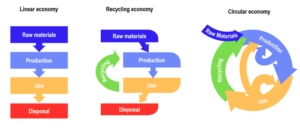
But when businesses make sustainability a top priority, they can have a dramatic impact throughout their network of suppliers, partners and clients. Linking sustainable businesses in “circular economies” spreads sustainable practices across industries.
Conscious Company Media is part of the community of businesses that have used a third-party verification of their impact. Use the free B Impact Assessment to evaluate your company’s impact on all stakeholders, including the environment, your workers, your community and your customers.

The Concept: Cycling Profits Among Sustainable Businesses

Mark Esposito, professor of business and economics at Harvard University and the Grenoble School of Management, defines the circular economy as a “no-waste industrial chain that promotes economic growth using the least amount of non-renewable natural resources as possible.” To give you an example, Levi Strauss & Co is working to implement its own no-waste chain by manufacturing jeans from recycled textiles, a process that requires significantly less water than making jeans from new cotton. The company now accepts textiles for recycling in all of its stores and aims to implement a closed loop recycling-to-manufacturing system by 2020.

This same no-waste concept also can be applied to everyday business transactions. In an ideal setting, every dollar an environmentally conscious business spent would become the earnings of another sustainable business, and that business’s expenditures would funnel into the profits of yet another sustainable business, and so on. In more concrete terms, an apparel retailer would source its offerings from suppliers committed to sustainability. Those suppliers, in turn, would purchase clothing from manufacturers using sustainable textiles. You get the idea.

The Challenge: Vetting the Sustainable Supply Chain

In the real world, circular economies centered around sustainability are easier said than done, and one of the biggest challenges is vetting. Today’s supply chains are more convoluted than ever, with 54 percent of manufacturers reporting no visibility into the sustainability of their suppliers.

Vetting partners and suppliers can be a huge undertaking. Having researched nearly 40,000 products sold at his virtual storefront, TheGreenOffice.com, sustainability consultant Alex Szabo speaks from experience when he says that vetting suppliers and potential partners is a central challenge for any business looking to create its own sustainable ecosystem. “It can take months to vet a new vendor,” Szabo says. “It’s the added time-cost of sustainability.”

Sustainability Certifications: It’s Not Too Much Too Ask
Third-party certifications like TSC, Fair Trade, the Marine Stewardship Council, Green America, and the B Impact Assessment Score make it easier to identify sustainable businesses to partner with and buy from. Take Stephanie Meade, director of culture and marketing at San Francisco-based New Resource Bank. Meade asks all loan applicants to complete the B Impact Assessment to help her determine their social and environmental performance. “The crucial thing for us is their commitment to improving their sustainability,” Meade says.

What if you love your current supplier or you are really excited about a potential new client, but they are not third-party certified? Talk with them. Carolyn McMaster, co-founder and principal of Thinkshift Communications, has pledged to work only with “do-gooder” businesses. She talks sustainability with all potential clients and refuses to work with any business that has a questionable track record.

The decision to work exclusively with sustainable businesses involved some tough decisions—including firing one of her biggest and earliest clients. “We were their agency of record for four years, and we had a wonderful relationship with them,” McMaster says. After many conversations, it became clear that the client would not make sustainability a priority in the foreseeable future. McMaster took a stand and parted ways. “Cutting ties made things super lean for a while for us, but it was freeing,” she says.

Who’s Not on Board Yet?

Talking with your partners, clients and suppliers also can help spread sustainable business practices. Ryan Honeyman, sustainability consultant and author of the B Corp Handbook, points out that certain industries such as real estate leave holes in what could otherwise be sustainable circular economies. In spite of these holes, Ryan believes there is simply too much social and environmental pressure for businesses in all industries to not adopt sustainable practices. Citing Nike and Walmart’s attendance at COP21, he added, “It’s inevitable that sustainable business practices will spread to other industries. It’s just a matter of time.”


Editors Note: The opinions expressed here by Impakter.com columnists are their own, not those of Impakter.com – Featured Photo Credit: Bcorp.
Tags: B CorporationBcorpCircular ConceptClimate ChangeEnvironmentSustainabilitysustainable business
Previous Post

New York DNA between Art, Architecture and Urban Green

Next Post

Brexit Deadlock: What Next?

Related Posts

Protests arise against Wall street’s oil deals, Big tech accounts for half of global clean energy, EU proposes stricter standards for corporate vehicles, DHL introduces new portfolio offerings for reducing scope 3 impacts
Energy

Activists Protest Against Wall Street’s Oil Deals

Today’s ESG Updates Protests' Strategies Change Amidst Banks' Inaction: Wall Street fossil fuel deals push climate groups to shift tactics,...

byFedor Sukhoi
February 24, 2026
Trump Admin Weakens Coal Plant Mercury Regulations
Business

Trump Admin Weakens Coal Plant Mercury Regulations

Today’s ESG Updates: Coal Plants Get Reprieve on Mercury Limits: Trump's EPA is rolling back mercury emission limits to cut...

byEge Can Alparslan
February 20, 2026
How Climate Change Is Reshaping Arctic Geopolitics
Climate Change

How Climate Change Is Reshaping Arctic Geopolitics

Once a remote and largely inaccessible region, the Arctic has become the focus of far-reaching international developments. In recent years, competition among...

byPier Paolo Raimondi - Senior Researcher at the Energy, Climate and Resources (ECR) Program of the Istituto Affari Internazionali (IAI)
February 20, 2026
How an Intersectional Approach Can Help Us Address Vulnerability to Climate Change
Climate Change

How an Intersectional Approach Can Help Us Address Vulnerability to Climate Change

Different forms of discrimination and marginalization — such as racism, ableism, and discrimination on the basis of gender identity —...

byInternational Institute for Sustainable Development (IISD)
February 20, 2026
Underwater Wall to Protect the ‘Doomsday Glacier’: Necessary Intervention or Costly Distraction?
Climate Change

Underwater Wall to Protect the ‘Doomsday Glacier’: Necessary Intervention or Costly Distraction?

Thwaites Glacier in Antarctica earned its dramatic nickname, the “Doomsday Glacier,” because its collapse could trigger a catastrophic rise in...

byBenjamin Clabault
February 19, 2026
biodiversity loss
Biodiversity

The Economics of Biodiversity Loss

In the 1990s, India’s vulture population collapsed due to the unintended knock-on effect of a veterinary drug for cattle, with...

byStefano Giglio - Professor at Yale Universityand2 others
February 19, 2026
Woman in sustainable shipping
Business

How Sustainable Businesses are Rethinking Shipping in 2026

Sustainable businesses are transforming the way they ship by reducing waste, optimizing processes, and choosing systems that use minimal materials...

byHannah Fischer-Lauder
February 19, 2026
ESG news on TotalEnergies climate trial, Heathrow SAF incentives, Shein EU probe, EU climate resilience gap
Business

TotalEnergies Climate Trial Shock

Today’s ESG Updates TotalEnergies Climate Trial: French prosecutors intervene to defend TotalEnergies in a landmark climate lawsuit, challenging environmental groups’...

byEve Rogers
February 18, 2026
Next Post
Brexit Deadlock: What Next?

Brexit Deadlock: What Next?

Recent News

Scholars Argue for a Pan-European Coalition to Counteract U.S. Aggression

Scholars Argue for a Pan-European Coalition to Counteract U.S. Aggression

February 26, 2026
Who Owns the Ocean’s Genetic Wealth?

Who Owns the Ocean’s Genetic Wealth?

February 26, 2026
Heidelberg Materials plant in Georgia, USA

Cement Giant Posts Record Earnings and Cuts Carbon

February 26, 2026
  • ESG News
  • Sustainable Finance
  • Business

© 2025 Impakter.com owned by Klimado GmbH

No Result
View All Result
  • Environment
    • Biodiversity
    • Climate Change
    • Circular Economy
    • Energy
  • FINANCE
    • ESG News
    • Sustainable Finance
    • Business
  • TECH
    • Start-up
    • AI & Machine Learning
    • Green Tech
  • Industry News
    • Entertainment
    • Food and Agriculture
    • Health
    • Politics & Foreign Affairs
    • Philanthropy
    • Science
    • Sport
  • Editorial Series
    • SDGs Series
    • Shape Your Future
    • Sustainable Cities
      • Copenhagen
      • San Francisco
      • Seattle
      • Sydney
  • About us
    • Company
    • Team
    • Partners
    • Write for Impakter
    • Contact Us
    • Privacy Policy

© 2025 Impakter.com owned by Klimado GmbH