Much attention was focused lately on the idea that Ukraine could launch a victorious counter-offensive in the south intended to push Russian forces into retreat everywhere, including from the areas in the Donbas region that Russia presently controls: The Donetsk, Kherson, Luhansk, and Zaporizhzhia Provinces, or oblasts.
Zaporizhzhia is where Ukraine’s – and Europe’s – largest nuclear power plant is located and where fighting has recently taken place, raising worries of a nuclear incident that would make the Chornobyl disaster pale by comparison. And it is where Ukraine’s President Zelinsky has warned that Russian troops will become “special” targets:
“Every Russian soldier who either shoots at the station or shoots under the cover of the station must understand that they are becoming a special target for our intelligence, for our special services, for our army.”
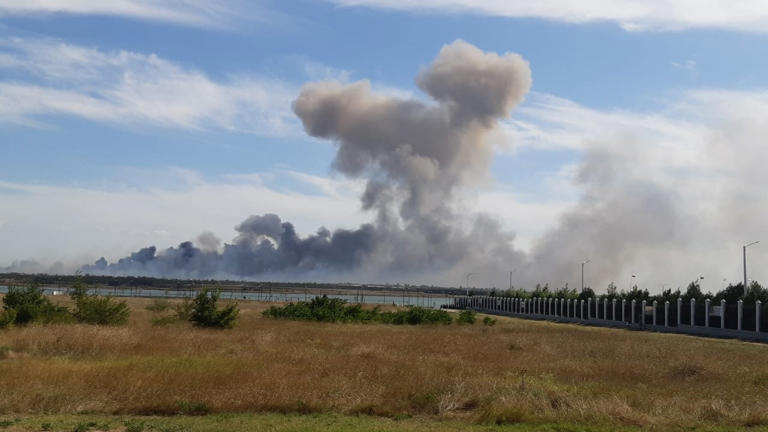
Talk of a counteroffensive has been going on for a while now, at least since early June and so, when the news came out last week that a Russian military airfield in Crimea had been hit by Ukrainian rockets, it looked like the war was indeed taking a turn for the best in favor of Ukraine.
Those blasts in Crimea were viewed as emblematic, signaling “the start of Ukraine’s counteroffensive in the south and a critical new phase of the war that could shape its ultimate outcome,” two Ukrainian officials told POLITICO.
Let’s face it: Those first six months of Russia’s war on Ukraine haven’t gone the way Putin envisaged. Indeed, the view that he will never be able to conquer Ukraine is gathering strength. At a meeting of European defense ministers a week ago, Ben Wallace, the UK minister, as he pledged more financial and military support to Ukraine, declared that Russia’s invasion of Ukraine had “faltered” and was “starting to fail”.
That doesn’t mean Ukraine is not in for another six more months of war or maybe more. Zelensky’s adviser Mykhailo Podolyak in an interview with the Guardian on August 16 said Russian supply lines will be systematically targeted and he announced similar attacks to last week’s blast at a Crimean airbase. The idea, as he put it, is to “Destroy the logistics, the supply lines, the ammunition depots. Create chaos within their own forces.”
And indeed, according to the latest news, there have been more attacks on Russian military facilities in Crimea. A series of strikes in occupied Crimea destroyed key military infrastructure, including a railway junction and a military airbase. Explosions at key Russian positions in occupied Crimea on Tuesday were “likely part of a coherent Ukrainian counteroffensive to regain control of the west bank of the Dnipro River,” according to the US think-tank the Institute for the Study of War (ISW).
Ukrainian officials are not confirming anything but they can’t contain their glee on social media.
Morning near Dzhankoi began with explosions. A reminder: Crimea of normal country is about the Black Sea, mountains, recreation and tourism, but Crimea occupied by Russians is about warehouses explosions and high risk of death for invaders and thieves. Demilitarization in action.
— Михайло Подоляк (@Podolyak_M) August 16, 2022
While Kyiv may not yet have enough power to retake the key southern city of Kherson, it looks now capable – helped by US-supplied Himars missiles – of seriously weakening Russian forces to the point where Putin may need to put a stop to his “special operation” of “denazification of Ukraine” and pull out.
The upshot: Russia is still advancing in the Donbas and for now Putin is still planning on organizing referendums to annex the two regions of Luhansk and Donetz, in particular in occupied Kherson, taking a leaf from the old playbook he used when he annexed Crimea in 2014.
But the main point is this: Russia in the south could well lose its grip – perhaps not over Crimea but certainly over the whole south of Ukraine which is a crucial region since that is where Odesa is located, its main port on the Black Sea.
What Ukraine needs to win the peace: A legally-binding security agreement
As John Bolton, former American diplomat and Trump adviser, recently wrote in the UK Telegraph, the next 90 days are likely to be crucial: Moscow could even agree to a cease-fire, he argues, but Nato and other Ukraine supporters “must start thinking now (and should have been thinking long before today) about how to prevent Moscow from seizing the diplomatic high ground and bring the conflict to at least a temporary halt on its terms, not Kyiv’s.”
And he sums up the situation for Putin in the following terms:
“Moscow’s casualties have been high, debilitating logistical and personnel problems persist, domestic public opinion is mixed and uncertain at best, and international sanctions have strained (albeit not visibly altered) the Kremlin’s war effort.”
That the casualties for Russian troops have been high, more than double those of the Ukrainian forces, is certainly the case: According to the Pentagon, Russia has been losing 500 soldiers a day, as against 200 on the Ukraine side.
And there’s no question that international sanctions have strained the Russian economy: It hasn’t yet lost as much as expected, but GDP has contracted by 4% in the second quarter of this year. That’s not the 7% analysts polled by Reuters had expected, but it is still a sizeable contraction.
And domestic opinion in Russia is decidedly mixed, with Russian billionaires reportedly disapproving of Putin’s military adventurism – but the united front of the West could fracture as people, especially in Europe, come under pressure from the rising cost of living and looming gas shortages this winter. So yes, for now, Western unity is strained though not yet broken.
So the next few weeks could be critical. And according to John Bolton, Putin “does not want to be caught with Russian forces in broad retreat, where any diplomatic effort would be taken as a sign of weakness.”
So, argues Bolton, expect Putin to announce, “with a straight face despite its obvious falsity, that the Kremlin has achieved its objectives”, halting all Russian military operations and demanding that Ukraine does the same. He’d call for immediate ceasefire negotiations to establish an agreed line of control between the forces. This is his “best option”, because, as Bolton puts it, “he knows that a cease-fire will give Russia time, years perhaps, to rebuild its military, restore its economy, and perhaps reabsorb more pliant, weaker parts of the Russian empire, from Belarus to Central Asia.”
One would expect of course Zelensky to flatly reject halting the conflict with Russia still holding perhaps 25 percent of Ukraine’s territory.
However, Bolton’s main point is that “Ukraine and Nato need a diplomatic agreement now against this pre-emptive Russian ploy, which may rapidly gain the initiative regardless of battlefield developments.” That means having an agreement between Ukraine and its allies that would call for a continuation of the sanctions despite the cease-fire.
That, writes Bolton, is the “most important element of a Western counter-strategy”. There will be a need “to make clear at once that all sanctions against Russia will remain in place until the full withdrawal of Russian forces from Ukraine’s territory.” Of course, “Many other issues, including reparations, prisoners of war and accountability also need resolving, but the key point is to stop Russia from consolidating its territorial gains through a scam, unilateral ‘ceasefire’.” (bolding added)
This makes a lot of sense and it is in this context that the “open letter” from Zelensky’s adviser Andriy Yermak recently published in the Guardian (August 11) must be read. He titled it provocatively: My country, Ukraine, has a proposal for the west – and it could make the whole world safer.
His proposal is straightforward: Draw up an agreement between the West and Ukraine in the form of a treaty. In his words: “A legally binding security guarantee from our allies, replacing the failed Budapest memorandum, would make a huge difference.” (bolding added)
Just for reminder, the said Budapest memorandum, originally signed in 1994 by the three nuclear powers, Russia, the United Kingdom and the United States (to which later were added France and China) prohibited them from threatening or using military force or economic coercion against Ukraine, Belarus, and Kazakhstan.
And as Yermak remarks, “tragically for Ukraine, the Budapest memorandum did not stand the test of time.” And now as the Ukraine war appears headed for an inflection point, it becomes more important than ever to preserve the “principle of self-determination” – which is precisely what Ukraine is defending in this war and it also happens to be the core principle of any viable democracy, something that no government in the West can deny.
In that letter, Yermak also informs us that work has already started on a legal instrument that would preserve this principle for Ukraine. As he says, “we have already started the process of securing guarantees from our allies. We have established a high-level working group co-chaired by myself and former Nato secretary general Anders Fogh Rasmussen. Members include some of our closest friends, including William Hague, the former UK foreign secretary, Kevin Rudd, the former prime minister of Australia, and Carl Bildt, the former prime minister of Sweden.” (bolding added)
This high-level working group looks to be what is needed to provide diplomatic cohesion for the West in the case Putin calls for a cease-fire. Because, as Bolton says, “Russia’s inclination to spring a “cease-fire in place” will increase as its prospects for substantial further military gains recede.”
After this terrible, unjust war, nobody would want Ukraine to lose the peace. And to win the peace, what Ukraine needs is a legally binding security agreement with the West, indispensable to prop up its position in the negotiations with Russia.
Editor’s Note: The opinions expressed here by Impakter.com columnists are their own, not those of Impakter.com –In the Featured Photo: Blast in Crimea, August 10, 2022. About a dozen Russian airplanes were reportedly destroyed Source: Flickr.com (cc)