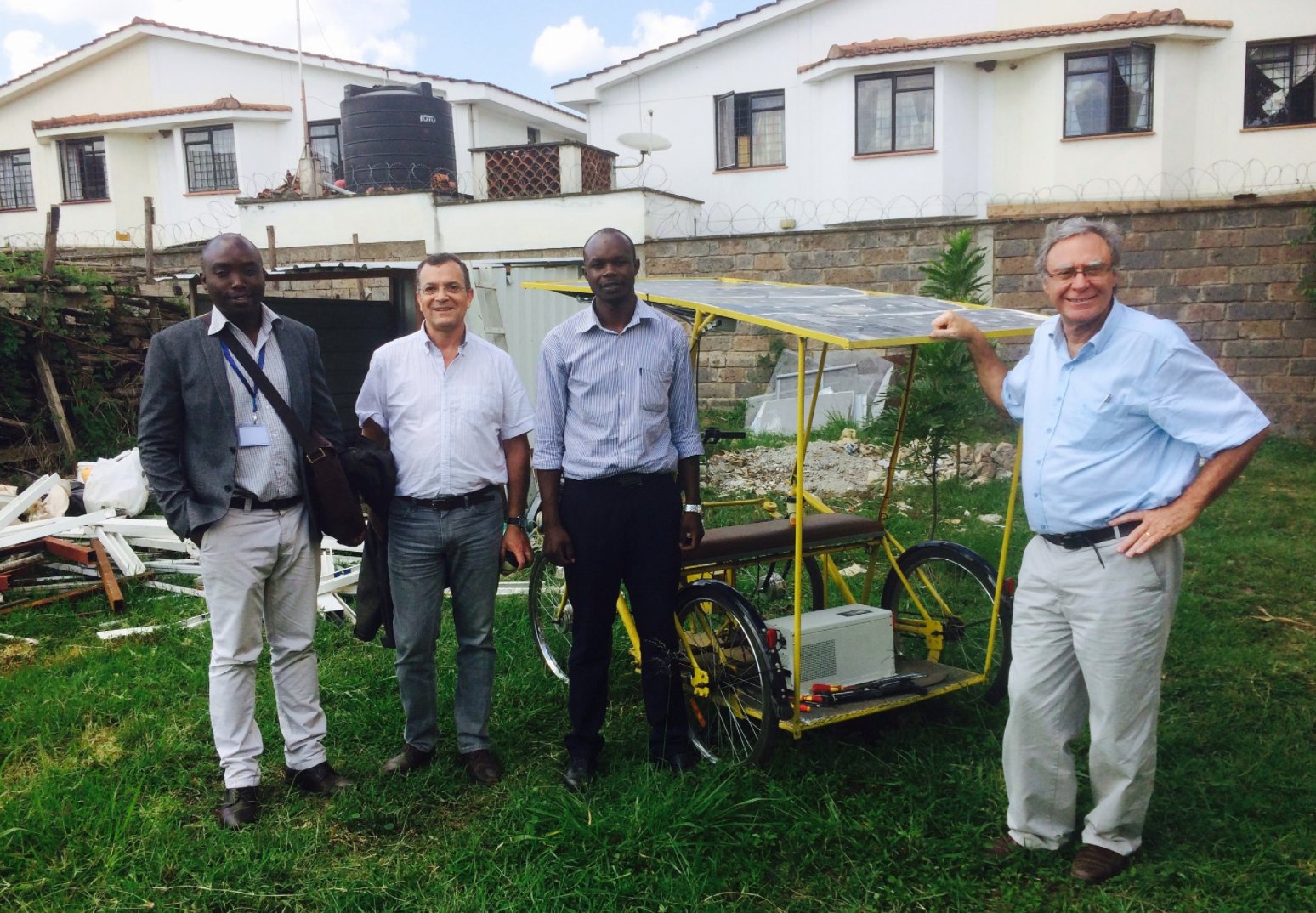

Around 85% of people in the world have access to electricity, but in sub-Saharan Africa that number drops to 40%. The global disparity of electricity access is not something that many of us think about in our everyday lives, but Roger Christen does. Having spent over 30 years implementing development projects for the World Bank across Africa, Roger is well placed to find solutions to the many issues present in the region. In his latest venture, Roger hopes to connect off the grid areas of Africa through combining solar panel electricity generation with a means of transport. The team have developed the Solar-e- cycles featuring solar panels which will allow people living in isolated areas of Africa to reach clean water much faster and then use the extra generated energy to power their home
The project is yet another example of the advantages gained through the rapid adoption of solar panels and with prices having dropped by over two thirds since 2011, developing countries are beginning to see the benefits.
I sat down with Roger to discuss the company and his aims for the future.
Can you tell me a little bit about your background and how the idea of Solar-e-cycles came about?
Roger Christen: For the last 30 years I’ve worked on preparing and implementing World Bank development projects for job creation and economic development with half my time in Africa. I got this idea of creating a light solar-powered electric vehicle as a means of transportation and for generating electricity to power the home. The idea originally came about when I was travelling in Cameroon. We stopped in a remote village where I learned of a large logistics operation to ensure that everybody had water. Half of the population was dedicated to just carrying water, 7km in the wet season, and 14km during the dry season. That was their life. So we had a think, how can we use solar energy to try and create a vehicle that would give you up to 50km a day and you could use the extra power at night to power some LED lights or a computer to study.
We started building some prototypes in 2014 in Morocco, renting a small garage (which seems to be the formula for success these days), and we built a few prototypes and applied for grants and won something in Kenya and now we’re building 130 vehicles in Kenya for a pilot project.
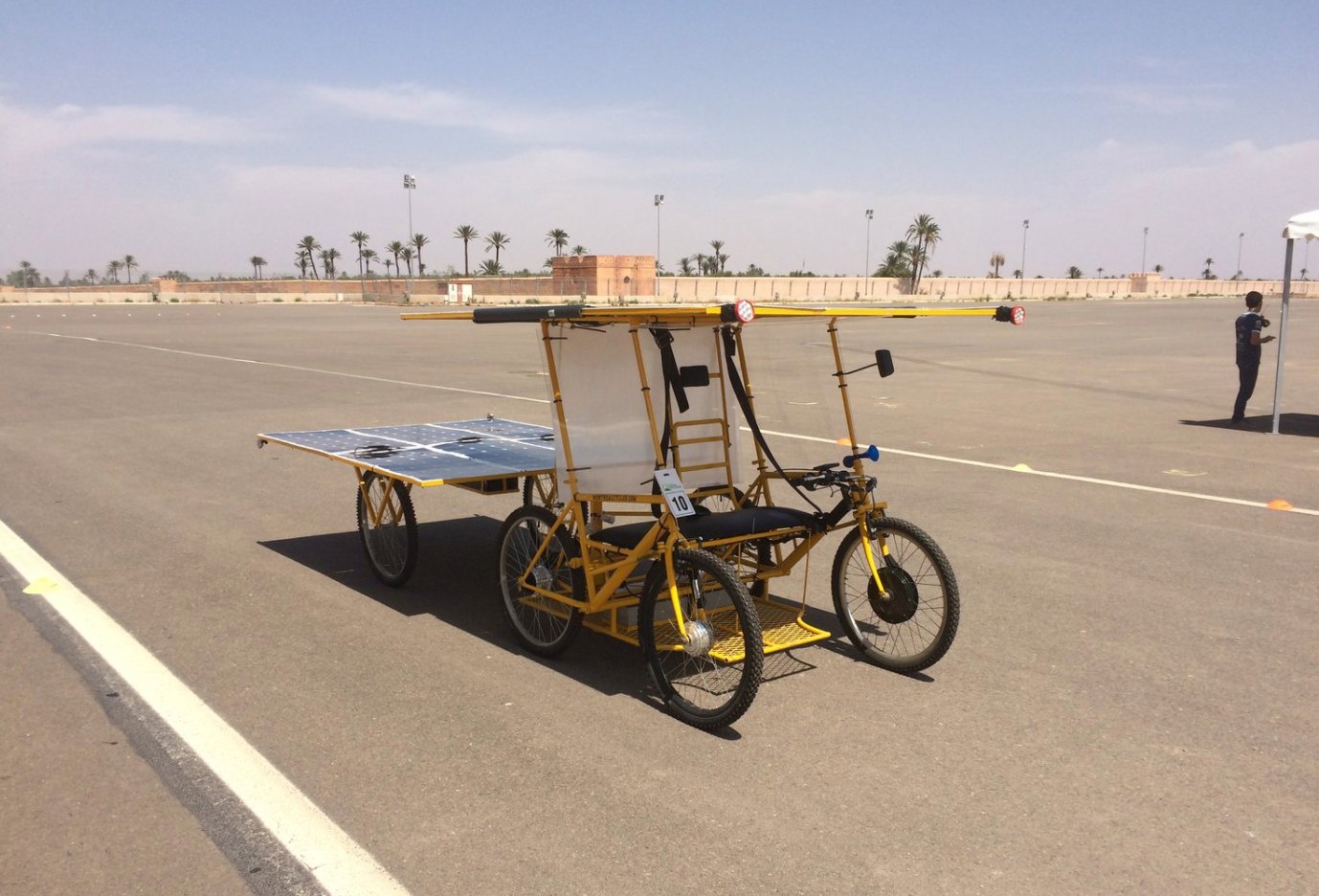
In the Picture: The Solar E Cycle on a street. Photo Credit: Roger Christen – Solar-E-Cycles
What’s your overall mission?
RC: To make the least costly form of transportation that can also power a home, but now the business model includes having all the data from the vehicle transmitted to our internet database and we can monitor how people drive the vehicle. We can monitor where they go so that we can put in GEO fencing to guarantee that the vehicle stays within the certain area. We want to apply microfinance techniques to select customers to lease these vehicles and to guarantee payment. We’re using the PAYGO system, which according to a World Bank report has allowed 8 million new customers in the last 5 years to get home solar systems through giving a deposit and then paying a certain amount each day or month to recharge their account and then after a year or so they own the system. We want to do the same thing.
What do you intend to charge for the vehicles?
RC: We thought, if we could offer this vehicle on a leasing basis, we could offer it to people earning $2 a day with a rental cost of 50c a day over 3 years. Right now we aren’t quite there, but we have a project that for around $3 a day is financially viable, but the real benefit of the vehicle is that not only does it give you mobility and power it can generate revenue; people can bring their products to the market, power a small business or even sell electricity.
And are the vehicles built within the local community?
RC: Well the strategy was to use off the shelf components to minimise the cost and investment in manufacturing so we’re using Chinese parts, fully inspected by SGS before they ship, but the local fabrication is all the steel framing and the assembly of course. The vehicles are very low maintenance but if something needs to be fixed that can be done locally too. It’s about 30% of manufacturing is local to start but obviously, long-term if we have volume we can start making motors, or assembling batteries or go a little further but it’s not cost effective until you have the volume.
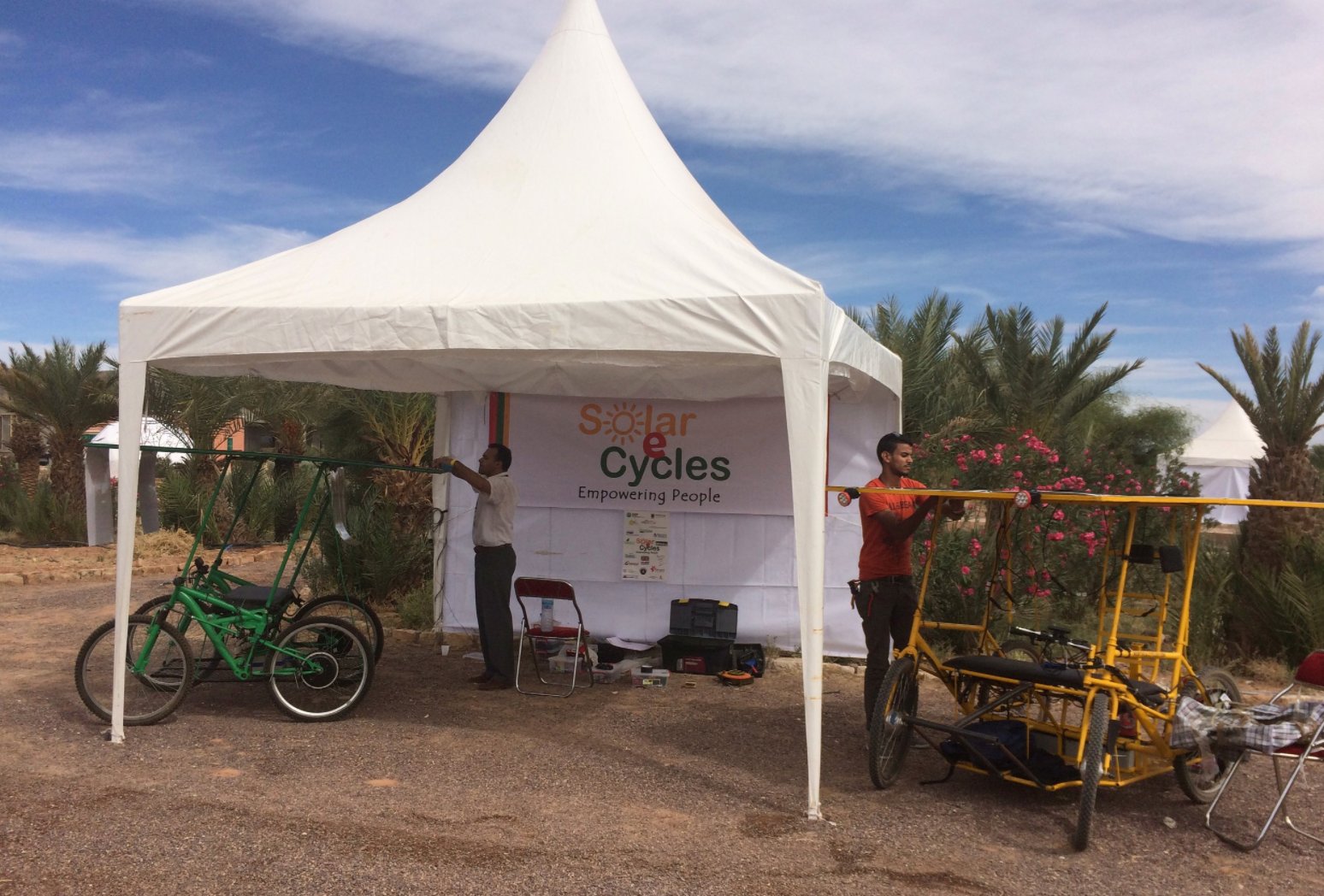
In the Picture: The Solar E Cycle on a street. Photo Credit: Roger Christen – Solar-E-Cycles
I see you’re developing a number of different vehicles at the moment, can you tell me a little bit more about that?
RC: We’re still really in the development stage at the moment but we’ve done some testing. For example, with our lithium battery pack, we’ve done 100km with our 4 wheel vehicle which has two 350W motors. We’re trying to use lead acid batteries because they’re much cheaper but they don’t have very much flexibility, but hopefully the pilot trials that we have in the field will provide us with a better understanding of the best options. Now the target is to have a 50km minimum of range and the solar panels are 300W so in 5 hours you can recharge the batteries fully. The basic model now is the tricycle with the 350W motor, but it has gears so obviously if the battery goes dead you can still pedal.
What milestones have you set for the next 5 to 10 years?
RC: Really at the moment we’re focusing on quite a short-term objective, we want to develop our vision for the next 10 years and thinking maybe optimally 10’000 business centres but that’s slightly unrealistic at this point. Our immediate goal is to build 10 vehicles and put them in the field in Kenya and to win the contract in Morocco for 15 vehicles. We’re also developing the design of a two-passenger more versatile vehicle for urban use. Our vision right now though is to provide a very cheap method of transport and electricity to the poorest people on the continent of Africa with the potential to expand of course. But in the long term, we think we have a disruptive solution for the combustion engine standard vehicle industry that exists today. We fit somewhere between the lowest cost fuel powered automobile and your everyday bicycle, so we think we have really identified a gap in the supply of services for mobility and electricity for Africa.
I’m sure there are many young people reading this right now who want to either get involved or start a similar project. How might they be able to have an impact and what is your advice to them?
RC: We have a large component of local fabrication that is needed, so to young people, we say contact us. You can create a business unit where you will manufacture steel frames under our guidance. We will supply all the electronic/PV components and software, but you can start a business unit anywhere in Africa in collaboration with us and we’ll provide training and supervision to help you expand.
If you are interested in getting involved you can check out the website at https://www.solar-e-cycles.com or contact one of the team at solarelectriccycles@gmail.com
EDITOR’S NOTE: The opinions expressed here by Impakter.com columnists are their own, not those of Impakter.com.