
In the 1990s, the political world, the so-called “international community” could not countenance the growth of a UN agency that apparently was a sinkhole of ever-growing expenditures and seemed to have more highly-paid directors in its organigram than anyone else. FAO and its Director General were violently criticized in the media, especially by the Heritage Foundation and by Graham Hancock in his book Lords of Poverty.

Member countries began clamoring for “zero-growth” budgets every two years when FAO convened its Conference to discuss its budget and program of work – these were the same countries that participated in the UN General Assembly in New York every year, except for one, Russia, that had left FAO shortly after its foundation (it has returned only recently).
The demands from member countries that financed FAO couldn’t be dismissed or ignored by the FAO Director General and his secretariat, and starting in 1994, FAO’s budget, instead of growing as in the past, began to be reduced, by some $30 to $50 million every year. Professional posts were also cut, and are now down to some 600 – from a high of 1,200. Likewise, field activities have been reduced by half and even more in some parts of the world.

In the photo: World Food Conference Opens in Rome (5-16 November 1974) – World Food Conference has been called by the UN General Assembly in Resolution 3180 (XXVIII) of 17 December 1973, to meet in Rome, Italy, 5-16 November, under the auspices of the UN and the UN Food and Agriculture Organization (FAO).Sayed Ahmed Marei (2nd from left), Secretary-General of the Conference, making a statement. From left: Dr. Addeke H. Boerma, Director-General of FAO; Mr. Marei; Mr. Waldheim; and WFC President, Senator Giuseppe Medici (Italy).05 November 1974.(source UN / multimedia)
In the general debacle, perhaps the only positive event for FAO was the suspension of the World Food Council in 1993; established by the UN General Assembly in 1974, this organism had achieved little and whatever little it stood for was absorbed into FAO. A first for the UN that rarely ever suspends an organization.
Along with budget reductions, there was a call to “review” FAO’s activities and worse, review its overall mandate, again with a view to “streamline” it and avoid “duplication” across the UN system of specialized agencies – not just the World Food Programme and IFAD, but others, like UNICEF (the children’s agency) or UNHCR (the refugees agency), that also engaged in agricultural development activities or UNEP that is focused on the preservation of the environment and therefore agricultural resources. Not to mention non-governmental organizations, especially the bigger ones like CARE and OXFAM or Save the Children, that had all jumped on the agricultural bandwagon.
The review of FAO actually took place within a larger review process embracing the whole of the UN and that lasted decades, eventually resulting in an overhaul of the UN system.
The review was inspired by the so-called “One UN” vision promoted by a small group of very liberal countries, the Scandinavian quartet, Denmark, Finland, Norway and Sweden. The idea was simple: the UN should act as one, each agency should act within its mandate, avoid trespassing, and provide leadership where it had, in terms of expertise, a clear comparative advantage over the others.
In the end, FAO’s expertise in all agricultural matters was recognized and FAO became the leader in some well-defined areas. For example, in an emergency, FAO has the role of primus inter pares to coordinate assistance.

In the photo: Deputy Emergency Relief Coordinator Visits Regions Devastated by Tsunami – Margareta Wahlström (centre right, standing), Assistant Secretary-General for Humanitarian Affairs, Deputy Emergency Relief Coordinator and Special Coordinator for Humanitarian Assistance to Tsunami Affected Communities, speaks with fishermen in the town of Jaffna in northern Sri Lanka. 16 January 2005 Jaffna, Sri Lanka.(source UN / multimedia)
Nevertheless the review process had left its mark. FAO, starting in 2007, was totally “reformed” along modern management lines, with a “flatter” command structure. The organigram was re-organized, field offices were strengthened and headquarters staff further reduced while more attention was given to staff capacity-building, employee rotation and the revival of the junior professional program.
The intentions were praiseworthy, but the results were slow to come.
This is not surprising. When an organigram is shred to pieces and every employee’s function is open to question, self-doubt and anxiety spread fast among the staff. When, in addition to that, people are actually moved to new offices abroad – because much of the reorganization consisted in “strengthening” regional and field offices – the sense of disorientation turned into angst, threatening the very survival of the organization.
Because when all is said and done, an organization is only as good as the people who work for it. By 2000, a lot of older people with experience had left FAO while young people with little experience but a lot of enthusiasm had joined. How would this play out?
Answers in the next article about FAO, “Revived But For How Long?”
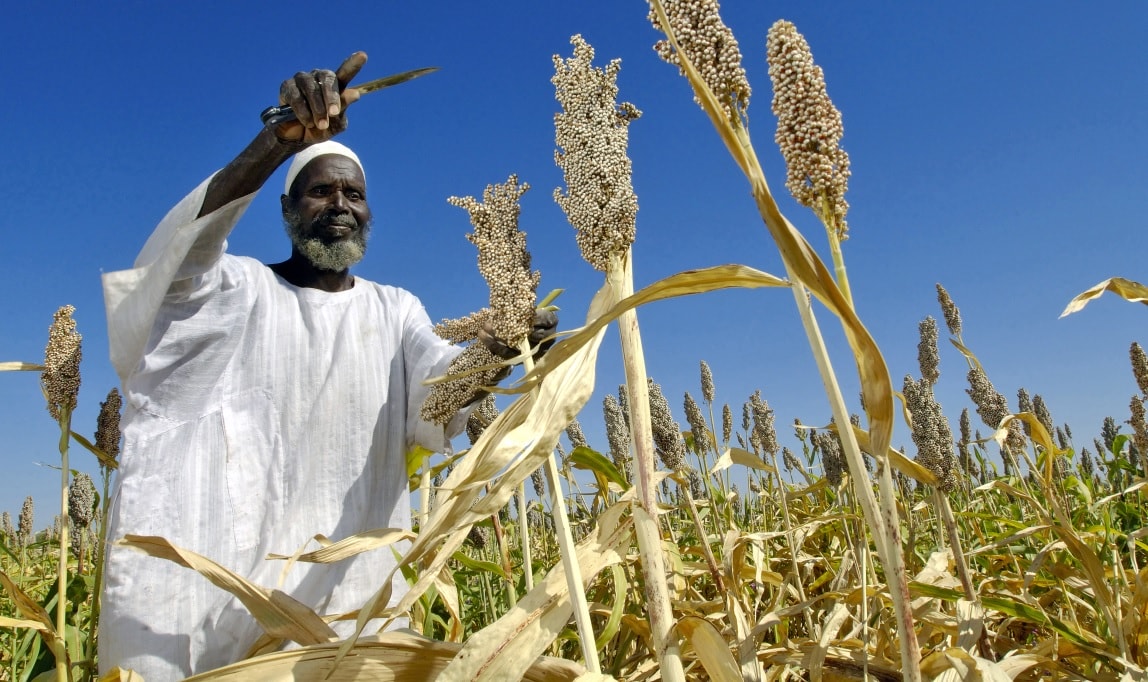
In the cover photo: Farmer Harvests Sorghum Seeds in Sudan – A local farmer harvests sorghum produced from seeds donated by the Food and Agriculture Organization (FAO) through the “Improving Seeds” project.11 December 2006 – Nyala, Sudan.(source UN / multimedia)
Part 1: FAO: A UNITED NATIONS AGENCY BORN WITH A DUAL PERSONALITY
Part 2: FAO: FROM A TECHNICAL TO A HIGHLY POLITICIZED AGENCY
Check also: WHAT’S WRONG WITH THE UN SECURITY COUNCIL