On Tuesday, June 21, five young people who have witnessed horrific consequences of the climate crisis filed lawsuits at the European Human Rights Court against 12 European governments for their part in the Energy Charter Treaty (ECT), an international trade agreement that protects energy investments by compensating oil and gas firms.
The claimants want their governments to exit the energy charter treaty, arguing that membership of the ECT is a dangerous obstacle to climate action.
Amidst the Gulf War and Soviet Union collapse, 55 countries signed the ECT in 1994 to protect their energy supply and investment in the energy sector, including Russia, Turkey, Switzerland, and the EU member countries at the time.
The ECT enables foreign investors to seek financial compensation from governments if changes to energy policy negatively affect their investments. Before an arbitration tribunal, corporations can request compensation from a state whose decisions affect the profitability of their investments.
Almost all European countries have been challenged under the ECT by investment funds or companies feeling they have been harmed by government decisions.
Last year, German energy giants RWE and Uniper filed lawsuits against the Netherlands to claim compensation of €1.4 billion over the country’s planned coal phase-out by 2030.
Almost 2/3 of the businesses advising the Energy Charter Treaty are misaligned with a 1.5°C energy transition in their policy advocacy.
New analysis from @InfluenceMap out today: #NoECT #ExitECThttps://t.co/hPUsA1JrJb
— CAN EUROPE (@CANEurope) June 20, 2022
The ECT has been increasingly criticised by environmental groups and governments who say it impedes countries’ efforts to phase out fossil fuels.
In response, the European Commission launched ECT reform negotiations in July 2020, but little progress has been made since ECT amendments require unanimity among the charter’s 52 signatories.
A growing number of EU governments, including France, Germany, the Netherlands, Poland, and Spain, have expressed doubts that the EU can fulfil its mandate of aligning the ECT with Paris Agreement targets on climate change. The countries have all consequently signalled their willingness to withdraw from the treaty in order to meet the targets, inviting the Commission to assess how a coordinated withdrawal could be initiated according to EU procedures.
The Commission responded with calls for “modernisation” amendments to be made to the ECT. Leaked cables however reveal that Japan and Azerbaijan have been significant obstacles to these negotiations, resisting changes to the definition of “economic activity” so as to keep fossil fuel investments protected.
In response to the Commission’s calls for “modernisation” amendments to the ECT, the aforementioned countries who oppose the ECT (with France and Spain at the forefront) publicised that they instead favour an ECT “exit scenario,” believing the ECT will never be able to adapt to the Paris Agreement.
The first time the ECtHR has considered the Energy Charter Treaty
The five claimants sued the 12 ECHR member states who are signatories to the treaty and home to companies that have been active users of the ECT: Austria, Belgium, Cyprus, Denmark, France, Germany, Greece, Luxembourg, Netherlands, Sweden, Switzerland, and the UK.
They argued that, by observing a treaty they claim is inconsistent with the Paris Agreement, these countries’ ECT membership violates the right to be protected against decisions endangering life (Article Two), and the right to respect for private and family life (Article Eight) in the European Convention on Human rights.
The claimants stressed that the ECT gives fossil fuel companies the power to sue governments for billions of euros in compensation over their climate policies through private arbitration tribunals that are democratically unaccountable.
All five plaintiffs have in common their experiences of natural disasters fuelled by climate change.
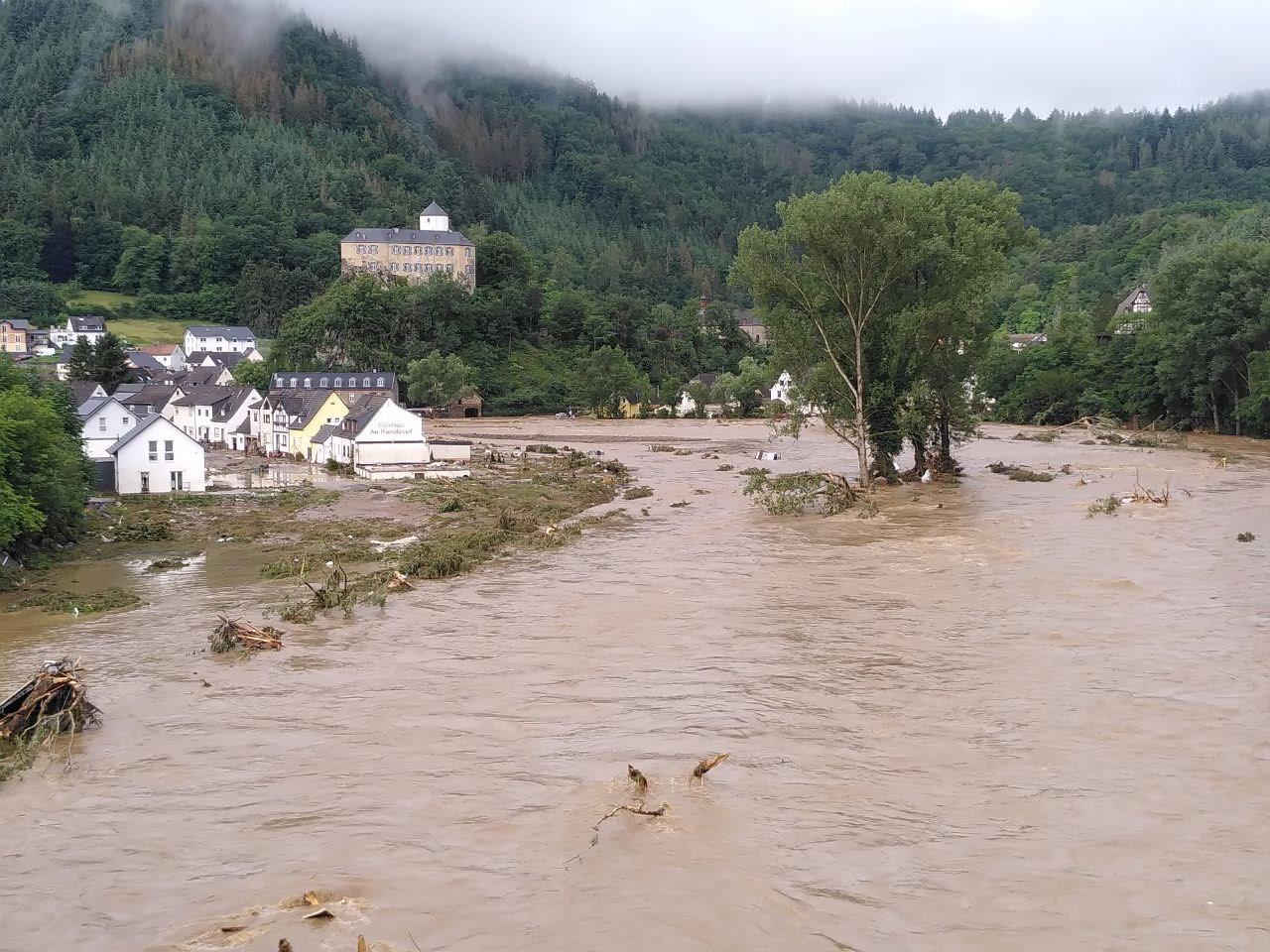
Julia, a 17-year-old from Germany, experienced the lethal flooding of the Ahr Valley in July 2021. She says:
“It just can’t be that the fossil fuel industry is still more protected than our human rights […] So that’s why I decided to join this legal action, to fight against the energy charter treaty still protecting the fuel industry.”
Damien, a 23-year-old Belgian national living in Chaudfontaine, which was severely affected by the floods of July 2021, said:
“I saw entire parts of my life vanish by the floods last year, neighbourhoods have been destroyed, and four people lost their lives […] The sound of water or rain makes me nervous. At the slightest rainfall or information about similar disasters, the fear returns.”
Alexandros, a 21-year-old student, experienced two forest fires in Greece in July 2021 and in 2018.
“We are under constant threat and uncertainty about our future. I feel stressed. Whenever I see pine trees under the sun, I get scared of a fire.”
There is also Maya, at 19, who said she “lost her childhood” when Hurricane Irma devastated St. Martin in September 2017, and Marion, who is 31 and who experienced the violent flash floods in Cressier, Switzerland, in June 2021.
The claimants’ lawsuit will hopefully increase support for an ECT exit strategy.
Legal action comes ahead of crucial ECT negotiations this week
On Thursday, June 23, the treaty’s Modernisation Group in the European Parliament and lawmakers will outline their red lines for the reform of the ECT to iron out last-minute disagreements.
The following day, on June 24, an ad-hoc Energy Charter Conference will take place in Brussels, convened by the ECT secretariat and attended by the treaties 52 signatories. The goal here is to agree on proposed reforms to phase out existing investments in fossil fuels over 15 years, and end investor protection by the end of 2040.
The Commission hopes that the states will agree on these arrangements and announce a political agreement to reform the charter.
But exiting the ECT is the only climate-viable option, activist say
Campaigners fault the compromise proposal, which they see as trying to placate countries that want to protect fossil fuel investors, like Japan.
ECT whistleblower Yaminah Saheb says the ECT is a real threat to the Paris agreement as it would allow companies to sue governments for an estimated €1.3tn until 2050 in compensation for early closure of coal, oil and gas plants – sums that would significantly endanger the green transition.
Friends of the Earth Europe campaigner Paul de Clerck shares these views. “The climate-action killer ECT can never be made compatible with the Paris Agreement and the European Green Deal,” he said.
On Tuesday, 76 climate scientists also sent EU leaders a letter stating that continuing to protect fossil fuel investors under ECT rules would prevent the closure of fossil fuel plants or ensure huge compensation payouts if shutdowns went ahead. The letter calls for the EU to work towards a withdrawal of member states from the treaty.
The significance of the young people’s challenge
The lawsuits filed on Tuesday provide another example of people going to court over governments affecting their “right to life,” as in the People vs Arctic Oil case initiated in the ECtHR in January 2022.
Back then, young Nordic environmental activists similarly filed an application claiming that Arctic oil drilling would violate Articles 2 and 8 of the European Convention on Human Rights by increasing harm due to climate change, and making it impossible for Norway to meet its Paris Agreement obligations.
Such cases being accepted for ECtHR deliberation sets an important precedent for people, mostly the young, to be able to hold their governments accountable for destructive environmental policies. This reflects the battle against climate change increasingly turning into a legal one.
For now, let’s hope that Friday’s meeting sees support for a clear ECT exit strategy, which would help the EU green deal and climate neutrality target, unlike an approval for ECT “modernisation,” which will likely do the opposite.
Editor’s Note: The opinions expressed here by Impakter.com columnists are their own, not those of Impakter.com. — In the Featured Photo: Ahr Flood in Altenahr, Germany, July 2021. Featured Photo Credit: Wikimedia Commons.