
We have seen unprecedented improvements in welfare in the past two decades. Global poverty rates are considerably falling, the number of out-of-school children was reduced by over 40%, and child mortality has dropped by 60% since 1990. However, the opposite trend is observed when it comes to the environment. Alarming levels of carbon dioxide are constantly being emitted globally, more than $5 trillion was spent to subsidize the exploitation of fossil fuels in 2020, and consumption levels are beyond the planet’s limits.
The good news is that there is a solution that allows us to keep on building a thriving global economy while reducing harm to the environment: transforming the workforce and its skills.
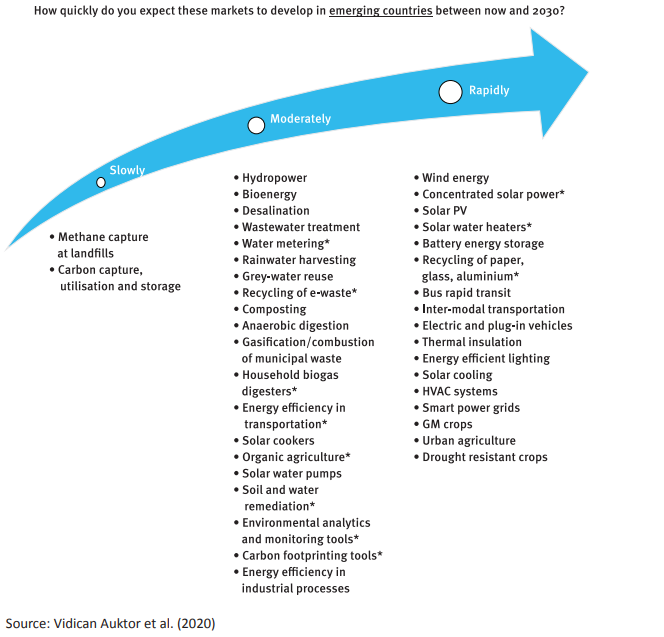
Reskilling and upskilling the workforce through skills development programs is key for a successful green transformation, especially since many green technologies are expected to expand moderately to rapidly in emerging economies (see the picture below). To meet such demand, it is crucial that workers have the appropriate skills.
The changes in workforce and skills are already happening. For example, according to the Green Skills Report 2022, the number of jobs in the United States in the renewables and environment sector has increased by 237% in the last five years, whereas oil and gas jobs have only grown by 19%.
“We expect to see millions of new jobs created globally in the next decade driven by new climate policies and commitments,” said LinkedIn CEO Ryan Roslansky. And indeed, green talent in the workforce is rising globally. A growth rate of 38.5% was detected, from 9.6% in 2015 to 13.3% in 2021. Additionally, 18 million more jobs will result from achieving the Paris Agreement’s 2°C goal.
Related Articles: The Skills for the Green Economy: Upskilling for a Sustainable Future | How Can Digital Skills Nurture Social Inclusion?
The numbers indicate that a green transformation through reskilling and upskilling the workforce is already underway. The question, however, is how do we encourage and accelerate the development of the skills needed for the green transition?
Guidelines for effective green skills development programs
UNIDO’s Learning and Knowledge Development Facility (LKDF) recommends specific guidelines for increasing the effectiveness of green skills development programs. Such guidelines are not only relevant for the public sector’s developing strategies, but also for the private sector which plays a central role in the green skills development process. These are:
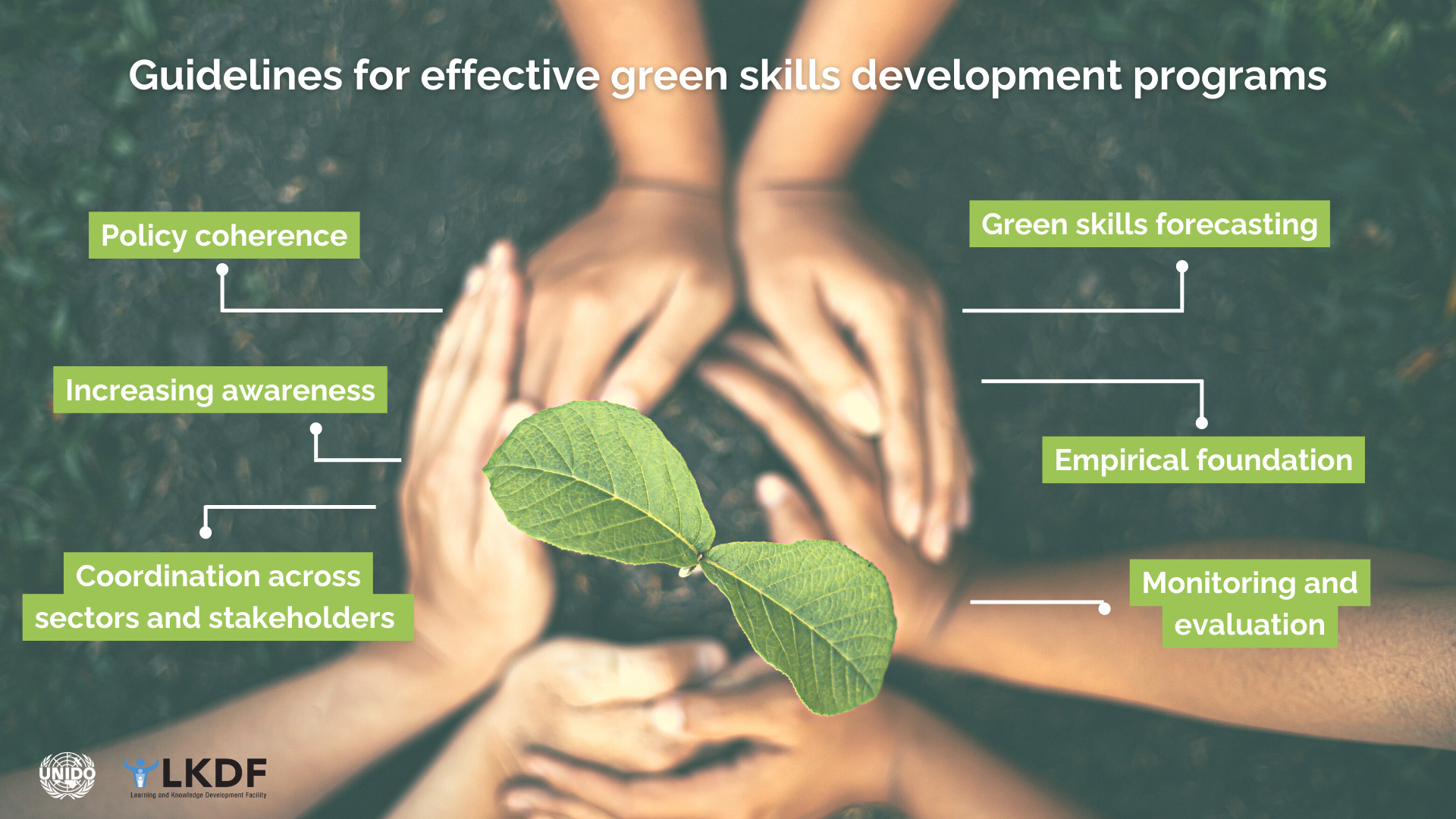
- Policy coherence between green skills development programs and other goals: Through a systematic process of stakeholder consultations, policy coherence between green skills development initiatives and other policy goals may be achieved. However, it is even more critical to ensure policy coherence among ministries, industry associations and firms, training and education institutions, civil society, and other stakeholders. To assure that policies implemented contribute to green jobs, enhance skills in green occupations, and are aligned with market needs, a structured process of stakeholder discussions is crucial.
- Solid empirical base for green jobs and green skills: A strong empirical foundation is required for well-informed policy. Policymakers should collaborate with the private sector and prioritize the creation of comprehensive labour market information systems, agree on definitions, and use systematic mechanisms to identify where green jobs are (which sectors and types of occupations) and what skills are currently required.
- Green skills forecasting: Anticipating future skills development demands significant capacities in forecasting green technology markets at the global and national levels, as well as commenting on such trends in light of existing local capabilities. The public and private sectors must work together to develop capacity for conducting needs assessments and to financially support such initiatives.
- Coordination of goals and interventions across sectors and stakeholders: Without comprehensive coordination and consultation across ministries with private sector actors (i.e. industry associations), trade unions, workers, education and training institutions, and societal groups, none of the above objectives would be accomplished. Given the cross-sector nature of green jobs, conversation and cooperation are even more vital in this setting than in more typical skill development initiatives.
- Increasing awareness on sustainability issues related to production and consumption of goods: Such activities are critical at all levels of education because they help to change behavior and generate demand for green technology and procedures.
- Monitoring and evaluation: Monitoring of inputs into skills development programs is just as crucial as monitoring of outputs. Since the labor market is always changing, not only due to economic fluctuations, but also due to rapid changes in technological development and dissemination, policy actions must be regularly monitored and calibrated/adapted.
Editor’s Note: The opinions expressed here by Impakter.com columnists are their own, not those of Impakter.com — In the Featured Photo: Workers at a windmill farm. Featured Photo Credit: Shutterstock.