

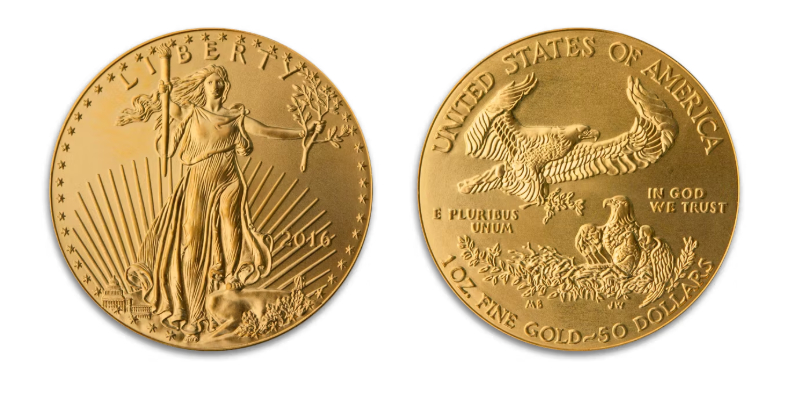
Picture handing a cashier a gold coin stamped “50 Dollars” for your groceries. Technically, it’s legal tender, so the math checks out. In reality, it’d be one of the worst trades imaginable, since a dealer down the street would happily pay thousands for it.
That gap between the number on the coin and what it trades for confuses plenty of first-time buyers. It feels like a typo or a trick, but there’s a clear logic behind it. The stamped figure and the real value answer two different questions.
The 1 oz American Gold Eagle is the perfect coin for unpacking this puzzle. Struck by the U.S. Mint since 1986, it’s one of the world’s most popular gold coins, and its humble $50 label hides a value driven by the metal inside.
Why the Government Puts a $50 Value on Something Worth Much More
Every Gold Eagle carries a face value because Congress made it official legal tender through the Gold Bullion Coin Act of 1985. That status puts government backing behind its weight and purity, which is a big reason buyers worldwide trust it without hesitation.
The $50 figure, though, was never meant to track gold prices. It’s a symbolic number that stays fixed while the metal’s value moves every day. If the Mint tried to match the two, it’d be stuck in an endless game of catch-up.
That’s the difference between bullion coins and everyday cash. A twenty-dollar bill is worth twenty dollars because the government says so. A Gold Eagle is worth whatever its gold commands, and the face value works more like a signature than a price tag.
The Gold Inside Is What Really Matters
Each one-ounce Gold Eagle contains exactly one troy ounce of pure gold, guaranteed by the U.S. Mint. That’s what drives its value. Everything else, from the design to the denomination, plays a supporting role next to that ounce of metal.
The composition surprises some people. The coin is struck in 22-karat gold, meaning it’s about 91.67% gold blended with silver and copper. Those extra metals make it tougher and more scratch resistant, so the coin weighs a bit over an ounce, around 1.09 troy ounces.
Because the gold content never changes, the coin’s value rises and falls alongside the spot price of gold. Check the market any morning, multiply by one ounce, and you’ve got the starting point for what an Eagle is worth before premiums enter the picture.
Why Two Identical-Looking Gold Coins Might Sell for Different Prices
Shop around and you’ll notice two lookalike Gold Eagles can carry different price tags. The biggest reason is the dealer premium, the amount added above the gold’s melt value to cover minting, distribution, and the seller’s costs of doing business.
Condition and availability matter too. A bright, unblemished coin usually sells for more than one with spots or scuffs, and premiums often climb when demand surges and supply tightens. During buying frenzies, even common coins can cost noticeably more than usual.
Then there’s the collector factor. Most Eagles sold as bullion, often with dates that vary, are valued mainly for their gold. Certain lower-mintage years, proof versions, and professionally graded coins in top condition can draw collectors and command more than their metal alone suggests.
What Happens When Gold Prices Rise or Fall?
Gold prices move constantly, reacting to inflation worries, interest rates, currency shifts, and global uncertainty. When the price climbs, a Gold Eagle becomes more valuable without its owner lifting a finger. When it dips, the coin’s market value slips along with it.
Through all of that, the $50 face value stays exactly where it is. It doesn’t care whether gold is soaring or sagging. That fixed number sits so far below the market price that it’s practically irrelevant for anyone buying or selling these coins.
That’s part of the appeal for people who want to hold something tangible. Its purchasing power comes from the gold, not the stamped denomination, so it tends to follow the metal over time. Like any investment, though, there’s no guarantee about where prices go next.
Conclusion
The Gold Eagle proves that the number stamped on a coin doesn’t always tell the whole story. Its $50 face value gives it official legal-tender status and government backing, but that figure was never designed to reflect what the coin is worth.
The real value comes from a full troy ounce of pure gold, shaped into a 22-karat alloy built to last. Add dealer premiums, condition, supply, and occasional collector appeal, and it’s easy to see why prices can vary so much from coin to coin.
So the next time you spot a gold coin labeled $50, remember it’s playing by different rules. The market price of gold does the heavy lifting, which is why a coin with such a modest denomination can quietly be worth thousands.
Editor’s Note: The opinions expressed here by the authors are their own, not those of impakter.com — In the Cover Photo: A 2016 American Gold Eagle displays a $50 face value despite containing one troy ounce of gold worth substantially more.. Cover Photo Credit: blanchardgold.com