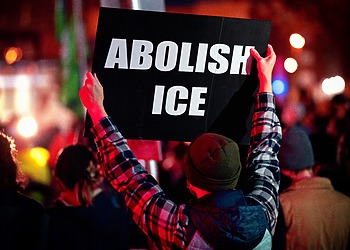
There are increasing numbers of protests in cities across the United States, triggered by the Trump Administration’s deportation pronouncement, policies, and hardhanded arrests by U.S. Immigration and Customs Enforcement agents (ICE).
On June 7, President Trump announced that he would be deploying 2,000-4,000 National Guardsmen to Los Angeles, California. He claimed that local officials had failed to deal with the unrest. Governor Gavin Newsom called this action “purposefully inflammatory,” saying it would escalate tensions and that it is “the wrong mission” that will “erode public trust.”
Another new separate policy pronouncement having the potential to generate widespread protest is the application by Homeland Security Secretary Kristi Noem to end a Biden Administration permission for over 500,000 individuals from Cuba, Haiti, Nicaragua, and Venezuela to live and work in the United States temporarily. The U.S. Supreme Court approved the application.

The 3.5% Rule
The “3.5 rule” is a set of conclusions from research conducted by Erica Chenoweth and Matthew Stephan, authors of “Why Civil Resistance Works.” They reviewed historical data and found support for the notion that a government could not successfully withstand a challenge when 3.5% of its population actively mobilized against it. Further, comparing violent to nonviolent approaches, they found that violence tends to breed further violence and that nonviolent strategies are often more inclusive, allowing for greater solidarity among diverse groups.
Nonviolent protests can appeal to a broader range of individuals, people who may be empathetic to the cause but unwilling to engage in or support violence. Nonviolent strategies are also better able to undermine the narratives that regimes often utilize to justify crackdowns on dissent.
By portraying demonstrators as violent or aggressive, regimes will seek to galvanize public support against them. Nonviolent movements can challenge such narratives by showcasing their purpose and commitment to peaceful change.
Those now engaging in protest or planning to protest in the future could take into account past experience in choosing between violent and non-violent protests.
Past Examples
The U.S. civil rights movement in the 1950s and 1960s was led by figures such as Martin Luther King Jr., who championed nonviolent tactics such as boycotts, sit-ins, and marches. The commitment to peaceful protest widened and substantially shifted public opinion, which resulted in legislative changes, including the Civil Rights Act of 1964, and indeed, there is a statue of Dr. King on the U.S. National Mall.
Another example is the anti-apartheid movement in South Africa, whose success was largely due to nonviolent strategies employed by Desmond Tutu and Nelson Mandela. They emphasized conversation, boycotts, and peaceful protests to confront systemic inequalities. Their approach built a significant domestic coalition and was also able to garner international support, which pressured South African leadership and ended Apartheid rule.
In India, Mahatma Ghandhi led several peaceful protests that encompassed “Satuagraha,” a philosophy of nonviolent resistance emphasizing truth and love-force over violence. One of his most famous was the Salt March, which protested the British monopoly on salt production and taxes.
There are other examples in the last several decades where authoritarian, corrupt leaders have been removed in the Philippines, Brazil, and South Korea by peaceful protest and an independent judiciary.
That said, the 3.5% rule’s underpinnings are basically a qualitative analysis. Like most rules, it has exceptions and critics. Protesters in Brunei in 1962 mobilized 4% of the population but failed to succeed; Bahrain’s nonviolent movement from 2011 to 2014 also failed despite having considerably more than 3.5% popular participation, leastways at its peak.
Although immigration is a different kind of challenge from those referred to, which were for equal treatment of citizens or national independence, it has much in common with them. Similarly, the complexities surrounding immigration issues also involve many voices: citizens, immigrants themselves, activists advocating for a more inclusive and humane immigration policy — and their opposite numbers, e.g., those strongly resistant to immigration.
Both sides have been capable of generating protests ranging from grassroots movements advocating for or against immigrant rights to large-scale demonstrations involving thousands, and in some cases, even hundreds of thousands.
The Key is Building Coalitions
Immigrant rights protests have shown they have the most potential when they connect with a broader audience. For instance, by linking immigrant rights with worker rights, private sector interests such as agriculture, racial justice, and social equity, such a movement is better able to cultivate a more comprehensive framework, one that resonates with many.
In sum, when individuals and groups recognize shared interests and struggles, a readiness to act together is heightened when the tactics employed are nonviolent.
Related Articles: Kill the Bill Protests: Is Shaming the Most Skillful Response to Violence? | Western Democracies Increasingly Prosecuting Peaceful Climate Activists, Report Says
The Power of Social Media
Social media and technology now play an instrumental role in shaping nonviolent protests, enabling them to reach larger audiences more quickly. Platforms like X, Instagram, and Facebook allow activists to organize rallies, disseminate messages, and build coalitions across geographical boundaries, mobilizing support for immigration protests.
These social media tools are ways to tell stories, thereby amplifying the voices of immigrants, their families, and marginalized communities. Sharing personal experiences humanizes complex immigration issues and encourages empathy and understanding within the public sphere. The viral nature of social media amplifies these narratives, engaging individuals who may have initially felt detached from the issues, and thereby expanding the participant base of the nonviolent movement.
The case of an illegal immigrant, Kilmar Abrego Garcia, who was mistakenly deported by the Administration to a maximum-security prison in El Salvador, captured nationwide attention, ultimately pressuring the Trump Administration to bring him back, after it was ordered by the Supreme Court to facilitate his return. The constant multimedia reporting on this case has had ramifications beyond Garcia himself.
Challenges to Nonviolent Movements
A very potent weapon to undermine nonviolent protests, relating to movements, immigration or other subjects, has been the drumbeat of opposition misinformation by private and public networks, welcomed by those in power and their enablers to hinder wide-scale participation.
This presents a major challenge for advocates of immigration, a subject as to which attitudes are often influenced by stereotypes, fear, and economic misconceptions that become deeply entrenched.
Nonviolent Protests Can Succeed
The 3.5% rule underscores the power of collective, nonviolent action to drive societal change. For those protesting governmental immigration policies in the United States, fostering coalition-building, utilizing technology, sharing narratives, and embracing inclusive approaches can be the means to gain wider popular understanding of the benefits of immigrants and their rights provided by the Constitution and laws passed by the Congress.
Assuring immigrants of their rights and place in the United States is essential if we are to realize a more just and equitable society; indeed, if we are to “Make America Great Again.”
Editor’s Note: The opinions expressed here by Impakter.com columnists are their own, not those of Impakter.com — In the Cover Photo: California National Guard in front of protestors, June 9, 2025. Cover Photo Credit: Wikimedia Commons.