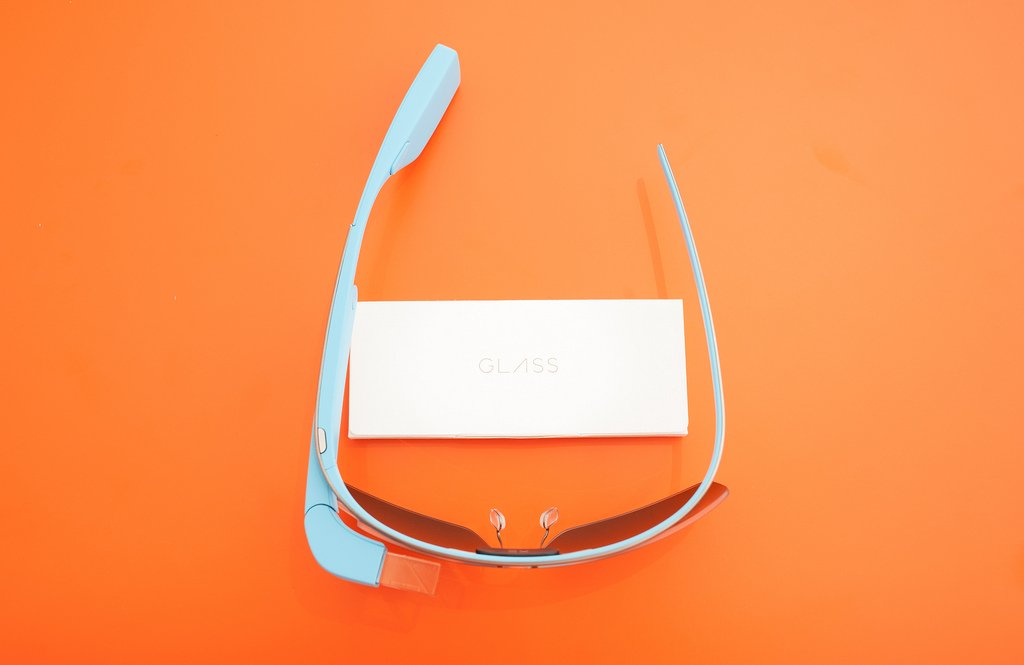
With the release of the Apple Watch, wearable technology is back on the forefront of people’s minds after the debacle that was the release of Google Glass. Will it be another remarkable success among the storied successes of the iPod, iPhone, or iPad? That remains to be seen. But both these giant’s forays into the wearable tech world make a very important point: wearable technology is the future.
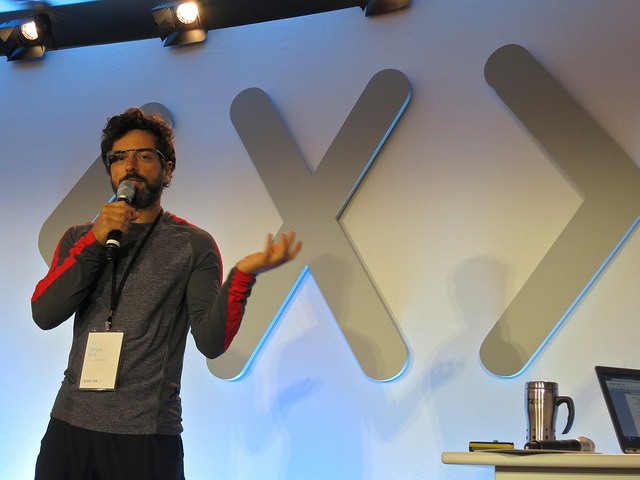 In the photo: Sergey Brin Solves for X sporting Google Glass – Photo Credit: Steve Jurvetson
Although Google Glass could be seen as a failure, in no small part because of a questionable marketing and release strategy, it still had and still does have a lot of potential, if the rumors that Google is working on Glass comes into fruition. Wearable glasses are remarkable because they achieve what only used to be a common euphemism, “look through someone else’s eyes”. This used to be impossible, but now with the leaps and bounds wearable technology is making, it has become a reality. For one example, a start-up called Pristine’s platform on Google Glass would allow a remote expert to see what, say a nurse or EMT, can see. This is remarkable. The most trained individuals would be able to provide expert medical advice no matter the location. Of course, this applies to other fields too.
Tech support has achieved a notorious reputation for not being able to properly assist the customer. This is a result of many factors. Customers have a hard time explaining their technical difficulties, and therefore, tech support workers have a difficult time providing appropriate advice. It can all be resolved simply through wearable technology. Tech support could easily connect to your Google Glass and lead the customer through his/her problems. Many headaches will be avoided. The opportunities that wearable technology like Google Glass can provide are endless.
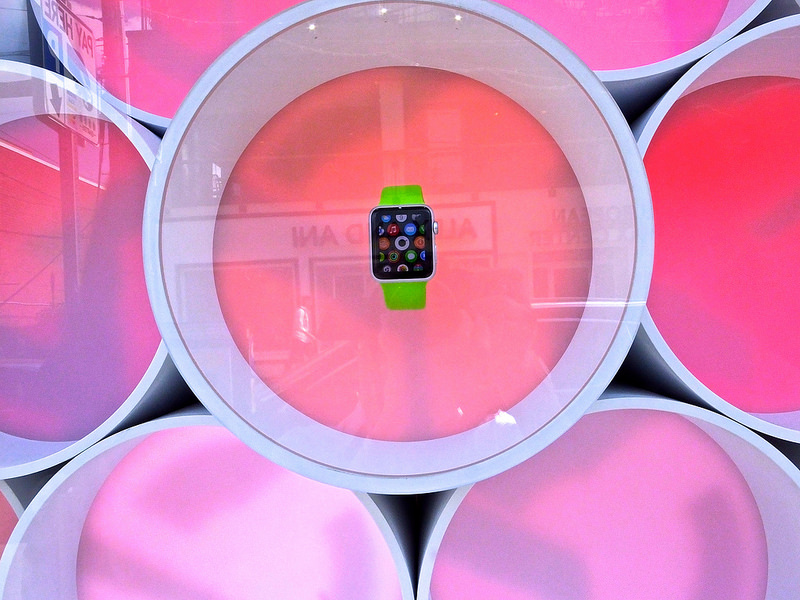 In the photo: Window display at the Apple Store in Shadyside – Photo Credit: Cam Miller
Most recently, the media has been taken by the craze of the latest Apple product, the Apple Watch. Having the power of an iPhone on your wrist is amazing. Although it is not likely to replace phones completely, wearable watches have the potential of becoming ubiquitous. While the Apple Watch has many of the same functions as an iPhone, it also has many healthcare applications.
It is a fact that the current version of the Apple Watch does not have too many applications, yet the potential for a revolutionary system that will monitor your health exists. Imagine going to the doctor, and your doctor asks, “How often do you exercise?” The tendency to lie exists perhaps because of embarrassment. Another problem may be that people do not get consistent exercise that they can track, but they get sporadic exercise. This exercise adds up, yet it is relatively hard to track. How can a person report this to his or her physician? Well, the answer is here, on the watch. Imagine that the doctor can just obtain this information from your watch (privacy concerns still exist and these will need to be debated further in future). The watch will not lie, and this is good. With clear and accurate information, the physician can make more accurate assessments of someone’s health and give more reliable recommendations to improve one’s health.
This is where the Apple Watch is currently at. But improvements can be made. Imagine an Apple Watch that could monitor blood glucose levels. What if the Apple Watch could record your sleeping patterns?
The possibilities are endless as are the pitfalls.
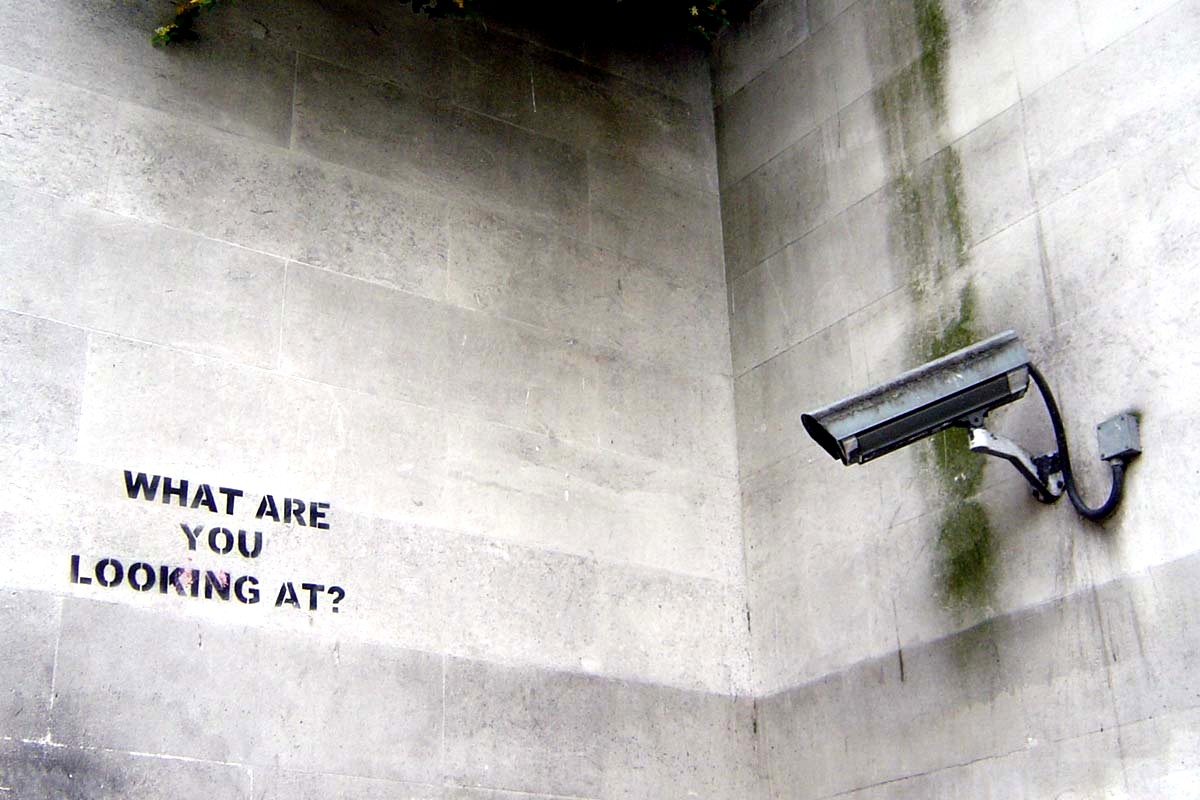 In the photo: Stencil by Banksy (2005, London ) – Photo Credit: nolifebeforecoffee
Recently with the revelations that NSA was spying on U.S. phone calls, people are debating more and more about privacy in an age where people are being more connected. That such issues come up is to be expected. The more you connect with something, less is available in the realm of privacy. By having multiple social media accounts, people make personal information available to everyone, sometimes without realizing it. Look at the Facebook burglary rings. This information can be used to break into someone else’s homes. Employers are using this information to vet job applicants. As is evident, this social media has allowed people to connect with people they want to…and some people they don’t. However, there is a difference between proudly advertising your vacation in the Bahamas, and a malfunction accidentally allowing hackers access to your personal health information. Health information is still something that people feel they need to keep private, and laws have upheld people’s rights to keep their health private. So although wearable tech has potential for great benefits to humankind, it also poses risks.
Google Glass poses risks in another way. In an age where people everywhere are being watched, people are concerned about the overt but also clandestine way Google Glass may record people in private.
………………………………………………………………………………………………………….. Related articles : PASSIONS, INTERESTS AND SOCIALMEDIA article by Claude Forthomme TRAVEL BOOKING DISRUPTION – YONDERBOUND CEO INTERVIEW article by Ingrid Malpartida …………………………………………………………………………………………………………..Again, it is important to note that we already live in an age where everything we do is monitored. There are cameras everywhere. The government may listen to our phone calls. We can barely walk anywhere without some camera that we may not notice tracking our movements. The reason Google Glass was feared was because it was so overt. No one bats an eye when a city government puts cameras on street corners. However, when a private citizen has the potential to record something in public, people get paranoid. This fear might be because people expect the government to have a higher standard of integrity than the average citizen.
The recent NSA issue has proven that we are all human, whether we are in government or not, and therefore, we are all flawed. Or maybe people honestly believe that cameras on every street corner will keep them safe. The point being made is that we as a society already live in a world where our reasonable expectation of privacy has changed.
It is hypocritical to be against technology such as Google Glass while still accept all the other ways Big Brother, as George Orwell says, has taken over our lives.
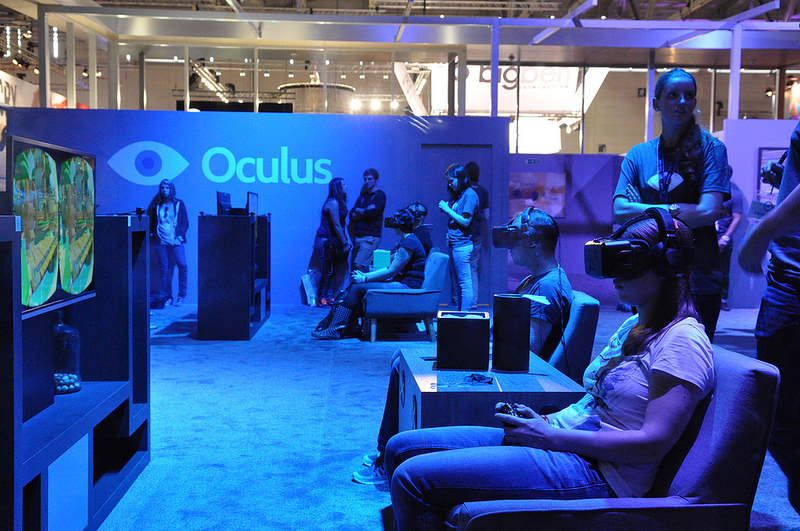 In the photo: Oculus Rift @ Gamescom 2014 – Photo Credit: Marco Verch
Technology is progressing at an amazing rate. Unfortunately, our discussions and thoughts on how technology affects our lives lag behind. We need to start having a conversation based on realistic expectations of what technology brings and petition for laws that more accurately reflect the technological world we live in today, rather than the now archaic world of years passed.