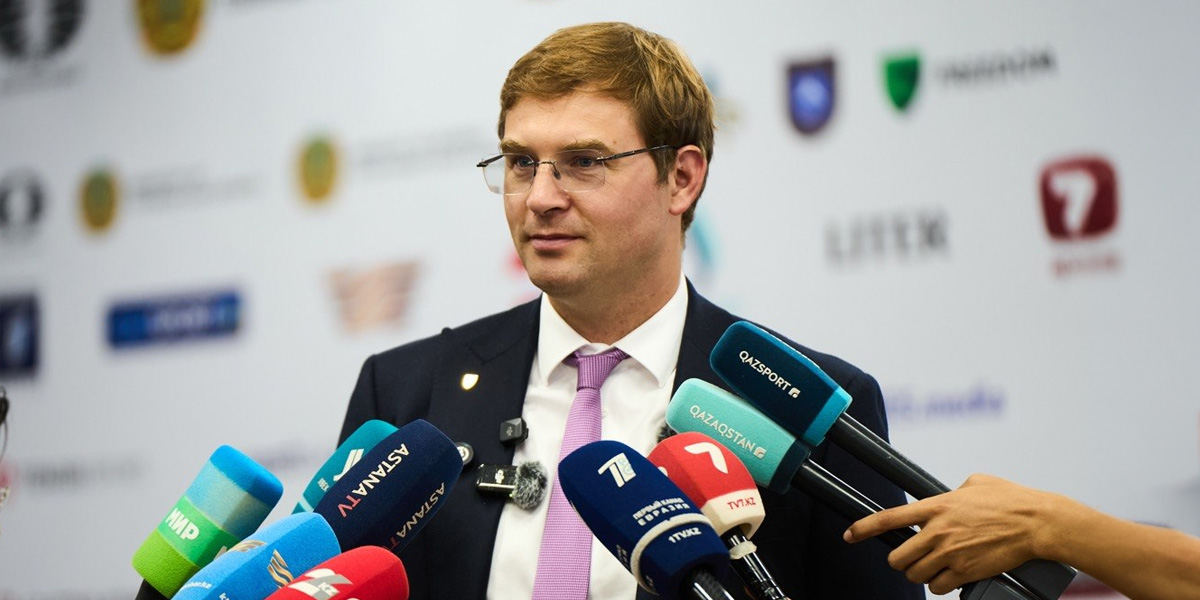
Timur Turlov, founder and CEO of Nasdaq-listed Freedom Holding Corp., believes the future of digital finance will belong to a small number of global platforms capable of offering the best technology across multiple markets. In an interview, he explains why Freedom sees Revolut as both a benchmark and a competitor, where he believes his Kazakhstan-built ecosystem can go further, and how the group plans to take that model beyond Central Asia. With banking and brokerage businesses expanding from Türkiye and Tajikistan to Europe, Turlov’s ambition is to turn Freedom Holding from a regional fintech ecosystem into a global financial platform.
“I believe we can compete with Revolut. We learn a lot from them, but there are also many areas where, in our view, we have gone even further,” Turlov told this news service. For Freedom, he says, having a strong competitor also provides a useful point of reference: “You don’t necessarily have to do something that nobody else is doing. I think it’s great that there are strong companies we can learn from and that give us a sense of direction, something to aspire to.”
Why Freedom Compares Itself With Revolut
Revolut was founded in the United Kingdom in 2015 and, over the following decade, evolved from a foreign-exchange and money-transfer service into a global financial platform. By the end of 2025, the company served 68.3 million retail customers, and by August 2026 it reported more than 75 million users. Revolut’s revenue rose 46% in 2025 to $6 billion, while profit before tax increased 57% to $2.3 billion. Net profit totaled $1.7 billion, according to the company’s annual results.
The two companies remain very different in scale, but their growth strategies follow a similar logic: both want their apps to become the primary place where customers manage their finances, while also expanding their banking presence. In the first quarter of Freedom’s 2027 fiscal year, which ended June 30, 2026, net revenue increased 40% year over year to $732.5 million. Brokerage revenue rose 60%, banking revenue increased 54%, and total assets reached $14.05 billion, according to Freedom Holding Corp.’s quarterly report.
Licenses as Infrastructure for Expansion
The similarities are particularly visible in the companies’ banking strategies. In March 2026, Revolut launched a fully operational bank in the United Kingdom, and on August 10 it received a full banking license in France. The company plans to use its French entity as one of its hubs for Western Europe, according to a Revolut announcement.
Freedom Holding, meanwhile, is expanding both by applying for new banking licenses and by acquiring existing banks. In June 2026, the holding company applied for a banking license in France and announced plans to invest €500 million there as part of its broader international expansion.
On July 31, 2026, Freedom Holding Corp. completed its acquisition of a 99.32% stake in Turkish Bank A.Ş. The bank is expected to become Freedom Bank A.Ş., according to the company’s announcement. A few weeks later, Freedom secured a Turkish brokerage licence.
In Tajikistan, Freedom’s digital bank has been operating since October 2025. In Georgia, the group has received approval to establish a bank.
The appeal of a banking license goes well beyond prestige. Oliver Wyman analysts cite reduced dependence on partner banks and greater control over products as two reasons fintech companies seek banking licenses. A license can also lower funding costs by giving fintechs access to customer deposits and eliminate fees paid to sponsor banks, although it brings stricter capital, compliance, and risk-management requirements, according to an Oliver Wyman study.
Going to Be Like Google
At the heart of the strategy is a bet that digital banking will become increasingly global. “Google is used all over the world, and 70–80% of all AI inference is handled by one or two companies. I am convinced the same thing will happen in digital banking. People around the world will use the best technology. Nobody will need the best bank in Kazakhstan, USA or Europe – what will matter is the best bank in the world,” Turlov says.
In this context, the comparison with Revolut is less a claim that the two companies are currently equal in scale than a statement of Freedom’s ambition. Revolut has already demonstrated that a digital financial product can scale far beyond its home market. Freedom is now trying to prove that a financial ecosystem built in Central Asia can also be successfully exported to other markets.
From a Bank to an Ecosystem
Timur Turlov says Freedom’s key differentiator lies not in the number of features available in its app, but in how deeply developed its individual services are. “We didn’t simply add a range of products to the SuperApp; we made those products market leaders. People come to the SuperApp not just for cashback but for the services themselves. Airline ticket sales have become a major driver for us, one of the reasons customers choose us,” he says.
The Freedom SuperApp brings together banking, brokerage, investment, insurance, payment, ticketing, travel, and e-commerce services. In Kazakhstan, the ecosystem includes Freedom Bank, Freedom Broker, Freedom Life, Freedom Insurance, Arbuz.kz, Ticketon, and Aviata, according to a corporate release.
“What Will Matter Is the Best Bank in the World”
For Timur Turlov, the ultimate goal is not to build a collection of local banks operating under the same brand, but to create a technology platform that can be replicated across markets.
“I don’t want to build a holding company that has the same name in every country but operates different businesses. That would not create the synergies we are aiming for. I want the Freedom SuperApp we built in Kazakhstan to be rolled out in other countries, so that we can export the entire technology platform to markets such as Türkiye, Pakistan and Georgia, as well as countries across Europe,” he says.
According to Timur Turlov, the team is trying to “package” its automated banking system, card-processing infrastructure, accounting systems, and loyalty program into a ready-to-deploy solution, with individual modules adapted to meet each local regulator’s requirements. The goal is to bring a unified technology product to new markets.
Editor’s Note: The opinions expressed here by the authors are their own, not those of Impakter.com — In the cover: Freedom Holding CEO Timur Turlov discusses the company’s global expansion strategy, its growing digital banking ecosystem and its ambition to compete with platforms such as Revolut. — Photo Credits: Freedom Holding Corp