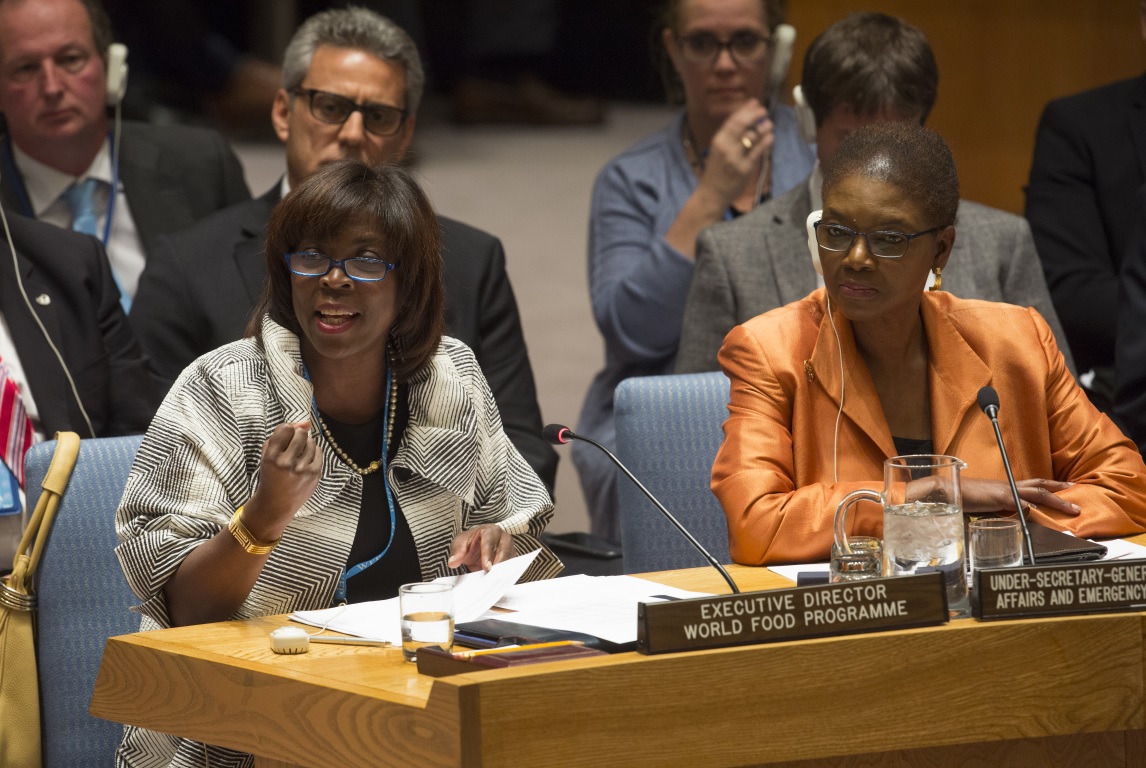
World Food Programme, Executive Board, 25 May 2015. This was a memorable day – the WFP Executive Director, Ms. Ertharin Cousin, made a highly remarked opening address, exclaiming: “the United Nations is 70 years old this year, it needs a reset!” And her guest of honour, Mr. Staffan de Mistura, the UN Special Envoy to Syria, described his job as “mission (nearly) impossible”.
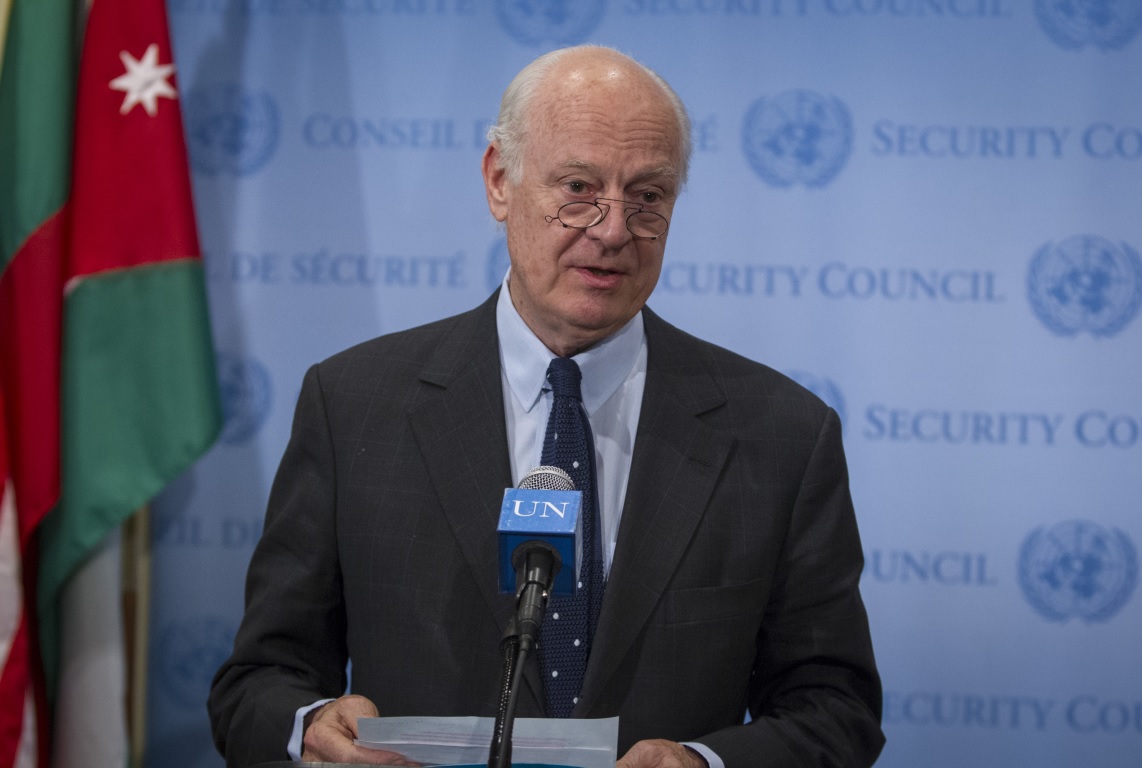 In the photo: UN Special Envoy for Syria Briefs Press Staffan de Mistura, Special Envoy of the Secretary-General for Syria, speaks to journalists, following closed-door Security Council consultations on the crisis in Syria. 24 April 2015 United Nations, New York – Photo credit: UN Photo/Loey Felipe
First, Ms. Cousin’s speech. She listed for the Board (consisting of a number of delegates from member countries, designated on a rotating basis) the rising number of emergencies that WFP has to face. In 2014, there were eleven high-level emergencies (classified as L2 and L3 in the UN jargon), an all-time high. Indeed, the WFP is set in principle to handle three high-level emergencies at any one time – not eleven.
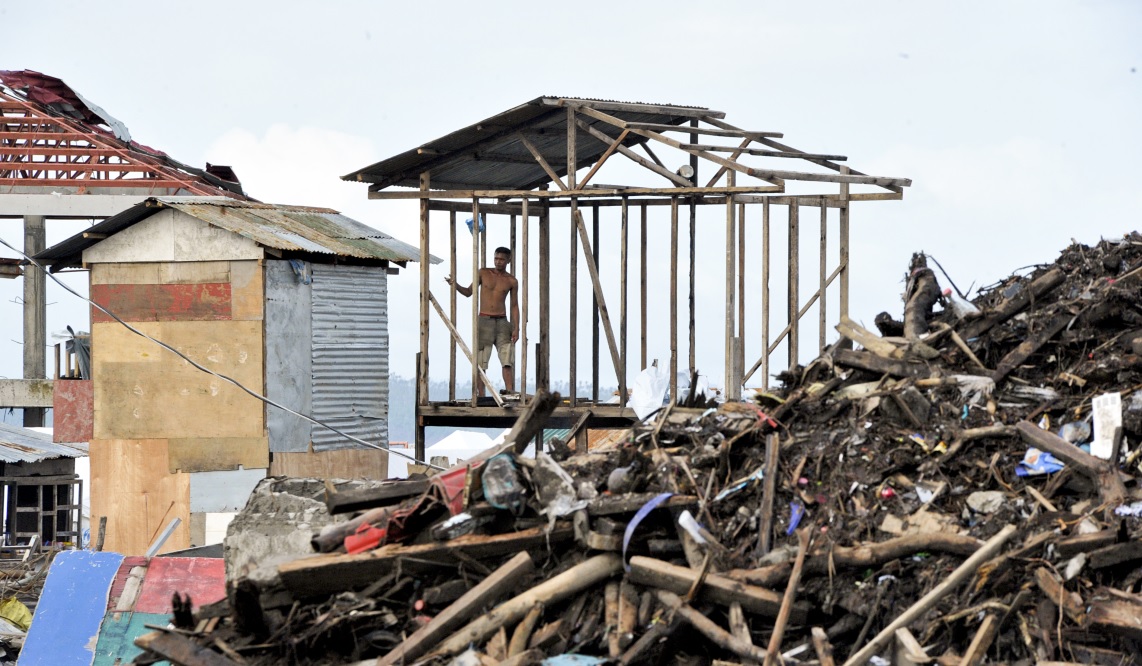 In the photo: SG Visits the Philippines, Assesses UN Relief Efforts Secretary-General Ban Ki-moon visited Tacloban City, in the Leyte Province of the Philippines, to assess the relief and rehabilitation efforts for the survivors of Super Typhoon Yolanda/Haiyan. A resident of Tacloban surveys the damage and debris left by the storm. – Photo credit: UN Photo/Evan Schneider
Why is this happening? In recent years, the number of emergencies around the world has been rising exponentially, and Ms. Cousin mentioned some of the major ones: Somalia (armed rebels and famine), Yemen (war and famine), Iraq (armed rebels), Libya (armed rebels), Syria (civil war), Central America (drought), Nepal (earthquake)…The list is endless and for two or three emergencies that end quickly (like typhoon Haiyan in the Philippines) others go on and on with no end in sight.
………………………………………………………………………………………………………….. Related articles : NEPAL – REACHING HIGHER TOGETHER article by Ertharin CousinSOUTH-SOUTH COOPERATION: THE PARNERSHIP article by Laurent Thomas
…………………………………………………………………………………………………………..
How did WFP manage? It did – even though funding was never sufficient – mainly because it had undergone since 2012 its own “reset”, following an internal management review carried out under Ms. Cousin’s watch. Called “Fit for Purpose”, it’s an organizational design plan calling for increased staff efficiency and effectiveness. It involves everyone engaged in WFP activities – and that means over 14,000 staff. A serious overhaul. With the objective, as Ms. Cousin put it, not to make the WFP a good agency – it was always good – but a “great agency”.
 In the photo: A scene from the Rio Centro Convention Centre, site of Rio+20, the UN Conference on Sustainable Development, taking place in Rio de Janeiro on 20-22 June. – Photo credit: UN Photo/Luiz Roberto Lima
Zero hunger is the flagship policy of the World Food Programme – as it is also that of the UN Secretary General Ban Ki-moon who launched in 2012 his “Zero Hunger Challenge” in the Rio+20 Summit (meaning it’s 20 years later than the first global summit on “sustainable development”).
Ms. Cousin did not mince her words: “2015 is a turning point that requires a coordinated participation in the major global conferences scheduled throughout the year to ensure that food and nutrition needs are prioritized by the governments setting humanitarian and development goals.” WFP is calling for Zero Hunger to be a priority on a variety of global agendas this year, and is set to do so next at the Third International Conference on Financing for Development to be held in Addis Ababa in July 2015. And of course, it will also do so at the most important meeting of them all, now that the world has reached the 2015 milestone for the Millennium Development Goals agreed to by world leaders back in 2000. This meeting, to be held in New York in September at UN Headquarters, is intended for world leaders to agree to the “Post-2015 Agenda” for “sustainable development”.
It will set the future of UN activities over the next 15 years. Yes, a reset! A reset that should be confirmed in Paris at the end of this year, with the world conference on Climate Change (COP21)
Second, the fate of Syria. The UN Special Envoy, Mr. de Mistura, did not hide the complexity of the situation he has to deal with in Syria.
Something like a “political Ebola”.
But he ended his remarks with an extraordinary anecdote, asking the Board members to draw their own inferences from what he was about to say, since he could not talk in detail about the present situation because of obvious confidentiality issues.
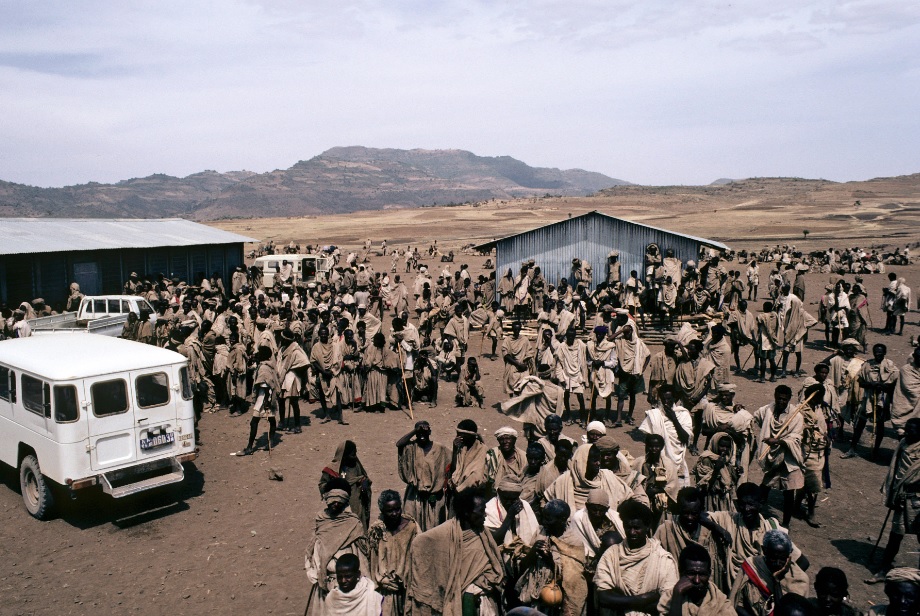 In the photo: Refugees waiting for food distribution at the Ebinat refugee camp in Gondar Province.01 January 1983 – Photo credit: UN Photo/Ian Steele
This is his story:
“It’s an anecdote that goes back to the mid-1980s, during the Cold War,” he said. “I was working in Ethiopia at the time of the great famine. At some point, we heard of thousands of people suffering from hunger – they were high up in the mountains, well out of reach of the refugee camps. We couldn’t reach them by truck, we needed helicopters and had no money for such an operation. It was deemed a “mission impossible”.
Yet, eventually, this is what became known as Operation St. Bernard.
How did it happen? I’ll tell you. I contacted the British Ambassador and when he said there was no money available for food aid, I diplomatically pointed to the fact that the UK had plenty of funding for training military staff in flying helicopters. Why not hold a training session in Ethiopia? I highlighted the benefit of training in a real situation with only one difference: trainees would drop food, not bombs!
Once I had secured the UK’s assent, I sought in turn West Germany’s and Russia’s (then the Soviet Union). It was easy: neither wanted to offer less than the UK. But suddenly a problem came up. The Russian had a reservation: why call the Operation St.Bernard? Being a good communist, he didn’t like the religious implication. I had a ready answer: a St. Bernard is not a saint, it’s a dog, a Swiss dog that provides assistance to people lost in the mountains. Even the Russian couldn’t refuse the concept of a humanitarian Swiss dog, and after an initial reluctance, the Soviet Union joined the operation. Eventually, some 800,000 people were saved…
Yes, what is needed in Syria is a St Bernard…
In the cover: Security Council Discusses Continuing Syria Crisis – Ertharin Cousin (left), Executive Director of the UN World Food Programme (WFP), addresses the Security Council meeting on the continuing conflict in Syria and the attendant humanitarian and refugee crises. At her side is Valerie Amos, Under-Secretary-General for Humanitarian Affairs and Emergency Relief Coordinator. – Photo credit to: UN Photo/Evan Schneider