Editor’s Note: The opinions expressed here by Impakter.com columnists are their own, not those of Impakter.com
Operation Peace Spring
Article by Mina Tumay-Derin Kocer
Donald Trump announced a week ago that the US will be leaving northern Syria, withdrawing its troops and not interfering with any conflict that might arise between Turkey and the Kurdish forces in the area. This decision by Trump that was announced allegedly without consultation with his officials and ministers faced severe national and global backlash. Since the withdrawal, Turkey under the orders of President Erdogan has launched ‘Operation Peace Spring‘ to push back the Kurdish terrorist groups in Northern Syria to create a safe zone surrounding its borders. With the US out of the picture, Turkey is set to have dominance over the area.
To provide a recap of the politics of the area: The US troops were in northern Syria acting as a source of protection for its Kurdish allies, who were needed in order to keep the remnants of ISIS tamed. For this cause, the US had been arming and training the Kurdish forces for years.
Another ‘War on Terror’
18 years ago, during a joint session of Congress and the American people, then-President George W. Bush gave his ‘War on Terror’ speech preparing the nation for an American invasion of Iraq, following the terrorist attacks of September 11th. He identified Al Qaeda as a ‘radical network of terrorists’ and promised that the US War on Terror ‘will not end until every terrorist group of global reach has been found, stopped and defeated’.
Today, since the 7th of October, Turkey has been fighting the YPG Kurdish forces at its Syrian border, who are an extension of the separatist organisation PKK, globally recognised as a terrorist group by the UN, EU and NATO, as well as the US, UK and many other states. However, since the beginning of the operation, Western media has portrayed the conflict favouring the Kurdish terrorist groups and declaring Turkey’s actions as barbaric. The use of language by highly respected institutions such as New York Times, and Washington Post, is portraying the terrorist groups as victims, and the Turkish as an oppressor. They phrase the operation as ‘Turkey against the Kurds’ — which does not reflect the reality: Approximately one-fourth of Turkey’s population are Kurds, nearly half of them for Erdogan’s AKP. Clearly, the operation Turkey launched does not target ‘the Kurds’ but the Syrian branch of the PKK.
Though there are some, like the former Special Presidential Envoy for the Global Coalition to Defeat ISIS, Brett McGurk, who argue that the YPG and the PKK cannot be seen as the same. However, one of McGurk’s colleagues, General Raymond Thomas of the US, admitted calmly that when the US started to supply weapons to the YPG, they knew that it had organic ties with the PKK. Even President Trump with a retweet, accepted that the US had allied with PKK, therefore accidentally legitimising Turkey’s offensive towards them as well as admitting the link between YPG and PKK and that the US has collaborated with them. As Turkish scholar of Washington Institute, Soner Cagaptay, puts is: They are two different brands with the same customer service.
The question to ask here would be, why, then, is it called a ‘War on Terror’ when a Western state invades a less-developed country such as Iraq on the alleged link of the leader with a terrorist group miles away from their land, yet when Turkey launches an operation in order to protect its borders from a terrorist group it is branded as barbaric?
In addition to that, from former Secretary of State and presidential candidate, Hillary Clinton, to the most hawkish Republican Senators, nearly everyone in the American political establishment stated that Trump’s decision meant ‘abandoning US allies’. Certain factors to consider here would be firstly, the tens and thousands of Turkish nationals killed by the aforementioned terrorist organisation, secondly, Turkey being one of the states to have received the Marshall fund and been a part of NATO since 1952, as well as having fought in the front lines of the Cold War.
War of Fear
Though, it has to be also accepted that the US did not cause this conflict alone. Turkey’s foreign policy decisions have not always been in tune with its allies, while Erdogan’s inconsistent understanding of foreign policy played a huge role too. Erdogan, with his former Ministry of Foreign Affairs, one of the ideologists of political Islam, and his fresh dissident, Ahmet Davutoglu, wanted Besher Assad gone — just like the US did. However, the two parties could not find a mutual path of action. The US did not want to support Sunni-Islamist troops which were already fighting against the Asad regime because of their fears: What if the Islamist radicals turn their head against the US and launch an anti-campaign? It was a familiar scenario. Turkey, with very understandable reasons, could not support the PKK. Erdogan and Davutoglu, without appreciating US’s concerns, saw the radical Islamists as their allies, diminished every diplomatic tie with the Syrian government — and the US, the PKK (YPG or the Syrian Democratic Forces). It was clear that the conflict of interests would’ve caused damage to all the parties one day. And, it was also clear that Turkey, the second-largest military in NATO, had the higher hand in the equation.
All that said, it also has to be noted that the military campaign to North East Syria will not solve the deeply-rooted Kurdish issue Turkey has anytime soon — all it will do is to postpone the moment Turkey has to face itself and admit that it is not solely a military concern. Turkey does not fear the possibility of a Kurdish state on its border, it fears the possibility of the Kurdish citizens in Turkey wanting to join. The main reason behind the military operation is also this — Turkey is in a war of fear. Though, as Assistant Professor Bilgehan Ozpek puts it, the way to fight terrorism is to demolish people’s reasons to fight for terrorist organizations in the beginning. And people’s reasons are of identity, of liberal democracy, freedoms all of all sorts, and of development. The Kurdish issue cannot be solved -and has not solved- by taking military action. It can be solved by exterminating ethnic injustices inside Turkey. Till that day comes, Turkey will continue to fight its own endless war — like it had been doing for decades.
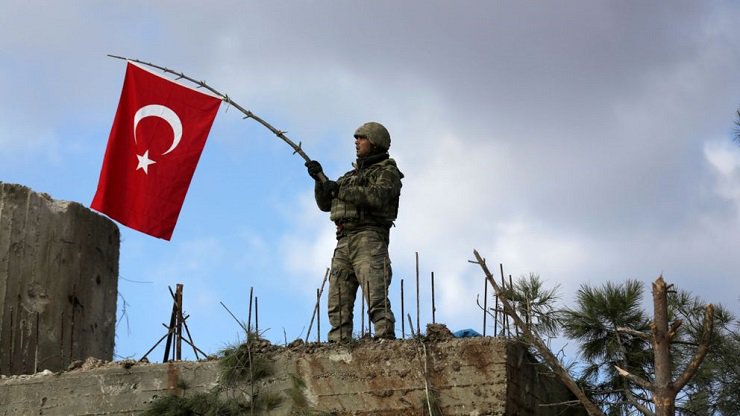
In the cover picture: Turkish soldier in Syria Image Credit: Global Research CA