Updated February 5. Trump’s agenda is to upend the world economic order and bring down the Federal government. The main strategy? Create chaos at home and abroad. Shock-and-awe tactics meant to immobilize people, reduce them to silence, and exact “anticipatory obedience,” as Yale historian Snyder called it in his book On Tyranny — the hallmark of fascist, dictatorial regimes. Welcome to Trump’s world!
Firing people, throwing fear in the hearts of supposed enemies — even withdrawing security detail from retired VIPs such as Boulton and Fauci who, despite serving him in his first term, and often quite well, have supposedly “crossed” him. And, of course, bullying nations to the negotiating table with tariff threats, increases that would actually hurt the American people who’d have to pay for them rather than the foreigners.
Hardly a dignified behavior for a US President, or for any political leader for that matter. You won’t catch China’s Xi Jinping doing anything like that.
So far, his cry around Greenland (the US has a “right to acquire”), Panama (kick out China), and trade wars on Canada and Mexico, despite their being America’s closest neighbors and historic allies, are just sad jokes. He ramped up his demands at the start of Week 3, saying while Netanyahu was on a visit, the US planned to “take over” Gaza, and the Palestinians should leave as it would be made into a resort. Another Trump resort with blue water, golden sand, and pretty girls, the “Riviera of the Middle East” in Jared Kushner’s vision?
It’s so preposterous that it’s hard to believe there’s anything serious here.
Indeed, within a few days, the tariffs were paused. Unsurprisingly, on the Republican side, this was seen as a victory in media like Pirate Wires (a morning read for Trump-voting CEOs). They exulted, calling it a perfect example of Trump’s “art of the deal” and that he had “cemented his legacy as dealmaker of the century.”
But was it even a “good deal”? What did Trump actually get from Canada and Mexico? A few thousand extra border guards, sure, but does America, reportedly the world’s top military power, really need more “guards” from foreign sources to control migrant flows and the Fentanyl emergency? In any case, military force has never been effective in addressing such complex societal issues. And forcing the Canadians to nominate a so-called “Fentanyl czar” is hardly a solution.
It’s not a question of containing these issues but resolving them, and that requires a lot more than gun waving at the border.
Who’s Trump kidding? And, unsurprisingly, he had to back down from his tariff threats when the stock market crashed for a few hours because of his “trade wars” tactics. Which, furthermore — and this bears repeating — are totally illegal: His tariffs went straight against the new US-Canada-Mexico trade agreement he himself had signed in 2019 as a follow-up to NAFTA, which had ensured smooth trade relations since the 1990s.
But launching commercial wars against old friends and allies is only half of it.
Last Saturday, one move stood out in the chaos, potentially the most disruptive, corrupt measure any US President has ever taken —and all done in favor of a foreign oligarch, reportedly the world’s richest man: he gave South African Elon Musk the keys to the US Treasury.
Handing over control of the US Treasury to Musk: What it means
For a while, most people failed to realize what this news meant. But MSNBC’s Lawrence O’Donnell didn’t. On February 4, he vigorously denounced it, arguing that the US is no longer a nation of laws and that giving Musk the keys to the U.S. Treasury is the “domestic equivalent of the nuclear codes”:
As Lawrence O’Donnell says, this constitutes the biggest breach in national security in US history, allowing one individual to go into the “inner sanctum of the US where your money is collected and spent, where your social security number is collected, where your baby’s social security number is collected on day one of your baby’s life.”
Nobody, no US Treasury Secretary before Musk got to it, has ever asked for or got near the Treasury payments mechanism. Unsurprisingly, O’Donnell in his video, calls for the impeachment of US Treasury Scott Bessent for handing over the keys of the Treasury to Musk. But, as O’Donnell himself acknowledges, with Congress in the hands of the Republicans, this won’t happen.
And he concludes: “Nothing is potentially more dangerous than that, nothing is more corrupt.”
Democracy dies in the hands of oligarchs
Democracy doesn’t “die in darkness,” as the Washington Post would have it, but in the hands of billionaires.
Robert Reich, former Secretary of Labour under President Clinton, has no doubts that it is happening, “this is what an oligarchy looks like.” In a “Coffee Klatch” held on February 1, he powerfully argued that Trump’s “divide and conquer strategy,” intimidating everyone to consolidate power, is a classic technique out of the fascist dictator’s playbook.
The “Unitary Executive” theory that emerged in the early 2000s as an enduring George W. Bush legacy is now the reality guiding Trump. The idea is simple: Go against the Impoundment Control Act of 1974 (confirmed by the Supreme Court in 1975) and take away from Congress “the power of the purse,” concentrating everything in the hands of the President.
And says Reich, it is all happening faster than predicted, yet Trump is not doing all this only for himself; he is, he says, “a front man for the people who are out to do this”: Behind him, you find the billionaire class. They were there already in his first term, but this time, they’re here en masse, pulling all the strings. Not just Musk, but all of them, Bezos, Zuckerberg, Pieter Thiel, etc. — in short, the tech titans. And as Varoufakis noted recently, these are not just any rich men with loads of money, they have control over most people’s digital life, from Google to Palantir and naturally, Musk’s X.
All this, says Reich, is about replacing democracy with dictatorship, and expect it to be a most effective dictatorship, with cameras and digital eyes and ears everywhere. Human suffering will be ignored and already is ignored: When a plane crashed over Washington, killing 64 people as it did last week, Trump showed no empathy for the many victims. Instead, he immediately apportioned blame, baselessly scapegoating DEI and the Democrats and conveniently forgetting he is the one who fired the head of the Federal Aviation Administration, causing chaos.
For those Americans, including Republicans, who don’t want to turn America into an oligarchy, there are things they can do, says Reich, like contact Congressmen but also engage in consumer boycotts and try to convince your friends who get the news from social media to turn more trustworthy sources like NPR and ProPublica that continue the strong American tradition of independent, investigative journalism (for more ideas, read Reich’s substack post about what you can do here).
If all this sounds like daydreaming, maybe not. Consider that America not so long ago was “the land of the free” where people helped each other and most definitely (as I recall from my student days at Columbia) talked to each other and, to put it simply, trusted each other. The fact that trust is dead today in America is what empowers someone like Trump and makes his power grab possible.
Reich’s Coffee Klatch video ends on a scene depicting how his confirmation hearing went in the Senate in 1992: He got something that would be utterly impossible today: He got 100% support from both sides of the Senate, with 100 votes for him and none against! Take a minute to watch, it will bring back to mind better times — times worth fighting for:
Voices of dissent were allowed back then!
Europe’s Reaction: What Came Out of the “Informal Leaders Retreat”
At the request of EU Council President Antonio Costa, an Informal EU Leaders retreat was held on February 3 to discuss measures to strengthen European defense. At the press conference that followed, EU Commission President Ursula von der Leyen, summing up the meeting, said: ”Europe needs a surge in defence. And for that our defence industrial base must be strengthened.” This means:
- A substantial increase in EU defence spending from the current average of 1.9% of GDP: It will have to start with more public funding, and for this, she is willing to “use the full range of flexibilities we have in the new Stability and Growth Pact”;
- Streamline lending practices to effectively launch European-wide projects and jumpstart private funding; This can only happen in close coordination with the European Investment Bank (EIB)
As she noted: “The EIB is willing to do that. They say, rightly so, that what they need is flagship projects on the table of the EIB. And, of course, we need more private funding.”
What all this means is more flexible and faster lending practices, cutting back on red tape, and all this is a key part of the EU Competitiveness Compass agenda, that she presented last week.
And so, the cat was out of the proverbial bag: Back to what to do with Trump and his bluster.
The line of defense is clear: Europe is ready to talk but won’t be cowered. Europe has many friendly countries and business partners around the world, with numerous trade treaties that it always respects. No threats, no changes to the rules, and continued support for green energy and the Green Deal.
The likely result? A Trump trade war will not only divert trade channels to China but to Europe too.
Is that to America’s benefit, Mr. Trump?
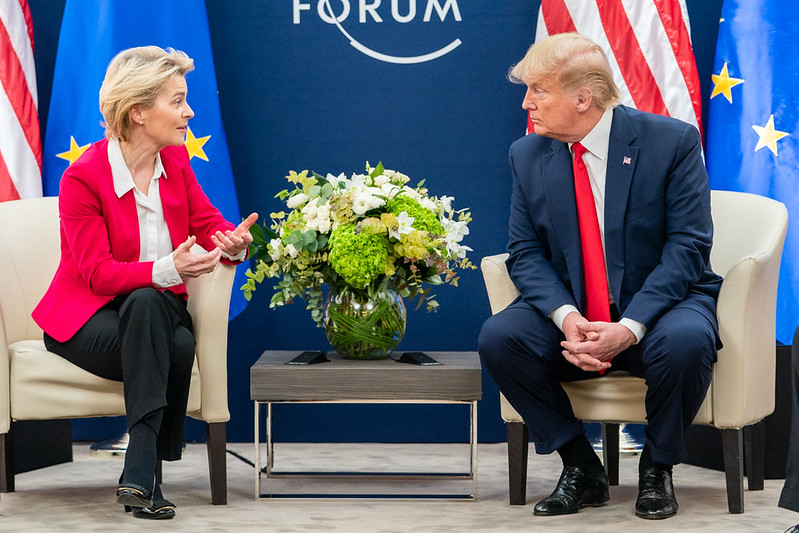
Editor’s Note: The opinions expressed here by the authors are their own, not those of impakter.com — Cover Photo Credit: Trump’s last meeting with EU Commission President Ursula von der Leyen during the 50th Annual World Economic Forum meeting Tuesday, Jan. 21, 2020, at the Davos Congress Centre in Davos, Switzerland. (Official White House Photo by Shealah Craighead) — it is too soon to tell whether we will get a repeat of this photo, or how their next meeting will look like.