A look at the far-reaching, global impact of the Trump administration considering global leadership, alliances, the rise of autocracy, technocratic control, and potential environmental collapse. Taken together, these factors could create a triple crisis or a perfect storm for a dystopian future. Combatting this future is no longer an option but a critical necessity
The Trump era has shaken more than U.S. politics — it has sent shockwaves across the globe. From weakened alliances and rising autocracy to environmental neglect and economic uncertainty, the world is witnessing the consequences of retreating American leadership. As authoritarian regimes gain ground and democratic norms erode, the question becomes urgent: can global stability survive, or are we entering a new age of instability and concentrated power?
Impacts of U.S. Decline in Global Leadership
In a recent “American Account” column, Dr. Irwin Stelzer of the Hudson Institute likened the U.S. economy under Donald Trump to “caudillo capitalism,” a system where powerful leaders shape their own narratives to align with their desires, often at the expense of reality. If the trajectory of Trump’s first term continues into a second, early signals suggest a sharp decline in global leadership, precipitating political, economic, and environmental instability not only for the U.S. but for the entire world.
Hallmarks of Trump’s Second Term (so far)
- Appointment of Unqualified Cabinet Members: Trump has prioritised loyalty over competence, often placing unqualified individuals in key government positions.
- Promotion of Project 2025: Seen by critics as a blueprint for authoritarian rule, Project 2025 raises alarms about the ideological reorientation of the administration.
- Disregard for Constitutional Norms: Trump’s contempt for legislative oversight and constitutional processes weakens the checks and balances that protect American democracy.
- Withdrawal from International Institutions: The U.S. has pulled out of key global organisations like the UN and WHO and cut critical foreign aid programmes such as USAID and the SDSN, signaling a retreat from multilateral engagement.
- Chaotic Trade and Tariff Policies: Trump’s tariff strategy, targeting both allies and adversaries, has led to unstable economic relations and a weakened global trade framework.
- Tax Legislation Favouring Short-Term Political Gain: Tax reforms under Trump have often favoured immediate political gain, at the cost of long-term fiscal stability.
- Unconditional Support for Netanyahu’s Israel: Trump’s steadfast backing of Israeli Prime Minister Benjamin Netanyahu while undermining humanitarian efforts in Gaza highlights the administration’s geopolitical priorities.
- Politicisation of Labour Market Data: The suppression and manipulation of labour statistics undermine public trust in the government’s economic reporting.
- Undermining Ukraine’s Zelensky: Trump has echoed pro-Kremlin rhetoric regarding Ukraine, further destabilising the region.
- Delaying the Release of Epstein Files: The delay in releasing critical documents related to Jeffrey Epstein’s case raises questions about transparency.
- Expansion of State Capitalism: Trump’s policies show an increasing shift towards a state-controlled cities and the economy, reminiscent of 1930s authoritarian models.`
These actions along with many others — restricting voting rights, ICC arrests, dismantling the Department for Education/Higher Education (especially DEI initiatives), withdrawing from the Paris climate agreement, undermining national security including the work of the DOJ, FBI, Social Security and other agencies — while primarily aimed at reshaping domestic policy toward an autocracy, also indicate a far-reaching reorientation of America’s role in the world.
Shifting World Power
1. New Alliances
As trust in U.S. leadership erodes, countries are increasingly turning to alternative power centres. Europe (biggest single market in the world) stands to gain influence as do China and Russia, sidelining the values of democracy and multilateralism. This shift weakens cooperation on critical global issues like climate change, trade, and human rights.
2. Erosion of Multilateral Institutions
With the U.S. stepping back from global leadership, institutions like the United Nations (UN), the World Trade Organization (WTO), and the World Health Organization (WHO) face fragmentation. This creates a vacuum where power-driven geopolitics — often unchecked by international norms — can thrive, undermining cooperation on global challenges.
3. Loss of Moral Authority
Without a democratic global champion, space opens up for regimes that see civil liberties as expendable. This could accelerate the normalisation of authoritarian governance and the erosion of individual freedoms on the global stage.
Rise of Autocracy
Global Authoritarian Shift
Countries with fragile democratic institutions — Hungary, Poland, and Turkey — are already leaning toward illiberalism. Should the U.S. continue to retreat from its leadership role, this trend could extend globally, fostering a new era of authoritarian governance.
Suppression of Dissent
Authoritarian regimes depend on tight control over information, utilising censorship, surveillance, and intimidation to suppress opposition and limit political participation. This effectively stifles free speech, creating an environment where dissent is met with harsh consequences.
Technocratic Control
Increasingly, economic and political power is concentrated in the hands of corporate elites and technological giants. This centralisation diminishes public accountability. Moreover, AI and automation threaten to displace millions of workers, exacerbating inequality and contributing to social unrest.
Environmental Consequences
Unchecked climate change, biodiversity loss, and resource depletion are all escalating crises. These threats jeopardize not just ecosystems but also the economic and political stability of entire regions. Authoritarian regimes, focused on short-term industrial growth, are likely to worsen these environmental challenges while curbing environmental activism and undermining efforts for global sustainability.
Related Articles: What Is Trump up to and Can It Be Prevented? | Trump’s Trade War: What Is the Right Response? | On Freedom: How to Protect Democratic Values in a Second Trump Regime
A Possible Dystopian Outcome
The combination of declining democracy, rising autocracy, unchecked technological power, and environmental collapse could lead to a dystopian future, marked by a triple crisis:
- Political Systems Dominated by Authoritarian Elites: A concentration of power in the hands of a few, leaving the masses disenfranchised.
- Economies Structured for the Benefit of the Wealthy: Growing economic inequality, where the rich control more resources and the majority face increasingly precarious livelihoods.
- A Planet Pushed Beyond Environmental Tipping Points: Ecological collapse exacerbating global instability, triggering widespread displacement, resource scarcity, and geopolitical conflict.
Paths to Prevention
- Global Solidarity
Building alliances among democracies, human rights organisations, and climate advocates is essential to counterbalance the influence of autocratic regimes. Collective action strengthens international cooperation on human rights, environmental sustainability, and global peace. - Political Accountability
Safeguarding democratic norms requires robust civic engagement. Promoting transparency, implementing institutional safeguards, and reinforcing democratic practices are crucial to resisting authoritarian trends. - Sustainable Development
Policies that prioritise planet sustainability — grounded in ecocentric (all species in a shared environment) rather than mainly human-centred values and principles — are vital.
To this end, education (both formal and non-formal) and transdisciplinary research funded equitably across all global regions integrating the One Health and Wellbeing concept, the Earth Charter principles, and the UN Sustainable Development Goals are key to fostering a more resilient and just world.
The trends highlighted in this analysis are concerning, but they are not inevitable. The risk of global dysfunction and authoritarian consolidation is real, yet through collective action — both within the U.S. and globally — we can influence the trajectory of the 21st century. It remains to be seen whether this era will be remembered for democratic renewal, equality, peace and progress or the rise of authoritarianism — control, fear, chaos, and dysfunction.
Author of “Sapiens,” Yuval Noah Harari raises a critical question in this context: In the age of information, can humanity move beyond mere understanding to use knowledge for societal betterment? He cautions that prioritising “order over truth,” as in historical examples like Nazi Germany, can turn information networks into instruments of oppression. While these networks have the potential to enhance efficiency and social organization, they can equally be exploited for authoritarian control.
Harari’s provocative reflection — ”If we Sapiens are so wise, why are we so self-destructive?” — reminds us that humanity’s extraordinary capacity for innovation is often overshadowed by repeated failures. As we face ecological and social crises, he also calls for urgent global dialogue to learn from our past mistakes and to collaboratively shape a sustainable future.
** **
This article was originally published by PEAH – Policies for Equitable Access to Health.
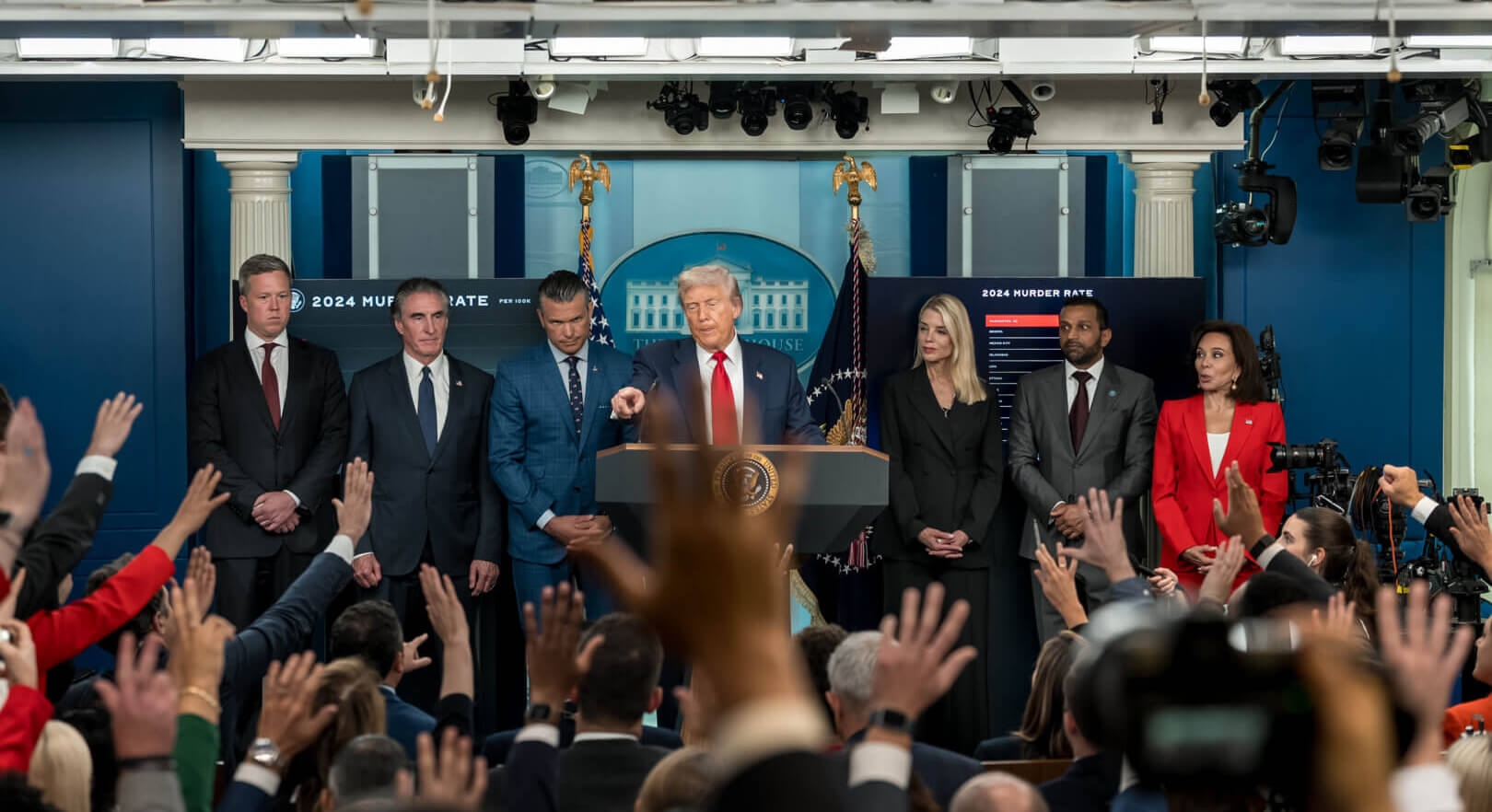
Editor’s Note: The opinions expressed here by the authors are their own, not those of Impakter.com — In the Cover Photo: President Donald Trump holds a press conference on crime in the District of Columbia, Monday, August 11, 2025, in the James S. Brady Press Briefing Room. Cover Photo Credit: White House / Abe McNatt.