At the UN Summit of the Future (SOFT) to be held on Sept. 22-23, 2024, over 130 Heads of State and Government will “tackle critical challenges facing the international community and address gaps in global governance, stakeholders.” In preparation, stakeholders have produced three key documents that attendees are expected to adopt: Pact for the Future, with a Global Digital Compact, and the Declaration on Future Generations.
Two “action days” precede it, involving non-governmental organizations (NGOs), academics and private sector” representatives (7,000 registered to date). The intention is to cover the main themes, including inter alia “accelerating sustainable development and reforming decades-old institutions, among them: “the UN Security Council and the international financial system.”
It is noteworthy that the meeting is scheduled “just before the annual high-level debate in the UN General Assembly.”
While generally commending the Summit Action Points, as was the case with the Rio Declaration on Environment and Development (1992), the Millennium Development Goals (2000), and now also the SDGs (2015) — with only 17% of the targets on track, I contend that the fundamental problem continues to be a flawed premise or assumption about our worldview in 2024 that places our health and wellbeing above all other lifeforms on the planet that sustain us.
The authors of “Why ecocentrism is the path to the future” probably said it best in their opening paragraph:
“Ecocentrism is the broadest term for worldviews that recognize intrinsic value in all lifeforms and ecosystems themselves, including their abiotic components. Anthropocentrism, in contrast, values other lifeforms and ecosystems insofar as they are valuable for human well-being, preferences and interests.”
Unquestionably, it is this thinking and our actions and behaviour, especially over past decades and centuries, that have brought us to a pivotal point as far as our future is concerned. In the “here and now,” consider, as examples, UN Secretary-General Antonio Gutteres’ most recent comments on climate change: “Revealed: wealthy western countries lead in global oil and gas expansion” and UK army chief General Sir Roly Walker’s wake-up call “We’ve got three years to prepare for war…”.
I also posit that the slow take-up of the SDGs and SOTF support so far across global regions is related to not addressing today’s socio-economic, geopolitical and environmental realities in relation to each other and the planet sufficiently enough at a level that matters to communities and individual families. The challenges are exacerbated especially in a world where disinformation and misinformation distort the truth and where division and chaos are becoming the norm across much of the world.
As shown below, shifting our worldview from mainly human-centrism (“it’s all about us” — evidenced across all existential threats!) to Earth/eco-centrism (“it’s about all species”) and striving toward the common good/purpose that transcends the divisions we have created is critical to our survival as a species and the future of the planet.
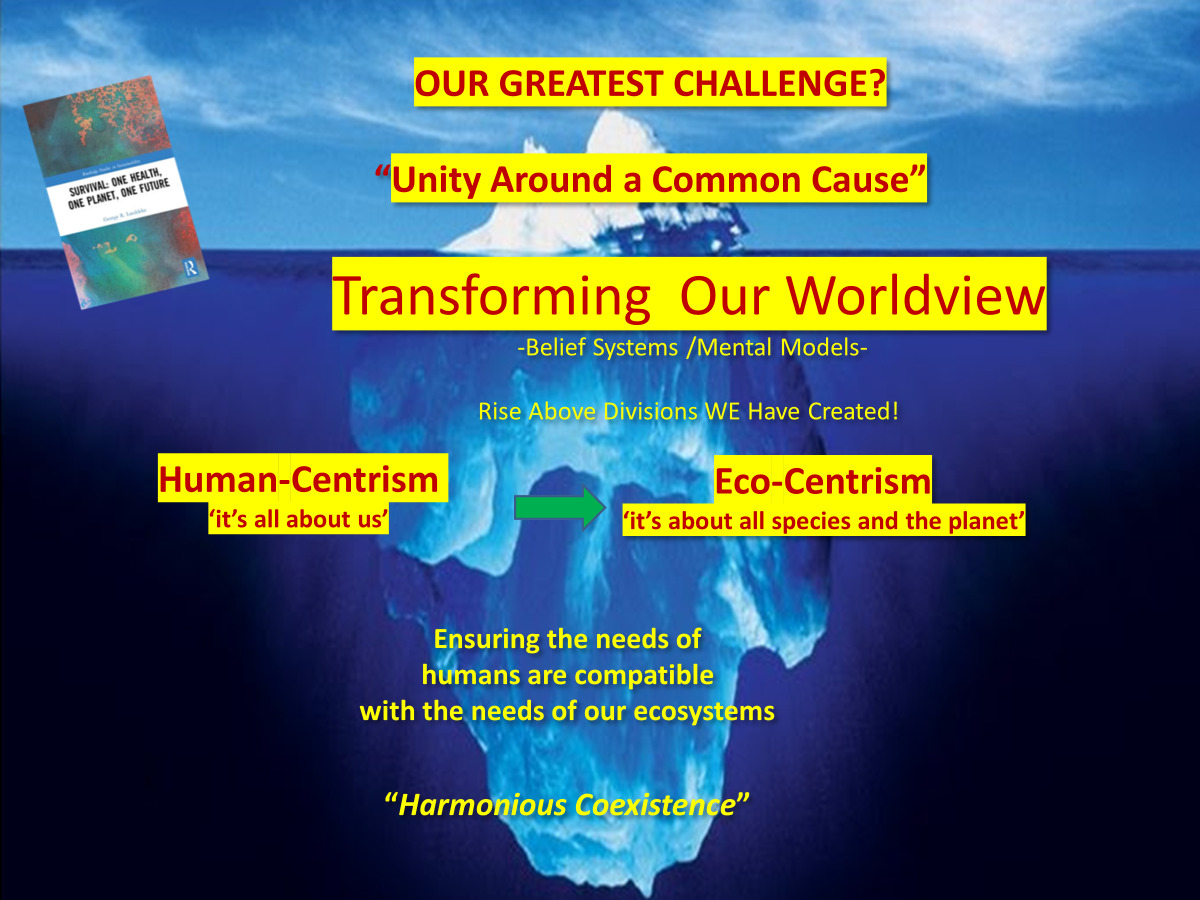 This societal re-orientation includes recognising that we are part of nature not separate from it: The failure to recognize this relationship is one of the root causes of the ecological crisis we now face. This shift is also paramount to re-gaining cooperation among nations and communities and the holistic emphasis that needs to be placed on global sustainability and placing this aspiration “at the centre of our efforts to achieve the 2030 Agenda” and the Summit aims.
Related Articles: Summit of the Future: Will One Health Be Given Its Due? | A Time to Choose: Utopia vs Dystopia? Democracy is Key
Two immediate Summit priorities flow from this re-thinking focusing on:
(1) “Leaving no-one behind” especially the need to include all other life forms on which our survival depends; and
(2) the urgency to focus on the outstanding “major challenges” but acknowledging that these aspirations (goals and targets) need to apply equally to all life forms on the planet to create “a more just, sustainable and peaceful world,” as made clear in the World SDG Dashboard 2024.
Considered collectively, Summit reports have the capacity “to make the Summit of the Future the transformational global moment that the world demands.”
Doing so calls on world leaders and society generally to provide answers, sooner than later, to at least three existential questions that face us:
- What kind of future are we headed toward?
- What kind of future do we need for sustainability?
- How can we make the future much less dangerous and inspire hope for this and future generations?
As things stand, I fear that the outcomes of the Summit will end up as the MDGs did in 2015 and the SDGs may in 2030 unless new thinking and new approaches are adopted by the UNGA. This requires starting with focusing UNGA attention first on the health and wellbeing of the planet and secondly on the nations they represent, in order to achieve the ‘common good.’
Knowing what we know, holistic and inclusive governance at global and national levels – especially listening to the voices of Youth, Women, and the Disenfranchised – is the way forward for the Summit of the Future to make a fundamental difference to the world today and to get all stakeholders behind the SDGs.
Holding the world together (glue) is the adoption by decision-makers at all levels of the unifying One Health & Wellbeing concept: Recognising the interdependence of all life on the planet and ensuring a healthy biosphere for all.
The reality is that never before in the history of the planet have we faced the possibility of dystopia and self-destruction caused by divisions (socio-economic, geopolitical, environmental) We have created.
Yes, we are the problem but also the only solution!
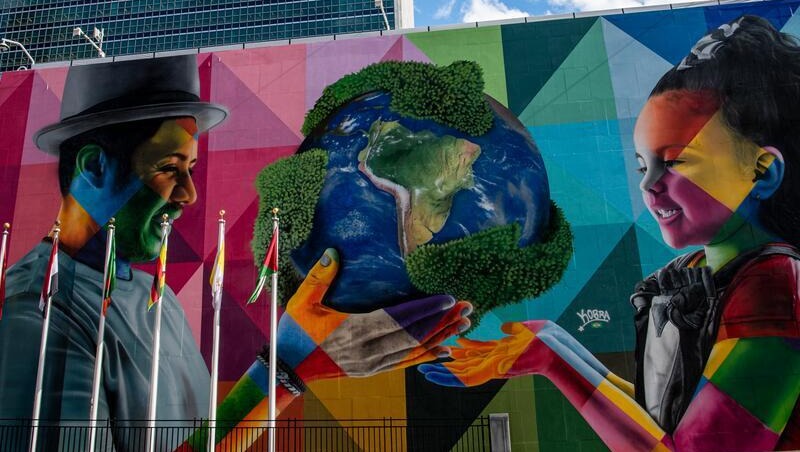
Editor’s Note: The opinions expressed here by the authors are their own, not those of Impakter.com — In the Cover Photo: A view of the Eduardo Kobra mural at UN Headquarters. Cover Photo Credit: UN Photo/Rick Bajornas.