
Research trends reveal massive gaps in students primed to become Kenya’s next generation of agricultural professionals and agripreneurs. Degree enrolment in agriculture courses decreased from 24,221 students in 2017 to 18,165 in 2018, a 25% drop, as students reported a lack of motivation and a negative perception of career prospects in the future of agriculture. However, youth—as future decision makers and drivers of agricultural transformation in Kenya—have an opportunity to contribute to the country’s food security.

For this, the Climate Smart Agriculture Youth Network (CSAYN) in collaboration with the CGIAR Research Program on Climate Change, Agriculture and Food Security (CCAFS), the Alliance of Bioversity International and CIAT (the Alliance) and the University of Nairobi (UoN), held the inaugural Climate-Smart Agriculture (CSA) Campus Forum at UoN. This aimed to build the capacity of students taking agriculture courses in CSA and equip them with knowledge to harness the massive opportunities in agribusiness.
Related topics: COVID-19 Finds African Youth Capitalising on Digital Space – The silver bullet to attract youth – Mitigate Massive Youth Migration in Africa
The Forum attracted 464 students from the College of Agriculture and Veterinary Sciences (CAVS), research scientists in CSA, professionals from research and development organizations, young champion farmers implementing CSA and faculty from UoN. The forum was broadcast on television and livestreamed by TV47 to Kenya’s 47 Counties.
Scientists unpack CSA and young farmers share first-hand experiences
Dr. John Recha, a CSA scientist with CCAFS who studied agriculture at UoN 25 years ago, explained the science of climate change and the effects on agriculture. He highlighted why CSA is a suitable approach to address climate change impacts on agriculture.
Dr. Evan Girvetz, Principal Scientist at the Alliance, unpacked practical examples of how youth are being engaged in numerous agribusiness activities. For example, the Alliance has partnered with John Deere, a tractor manufacturer, and Hello Tractor, a digital platform that connects smallholder farmers to mechanization services on a conservation tillage program, where farmers can request a tractor though mobile digital platforms as easily as requesting an Uber.
The opening session was followed by an interactive experience with two young agripreneurs: Ronald Dianga, who runs Kenarava Agribusiness, a company that provides agribusiness consultancy in farm management and farmer training; and Anthony Malovi, who farms on five acres of land in Kitale. They advised students to take a business approach to farming, leverage their academic skills in agriculture and tap into opportunities in climate-smart farming.
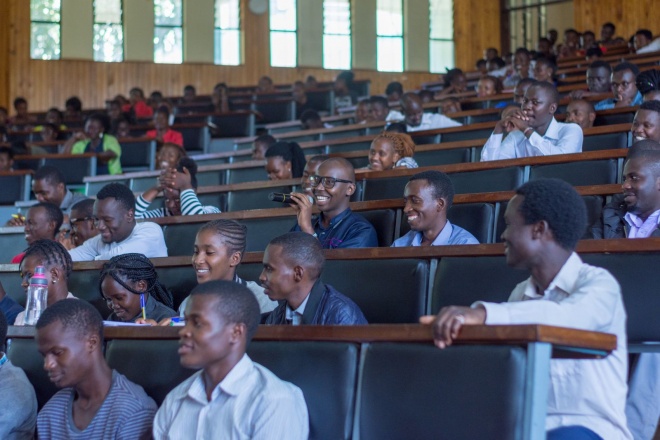
Agricultural student participants at the CSA Campus Forum at the University of Nairobi. Photo: B. Wema (Independent Photographer)
Key takeaways from the CSA Campus Forum
- Knowledge is power – climate education for youth is vital
Developing tailor-made knowledge and information sharing platforms could be useful in raising awareness and informing youth about CSA, building their capacity, tapping into their growing energy and drive for climate action, and identifying avenues to transition to CSA.
- Gaining insight from fellow young people – the efficacy of peer to peer learning
Experience sharing through multi-medium dialogues creates space for positive youth influencers to dispel negative perceptions and stereotypes and facilitate young people to become more engaged in agriculture.
- Seeing is believing – practical demonstration is needed
Pictorial articles, videos and CSA demonstration farm visits, will enhance knowledge of locally appropriate and environmentally sound farming approaches and technologies.
- Climate-smart innovations – digital farming key to youth involvement in agriculture
The digital agriculture revolution has the potential to birth the twin benefits of scaling out CSA while attracting, engaging and retaining youth in the sector.
- Research – the need for evidence to inform programmatic interventions
Gaining insights on youth perceptions and attitudes in agriculture could enable relevant actors in the CSA space to develop scalable methods and tools that effectively engage young people, and base policies on these research outcomes.

Based on the insights and building on the conference momentum, the partners and organizers hope to scale out the CSA Campus Forum. Participatory learning platforms for students will be key in changing any negative perceptions towards agriculture, and increasing knowledge and impact.
About the author: Victor Mugo is Country Coordinator for the Climate Smart Agriculture Youth Network (CSAYN). Ivy Kinyua is Research Assistant at the Alliance of Bioversity International and CIAT. Catherine Mungai is Partnerships and Policy Specialist at CCAFS East Africa. John Recha is Participatory Action Research (PAR) Specialist at CCAFS East Africa.
EDITOR’S NOTE: The opinions expressed here by Impakter.com columnists are their own, not those of Impakter.com. Photo Credit: B. Wema