
Impakter
  • Environment
    • Biodiversity
    • Climate Change
    • Circular Economy
    • Energy
  • FINANCE
    • ESG News
    • Sustainable Finance
    • Business
  • TECH
    • Start-up
    • AI & Machine Learning
    • Green Tech
  • Industry News
    • Entertainment
    • Food and Agriculture
    • Health
    • Politics & Foreign Affairs
    • Philanthropy
    • Science
    • Sport
  • Editorial Series
    • SDGs Series
    • Shape Your Future
    • Sustainable Cities
      • Copenhagen
      • San Francisco
      • Seattle
      • Sydney
  • About us
    • Company
    • Team
    • Partners
    • Write for Impakter
    • Contact Us
    • Privacy Policy
No Result
View All Result
Impakter logo
No Result
View All Result
Deep Sea Mining

Illustration of a deep sea mining machine for the retrieval of minerals and deposits from the ocean floor found at depths of 200 metres up to 6,500 metres.

The Quiet Financial Backers Behind Deep-Sea Mining

Major banks are greenwashing their commitments by continuing investments in one of the world's most controversial extraction industries

Lena McDonoughbyLena McDonough
February 24, 2026
in Business, Energy, Environment
0

Major financial institutions have publicly committed to staying out of the deep-sea mining industry. The money tells a different story. A recent DW investigation found that some of the world’s most prominent banks have invested at least $684 million (€581 million) in companies linked to the industry, among them Deutsche Bank, UBS, Credit Suisse, Crédit Agricole, and BNP Paribas. 

These banks have been enabled to keep investments flowing towards mining operations while still claiming to be removed from the industry and reaping the reputational benefits of sustainable investing. As DW researchers put it, these practices are “akin to refusing to finance an oil drilling site for climate reasons but still buying shares in the drilling company.” The companies maintain the legality of their positions through carefully worded exemptions buried in fine print, relying on a lack of public scrutiny to avoid accountability.

Tariq Fancy, former chief investment officer for sustainable investing at BlackRock, warns of the hidden costs that ESG can bring when it is prioritized over political reform and stronger regulation. “In many cases it’s cheaper and easier to market yourself as green rather than do the long tail work of actually improving your sustainability profile,” Fancy said.

Using data from the Anti-Corruption Data Collective (ACDC), the investigation also found that countries that have called for a halt to deep-sea mining nonetheless have public pension funds invested in vehicles like the Triton IV private-equity fund, which finances mining operations or companies that service them. As of now, no pension funds have pledged to exclude deep-sea mining.
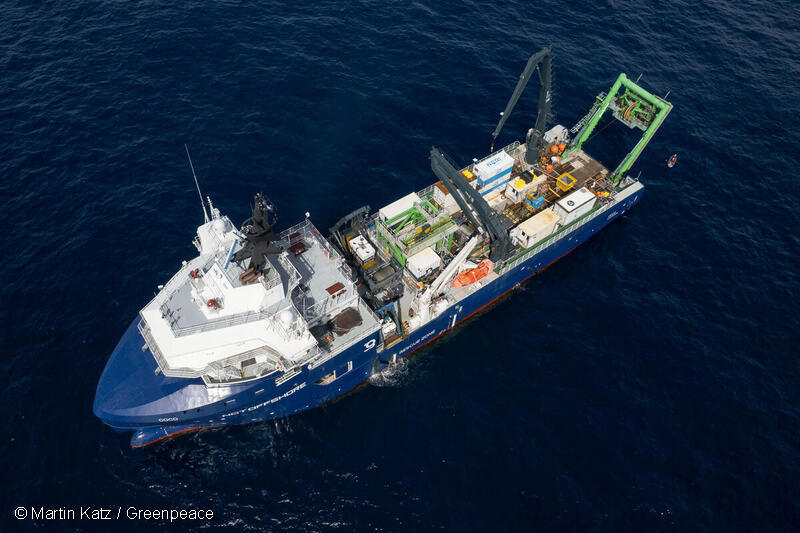
Deep Sea Mining
The MV COCO, a specialized offshore drilling vessel currently collecting data for deep sea mining frontrunner, The Metals Company, on its last expedition before it files the world’s first ever application to mine the seabed in the Pacific Ocean, Nov. 23, 2023. Photo CreditL © Martin Katz / Greenpeace

The Industry Behind the Investment

So what exactly are these institutions quietly financing? Initially, deep-sea mining was introduced as it promised to bring the critical minerals for the energy transition without the costs on land. But the costs still exist, and likely in greater numbers, they are simply buried thousands of meters below the ocean surface. As with most other environmental and resource conflicts, if we cannot see where the damage is being done, it is probably causing great distress to whatever ecosystem it was introduced to.

Exploratory deep-sea mining began in the 1970s, but it wasn’t until 2022 that true commercial mining technology was tested. Therefore, scientists have only had a few years to investigate the changes that these practices bring to these mysterious ecosystems (less than 0.001% of the deep seabed has been observed by humans). While the full effects are still not known, it requires no specialist knowledge to conclude that scraping a large machine along the deep ocean floor to scoop up nodules containing minerals and stir up sediment is heavily disruptive to an ecosystem.

In terms of international governance, the United States stands alone in continuing to openly pursue deep-sea mining in international waters. The UN’s International Seabed Authority (ISA) is the world’s authority on deep-sea practices, and while the rest of the world’s governments are united to protect the deep-sea, the U.S. is not a member. This governance gap has given financial institutions the room to maneuver, and the cover to obscure their involvement.

Related Articles

Here is a list of articles selected by our Editorial Board that have gained significant interest from the public:

  • Deep Seabed Mining: What Are the Risks?
  • Debunking Deep Sea Mining Myths
  • The International Seabed Authority’s War With Itself
  • You Can’t Mine the Seabed Without Proper Rules

An Ecosystem We Have Barely Begun to Understand

An estimated 91% of ocean species have yet to be classified, meaning humanity is dismantling ecosystems it has barely begun to understand. Deep-sea microbes alone have already demonstrated unqiue scientific value, having contributed enzymes to SARS-CoV-2 PCR tests, cancer research trials, and numerous other medical applications still being uncovered. To accelerate the destruction of these habitats before their inhabitants are even catalogued is to subordinate scientific discovery and potentially life-saving medicine to short-term financial gain.

The institutions financing deep-sea mining from the shadows are banking on continued public unawareness. But the combination of inadequate international oversight, non-transparent investment structures, and an ecosystem of irreplaceable and largely unknown value makes this one of the most consequential environmental blind spots of our time. Major banks, pension funds, and private equity firms must be held to higher standards: full divestment from deep-sea mining, not just from its surface, but from every fund, share, and subsidiary. The ocean floor is not a resource to be quietly liquidated. 


Editor’s Note: The opinions expressed here by the authors are their own, not those of impakter.com — In the Cover Photo: Illustration of a deep sea mining machine for the retrieval of minerals and deposits from the ocean floor found at depths of 200 metres up to 6,500 metres. Cover Photo Credit: © Jack Cowley / Greenpeace.
Tags: Deep seabeddeep-sea miningDWecosystemsfinancial institutionsInternational Seabed AuthorityInvestmentISAOcean HealthoceansSeafloor
Previous Post

Activists Protest Against Wall Street’s Oil Deals

Related Posts

Can Human Behavior Explain the Recent Spike in Shark Attacks?
Environment

Can Human Behavior Explain the Recent Spike in Shark Attacks?

In January, headlines were dominated by the four shark bites occurring within 48 hours off Australia’s coast. This is not...

byLena McDonough
February 17, 2026
Trump to Accelerate Permits for Mining in International Waters
Business

Trump to Accelerate Permits for Mining in International Waters

This Week’s Regulatory Updates Trump to Fast-Track Permits for Deep-Sea Mining in International Waters: Trump moves to fast-track U.S. deep-sea...

byAriq Haidar
January 23, 2026
The Imperative of a Nature-Positive Future
Biodiversity

The Imperative of a Nature-Positive Future

For most of human history, survival was a gamble. Half of all children never reached puberty. Life expectancy hovered around...

byMarco Lambertini
January 16, 2026
Google Expands Data Center Energy Strategy with Gas and Carbon Capture Investments
Business

Google Expands Data Center Energy Strategy with Gas and Carbon Capture Investments

Today’s ESG Updates Google Invests in Carbon Capture Power Project: Google is partnering with I Squared Capital to build a...

byEge Can Alparslan
October 24, 2025
Property developer
Architecture

Taking Smart Risks: Building Wealth Through Property and Career Choices

Every business owner is going to face times when they have to make bold decisions and bold moves. It could...

byHannah Fischer-Lauder
October 21, 2025
Plastic pollution coral reefs
Biodiversity

Protecting Coral Reefs From Plastic Pollution: The IUCN Congress as a Catalyst for Action and Collaboration

This week, the International Union for the Conservation of Nature (IUCN) sees its World Conservation Congress kick off in Abu...

byJanne van Eerten - Sr. Global Public Affairs Manager at The Ocean Cleanupand1 others
October 8, 2025
UN General Assembly and Climate Week Kick Off in New York
Business

UN General Assembly and Climate Week Kick Off in New York

Today’s ESG Updates NYC Climate Week Hits Record Scale: Over 1,000 events and big investments expected despite policy headwinds from...

byLena McDonough
September 22, 2025
How Human Pressures Are Transforming the Ocean Beyond Recognition
Biodiversity

How Human Pressures Are Transforming the Ocean Beyond Recognition

Key Takeaways Human pressures on the ocean are projected to more than double, and could triple, by 2050. Ecosystems critical...

byLena McDonough
September 16, 2025

Recent News

Deep Sea Mining

The Quiet Financial Backers Behind Deep-Sea Mining

February 24, 2026
Protests arise against Wall street’s oil deals, Big tech accounts for half of global clean energy, EU proposes stricter standards for corporate vehicles, DHL introduces new portfolio offerings for reducing scope 3 impacts

Activists Protest Against Wall Street’s Oil Deals

February 24, 2026
New U.S. Tariffs and One Health: The Likely Consequences

New U.S. Tariffs and One Health: The Likely Consequences

February 23, 2026
  • ESG News
  • Sustainable Finance
  • Business

© 2025 Impakter.com owned by Klimado GmbH

No Result
View All Result
  • Environment
    • Biodiversity
    • Climate Change
    • Circular Economy
    • Energy
  • FINANCE
    • ESG News
    • Sustainable Finance
    • Business
  • TECH
    • Start-up
    • AI & Machine Learning
    • Green Tech
  • Industry News
    • Entertainment
    • Food and Agriculture
    • Health
    • Politics & Foreign Affairs
    • Philanthropy
    • Science
    • Sport
  • Editorial Series
    • SDGs Series
    • Shape Your Future
    • Sustainable Cities
      • Copenhagen
      • San Francisco
      • Seattle
      • Sydney
  • About us
    • Company
    • Team
    • Partners
    • Write for Impakter
    • Contact Us
    • Privacy Policy

© 2025 Impakter.com owned by Klimado GmbH