In January when Trump’s brutal masked Immigration and Customs Enforcement (ICE) thugs have murdered two innocent civilians in Minneapolis — one a mother of three, the other a registered nurse — and lied about the killings despite video evidence to the contrary, I wake in the mornings with my usual dismayed befuddlement — a conviction that what he is perpetrating is illegal and unconstitutional, combined with confusion about what anyone could do to stop his heartbreaking determination to turn the United States into Hitler’s Germany.
But then, all kinds of eloquent progressive voices arise, from faith leaders and Members of Congress to journalists and media pundits like the indefatigably outraged Robert Reich, who has been speaking up since the first Trump administration, and Jen Rubin and Norm Eisin, who launched their Contrarian Substack in the first days of his second term.
The Prophetic Voice
The progressive media are joined by the faith community, Members of Congress, Governors, and Mayors in an indignant and values-inspired oratory that assuages our sense of helplessness. At a time when moral clarity is sorely needed, we are fortunate to have these practitioners of what I would define as the contemporary prophetic voice.
The prophetic tradition springs from historical Judaism, beginning with Amos in the 8th century BCE and including figures like Micah and Isaiah. Our modern practitioners “speak truth to power,” as Civil Rights leader Bayard Rustin put it, calling for a return to moral and ethical values when a government or other entity has strayed from its guiding principles.
- Isaiah 58: 5: “Is not this the kind of fasting I have chosen: to loose the chains of injustice and untie the cords of the yoke, to set the oppressed free and break every yoke?”
- Amos 5:24: “But let justice roll down like waters, and righteousness like a mighty stream.”
Just as the Biblical Prophets spoke out against unjust leaders who practiced personal aggrandizement rather than compassion, during our nightmare of creeping dictatorship, we have been buoyed up by passionately prophetic rhetoric from both religious and secular leaders.
Contemporary Christian Prophets
The modern prophetic tradition began with Civil Rights leaders like Dr. Martin Luther King Jr, Ralph Abernathy, and John Lewis, and is carried on today by religious leaders like Reverend Al Sharpton and Bishop William J. Barber II., whose sermons and calls to action blend righteous anger with the ethics of Christian love. Reverend Barber, who established his “Moral Monday” rallies in 2013 as a continuation of Dr. King’s Poor People’s March, urges ordinary people to “build social justice movements that uplift our deepest moral values.” In mid-January, he called for a meeting of “clergy and moral leaders” to “discuss the crisis we face as a nation and how we are called to “love and mobilize forward for a future of:
- unabridged voting rights;
- living wages/ending poverty;
- welcoming immigrants;
- religious values of mercy, grace, empathy–not religious nationalism;
- fully-supported public education;
- healthcare for all;
- love, not hate–keep peace, not ICE raids and unchecked militarism;
- saving our environment instead of turning it over to the polluters;
- letting the people be in control, not a few millionaires and technocrats.”
Here is Rev Barber’s counter to Trump’s 2025 State of the Union Speech, delivered in full prophetic mode:
After the fatal shooting of Renee Nicole Good (a mother of three) by an ICE agent in Minneapolis, whom the Trump administration refuses to prosecute, Catholic bishops, following the lead of Pope Leo, stood up in opposition to the cruelties of immigration enforcement. This includes the entire U.S. Conference of Catholic Bishops. Episcopal Bishop Bob Hirshfeld decried “the cruelty, the injustice, the horror . . .unleashed in Minneapolis,” and asked his clergy to put their affairs in order “because it may be that now is no longer the time for statements, but for us with our bodies to stand between the powers of this world and the most vulnerable.”
The Prophetic Voice in Congressional Oratory
At the time of Trump’s Congressional impeachment trial for the January 6 insurrection, which took place in The House of Representatives in February 2021, law makers expressed their outrage in speeches that were prophetic in tone, calling for a return to traditional democratic values.
They include Maryland Representative Jamie Raskin, California Representative Adam Schiff, and Wyoming Representative Liz Cheney who, as a Republican, knew that she would be hounded out of Congress for her courageous stand but who voted for impeachment because she was convinced that Trump had encouraged a violent attempt to impede the orderly transfer of power which she termed a “sacred process of our Republic.”
On the fifth anniversary of the January 6, 2021 capitol riot, in a speech that echoed the ardent rhetoric during his leadership in the 2020 impeachment proceedings (which the Republicans are still terming a peaceful protest), Representative Raskin testified against their ongoing refusal to accept its deadly seriousness:
In a stunning example of prophetic rhetoric, Senator Corey Booker arose on March 31, 2025 to orate intensely and in great detail for 25 hours and 5 minutes “with the intention of speaking as long as he was physically able to uplift the stories of Americans who are being harmed by the Trump Administration’s reckless actions, attempts to undermine our institutions, and disregard for the rule of law.” Every time I tuned in, Senator Booker was explaining a specific point of a law the administration had broken or reading a story from someone who was suffering from Trump’s depredations on American well-being.
Media Independence
During Trump’s first administration, newspapers like The New York Times and the Washington Post, along with television stations like CBS and ABC, were slow to call him out. More often, they became morally mired in false equivalences, like giving the same weight to his fascistic moves against democracy as to long-accepted democratic norms.
In a vacuum of moral backbone from the legacy media, social media offered a way to practice First Amendment journalism. From the first day of the first Trump administration, economist Robert Reich sprang up daily to express his outrage, with prophetic denunciations and analytic clarity, at the new administration’s abuses.
As Professor of Public Policy at the University of California-Berkeley (recently retired), U.S., Secretary of Labor under Clinton, and author of 18 books, Rich has taken economic inequality as his lifetime target. In his 2018 The Common Good, he recognized the “Trumpian neofascism” of the new administration and inveighs against it for fostering the greed of the rich rather than the needs of the whole. He insists that “Trump is not the cause. He is the consequence — the logical outcome of what has unfolded over many years…by dint of his pugnacious character and the divisiveness he has fueled, (he) raises the question of what connects us, of what we hold in common.”
Reich proved a deft social media pioneer: he co‑founded Inequality Media and Inequality Media Civic Action rbreich.com, and has skillfully adapted a wide variety of social media techniques with his posts, interviews, commentaries, and moral prescriptions, often illustrating his points while sketching his whimsical cartoons on a white board.
Just last month, Reich published his memoir “Coming Up Short: A Memoir of My America.” His YouTube channel has 1.3 million subscribers. Here he is, inveighing against the terrible things that went on in 2025 and hoping for better things in 2026:
The Substack Phenomenon
Reich has no specific media affiliations — he is not salaried by any news outlet, though he publishes guest columns and op eds and is a frequent TV commentator. One of the ways that he has kept his independence from corporate media is with a Substack of political commentary and analysis, which has over a million free viewers and more than ten thousand subscribers, where he publishes essays, political analyses, Sunday caption contests, and access to his “Office hours” discussions as well as to some of his university courses.
Substacks were invented in 2017 by Chris Best, Hamish McKenzie, and Jairaj Sethi to foster direct writer-to-audience relationships independent of corporate media affiliation. By the 2020s, they have become widely popular tools for writers to share newsetters, essays, podcasts and video posts, offering the content free or by subscriptions.
Fast forward to the present administration’s unabashed efforts to quash First Amendment rights to Freedom of the Press by quelling media criticism, cowing newspapers and television outlets by threatening their licenses, suing them, arresting journalists, and positioning Trump cronies in key executive or editorial positions.
CBS, for example, intimidated by Trump’s suing them for a “60 Minutes” interview with Kamala Harris, recently installed Bari Weiss, a Trump-friendly CEO who immediately cancelled a 60 Minutes investigation of conditions at the CECOT mega‑prison in El Salvador. Several weeks later, after internal rebellion from her responsible cadre of TV journalists, she allowed it to air.
Both Disney, owned by ABC, and CNN, owned by Warner Brothers, succumbed to Trump’s bullying, while, at the Washington Post, Trump-compliant editorial practices so disgusted long-time editorial journalists Johathan Capehart and Jen Rubin that they both left: Jen Rubin because she refused to participate in what she termed “media complicity” to billionaire‑owner Jeff Bezos; and Jonathan Capehart when Bezos demanded he bring more “optimism” and “patriotism” to his editorial content.
Related Articles
Here is a list of articles selected by our Editorial Board that have gained significant interest from the public:
The legacy media’s demands for obeisance spurred (former Conservative, now Trump-critic) Rubin to team up with attorney Norm Eisen to publish The Contrarian on Substack, where they speak without the constraints of corporate media. Writing every day and podcasting several times a week, they call out the administration and offer ways to save democracy with a unique combination of cheerfulness, legal acumen, and journalistic analysis. Meanwhile, we subscribers ($7 a month) feel empowered by their devoting most of the income we generate to legal organizations in court against Trump.
During this period of our political sorrows and travails, one of the richest lobes of prophetic oratory had been MSNBC, a television station where brilliant progressive journalists like Rachel Maddow, Lawrence O’Donnell, Joy Reid, and Jonathan Capehart delivered the bad news with moral horror and the good news with moral glee.
Then, in January 2026, Maddow, Reid, and comedian Stephen Colbert (whose late-night show was canceled by CBS) took the extraordinary step of declaring independence from corporate media by establishing the financially independent MSNOW: “Together, they represent three different lanes of modern media — investigative journalism, political satire, and activist commentary — all converging on the same conclusion: the existing model is no longer sufficient….Financially independent from corporate dependence, it is not just ‘another brand,’ writes Maddow, ‘It’s about protecting journalism itself — the slow, difficult, necessary work of telling the truth without asking who might be offended by it.’”
‘Moral Imperative of This Moment’
There is a paradoxical quality of the prophetic voice that both fasctinates and uplifts me: at the same time that prophetic orators and writers call out dismaying (even disgusting) facts about what is going wrong, the sermons and speeches, the writing and videos and broadcasts of these faith leaders and political officials and journalists resound with an undertone of moral clarity that rings in our souls like a bell. We anxious Americans, who get up every morning hungry to resist the steady advances of Trumpian dictatorship, are fortunate to hear the voices of Robert Reich and Rachel Maddow, Jamie Raskin and Corey Booker responding with eloquence and compassion to what Maddow calls out as the “moral imperative of this moment.”
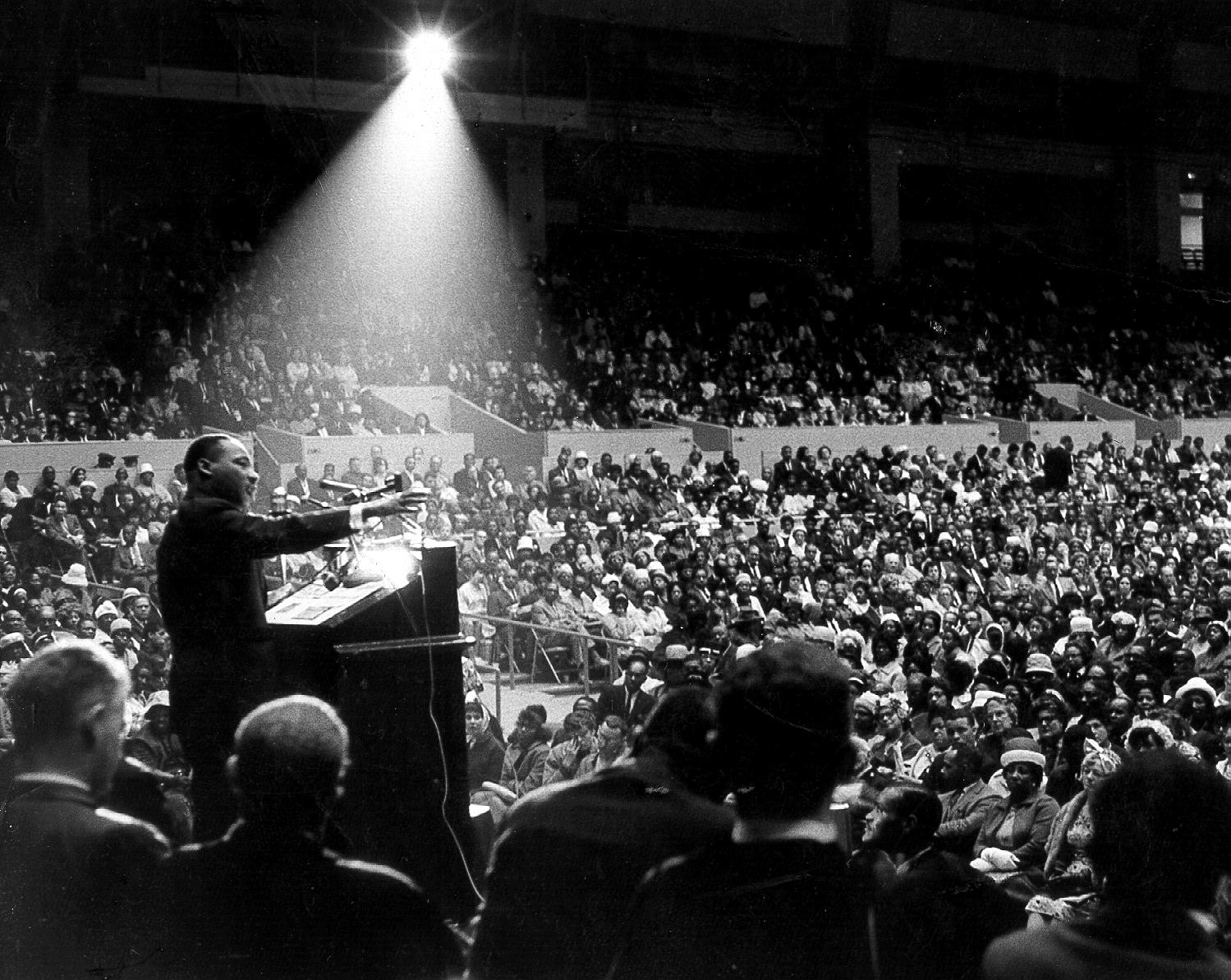
Editor’s Note: The opinions expressed here by the authors are their own, not those of impakter.com — In the Cover Photo: Martin Luther King, Jr. speaking at interfaith civil rights rally, San Francisco Cow Palace, June 30 1964. Cover Photo Credit: George Conklin.