Those of us outside Africa have had much to focus on lately, from Ukraine to South and North Korea, inflation, climate change, pandemics, nuclear threats, and the US midterm elections. What has been lost from our Western headlines and news coverage —but not for those concerned—is the complex relations in the Horn of Africa as people and countries vie for space and recognition.
You could call it the three Es and a T: specifically Egypt, Eritrea, Ethiopia, and the Tigray Region.
In understanding regional challenges and pressure points keep in mind that Egypt and Ethiopia are both very overpopulated countries with over 100 million people and rely on the Nile River for water for their people, and increasingly, for their economies (Eritrea has slightly over 6 million people).
The warring parties: Ethiopia, Eritrea, Tigray
Ethiopian President Abiy Ahmed received the Nobel Peace in 2019 for bringing an end to the 20-year stalemate with Eritrea. At that point, he was a virtual star in the West, but that quickly faded over the course of the next two years with the devastating war with the Tigray People’s Liberation Front (TPLF) in Ethiopia’s northern Tigray Region, one in which he was joined by Eritrea in fighting the TPLF.
The extent of hostilities in Tigray and to some extent outside that region had a major negative impact on the people with over two million people displaced and possibly 500,000 or more killed – by some estimates, up to 800,000 were killed.
The war has also resulted in the loss of social cohesion, infrastructure, and economic activity. Civil strife like this means political wounds are deep and will be hard to quickly heal.
That said, for the first time, there are real prospects to start the healing process. After 10 days of peace talks, and successful negotiations in South Africa, an agreement was reached between Ethiopia and the TPLF to what is called “a permanent cessation of hostilities”.
This step could lead in the future to a more comprehensive pact and ultimately the end of the conflict.
While the agreement is not yet publicly available, it has been described by the press as follows:
African Union envoy Olusegun Obasanjo, in the first briefing on the peace talks in South Africa, said Ethiopia’s government and Tigray authorities have agreed on “orderly, smooth and coordinated disarmament.” Other key points included “restoration of law and order,” he said, as well as “restoration of services” and “unhindered access to humanitarian supplies.”
This is promising except for one fact: One of the Es, Eritrea, was not a signatory to the agreement. Even though Eritrea has now improved its relations with Ethiopia and fought to contain the Tigray resistance, nonetheless it was not part of the peace talks and it is not clear what its government will do.
Further, representatives from Ethiopia’s Amhara region were also not a signatory, and it has had a long history of border disputes with Tigray.
One must hope not only that relative peace holds and the two parties adhere to the agreement terms, but equally if not most importantly, that the Eritreans will sign on to it.
If this proves to be the case, Western partners providing the needed humanitarian supplies and development aid will need to support continuing improved relations between the erstwhile warring parties, with external assistance and encouragement.
Future economic development in the Horn of Africa is facing a special geopolitical challenge: The Nile river that flows from south to north, tying the two Es, Egypt and Ethiopia, which inevitably involves the third E, Eritrea–and Sudan- in any development plan.
The “Dam” question: Ethiopia-Egypt Nile Problem
Both countries see their future as tied to the Nile River with Ethiopia seeking massive new power generation from its Grand Ethiopian Renaissance Dam (GERD) as the means to propel its economic growth.
Egypt’s economy, agriculture, civilian populations, culture, and history, make it virtually impossible to separate from this river.
For decades, Egypt and another major affected country, Sudan, have disagreed with Ethiopia on the need for a legally binding agreement on the operation of the dam – Ethiopia says any pact should only be advisory.
The crux of the problem today is what happens next with this disputed dam, the largest hydroelectric project in Africa, with a cost of more than four billion dollars (some say five billion).
Much to the dismay of its neighbors, in August 2022 Ethiopia had completed the third GERD filling unilaterally, steps not yet taken in March 2022 when this was the subject of an Impakter article.
To Egyptian leaders, reductions in the flow of the Nile River is equivalent to undermining national security and survival.
On November 2, 2022, Egypt President Abdel Fattah al-Sisi said at the Arab Summit in Algeria put it this way:
“Egypt’s water resources have become unable to meet the needs of its population despite following a policy to rationalize consumption, through the frequent reuse of agricultural irrigation water that made the overall efficiency rate of its use in Egypt one of the highest rates in Africa.” (bolding added)
And further,
“Climate change has become a reality imposed on the world, and the dilemma of water security portends dire consequences if ignored, he said, stressing the need to preserve common Arab unity to face challenges.”
To be noted in this connection: The Egyptian President’s statement appears to overlook a critical element of the food insecurity situation in Egypt, namely its heavy dependence on grain imports from Ukraine and Russia and makes no mention of it.
He makes no mention of the recent UN “Black Sea Grain Initiative” which is a major achievement resulting from the combined efforts of governments, the United Nations, international institutions, and non-governmental organizations, in particular, the Centre for Humanitarian Dialogue (HD), and its leader David Hartland. On Nov. 3, the HD Center received the 2022 Carnegie Wateler Peace Prize at a ceremony in The Hague in recognition of their work “to prevent and resolve armed conflicts through mediation and discreet diplomacy”.
The current Arab League meetings, as a result of its side and informal discussions, make it difficult to gauge whether behind the scenes there is important progress being made by the parties with help from outsiders.
One can hope such is the case, given the consequences if no solutions is found.
The Horn of Africa Needs Watching
International attention today is mainly on Ukraine, to a lesser degree on the Far East, Middle East, and elsewhere, as well as elections in many places.
While all of the above are important, we cannot lose sight of the fact that this region is significant and essential to global stability, climate change, economic growth, and pandemic containment.
The Horn of Africa is sort of the “door” to the continent. In the countries mentioned as well as in Djibouti, both Russia’s and the People’s Republic of China’s presence and influence have been rapidly rising. And, this is the case in other corners of Africa, such as in francophone countries in West Africa where since February 2022 France announced the withdrawal of its troops from Mali.
Is this a time for the West to step back from its presence in Africa? Better hope not.
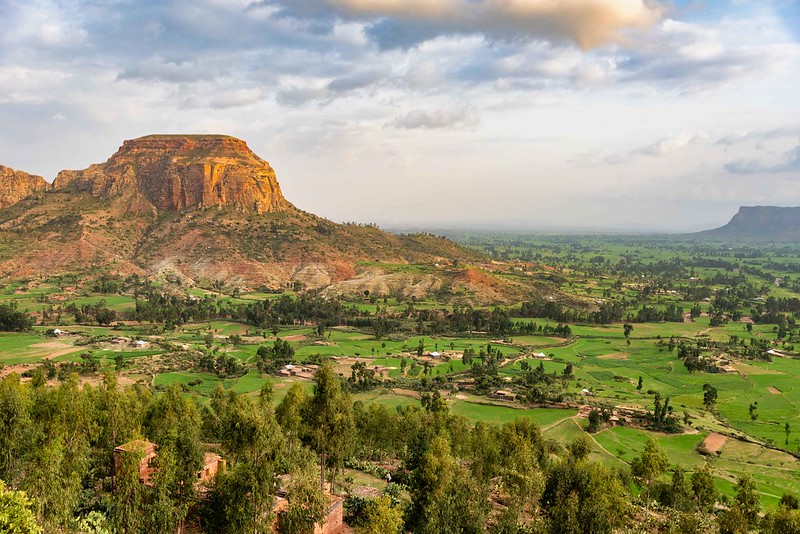
Editor’s Note: The opinions expressed here by the authors are their own, not those of Impakter.com — In the Featured Photo: Rural Tigray before the war – photo taken on 25 July 2017 – as the photographer Rod Waddington says: “ It’s heartbreaking. We are partners with friends in Adigrat in a restaurant for 8 years. Berhan said the soldiers came and looted the business and took everything back over the border to Eritrea. Tigray is being stripped of everything.” Source: Flickr