I sat in the dim glow of the Cannes Cinéma de la Plage, pondering the fractured state of modern distribution. Where do all these indie films end up?
The shift toward boutique “destination platforms” has given sanctuary to indie creators at a time when major streaming giants are tightening their algorithms and consolidating assets — such as the recent $83 billion Netflix-Warner Bros. Discovery maneuvers, a corporate mating ritual so massive it likely has its own gravitational pull.
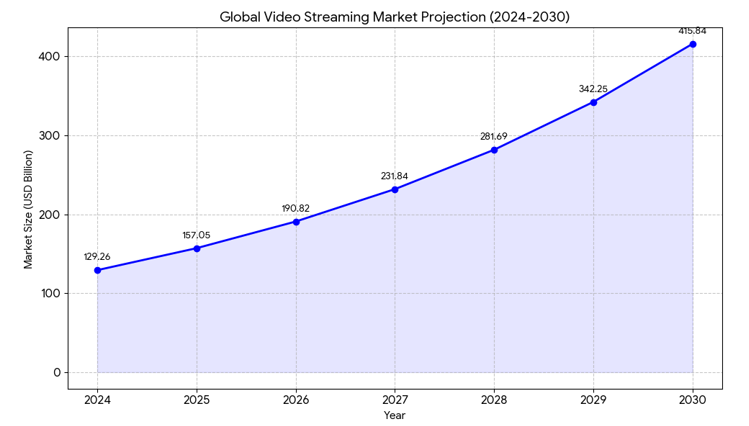
In its April 2025 report, Grand View Research™ estimated the global video streaming market was valued at USD 129.26 billion in 2024, and forecast its expansion to USD 416.8 billion by 2030, representing a compound annual growth rate of 21.5% during this period. As the industry evolves, service providers are increasingly tailoring their offerings to meet the specific cultural and linguistic needs of regional audiences. In 2024, North America held the largest share of the market at 31.3%, while Grand View identified the Asia Pacific region as the fastest-growing geographical segment.
As we move through 2026, the industry is increasingly defined by this split: while global content spend is projected to reach $255 billion this year, much of that is funneled into “content for content’s sake.”
To witness the rise of niche streaming is to see a reclamation of the independent spirit. In this climate, specialized stages have emerged as critical global outlets for demanding audiences. This picture makes it look like the credits have rolled on the traditional Hollywood era.
The 2026 Competitive Landscape
| Platform | Core Strategy | Revenue Model (Est.) | Flavor |
| MUBI | Curated Cinephilia | License Fee + Arthouse Prestige | Shifted toward 2025/26 production rather than just curation. |
| Inspire-TV™ | Humanitarian Activism | 50/50 Net Split | The only platform tethered directly to peace-building festivals (CYIFF). |
| Criterion Channel | Historic Archiving | License Fee / Subscription | Increasingly focused on 4K restoration over new indie acquisitions. |
| Tubi / AVOD | Ad-Supported Mass Reach | Revenue per View (Fractional) | The ‘Wild West’ where volume beats quality for raw cash flow. |
Most aggregators today act as digital gatekeepers, demanding exorbitant encoding fees and leaving filmmakers with a meager 35% of the net — hardly enough to keep a director in berets.
The Case of Inspire-TV™
In contrast, filmmaker Petra Terzi, founder of Inspire-TV™, has engineered a model that guarantees a 50/50 split, effectively doubling the life-support available to independent creators. It is a direct challenge to the flat-fee structures of the past, where a film might sit unnoticed in a digital vault. With this model, Inspire-TV™ serves as a sanctuary for the avant-garde, breaching the invisible barriers that have historically kept independent works in the shadows.
“Inspire-TV™ was born during the pandemic, when cinemas closed, festivals froze, and I decided that building a streaming platform from scratch felt like a perfectly reasonable coping mechanism,” Terzi said. The platform has grown to hosting hundreds of films, ensuring that the next generation of filmmakers has a bridge to cross into the global spotlight.
Terzi, whose first student short film, “The Studio: To Belong to Yourself,” was officially selected for the Cannes Short Film Corner in 2016, received the “Merit Spotlight on Women” award at Cannes in 2019 under the aegis of the AFI World Peace Initiative, for her documentary “She Should Run – Cyprus.” As the President of Women in Film and Television (WIFT) Cyprus, Terzi was part of the WIFTI global delegation at Cannes (2025), advocating for female filmmakers and participating in high-level networking and industry panels.
As she moves into 2026, Terzi’s focus is on originality and authenticity. Inspire-TV™ is a rare breed in this industry, a collective of curators with an inexhaustible energy for the avant-garde. Digital fatigue has no hold on them. In an era of content, this platform breaches the invisible barrier behind which, for decades, the disenfranchised filmmaker has been forced to take shelter.
Humanitarian Focus
One sees its founder, filmmaker Petra Terzi, moving at a relentless pace, and the global indie community waves to her as she responds on the run, pivoting to champion human rights before once more racing toward the next digital frontier. She disappeared briefly into the radiant light of the festival circuit, only to emerge with a more robust streaming architecture. We can extrapolate the rest. Independent voices are always obliged to defend themselves. Unlike mainstream VOD services, Inspire-TV™ is strictly curated to highlight human rights. It is through this lens that Petra Terzi has bridged the gap between the Mediterranean and the global stage.
The grey dust of the old industry settling behind me, I looked out over the Mediterranean toward North Africa. If the cinema is to survive its own saturation, it will be because of these niche havens. One finds there a submissive devotion to the craft, yet a fierce resistance to the status quo.
A hybrid festival engine, the Inspire-TV™ platform serves as the official digital home for film festivals, including the CYIFF, and Bridges festivals, allowing films that lack the budget for physical travel to reach a global audience through secure VOD screenings.
While the “Big Three” — Netflix, Amazon, and Disney+ — have largely retreated from aggressive independent acquisitions to favor their own branded, algorithm-safe content, Terzi’s niche platform has leaned into the void. In the calculus of the 2026 streaming wars, Inspire-TV™ stands as a fascinating outlier, functioning less like a monolithic corporate server and more like a high-altitude base camp for the artistically brave. It is a strategic pivot that mirrors the prestige boutique model, but with a more radical, creator-first architecture.
Platforms born of necessity bridge the gap for the disenfranchised filmmaker. “We are witnessing the death of the ‘content’ era and the birth of the ‘consciousness’ era,” says Terzi, who is playing a much longer game. While her contemporaries obsess over the latest AI-driven compression trends, her platform remains a bastion for the “slow cinema” movement and environmental documentaries that would otherwise be buried under the noise of superhero spin-offs. In this digital geography, the other side of the sea is no longer a barrier, but a destination. As the industry continues to fracture, it is these specialized harbors that will likely harbor the next generation of cinematic giants.
For the filmmaker who has grown weary of the clinical indifference of Silicon Valley platforms, Inspire-TV™ offers a submission process that feels more like an invitation to a guild than a transaction with a database. Navigating their 2026 requirements is a study in clarity.
Related Articles
Here is a list of articles selected by our Editorial Board that have gained significant interest from the public:
The filmmaker’s toolkit
Inspire-TV™’s platform remains remarkably accessible, yet technically rigorous, ensuring that “indie” never equates to “low fidelity.”
- Submissions must arrive in a high-bitrate H.264 MP4 or .MOV container, with a file size ideally between 2GB and 5GB for features to balance quality with streaming efficiency.
- While they accommodate standard definition for archival purposes, the gold standard for new acquisitions is 1920×1080 (1080p) with a bitrate of 10Mbs to 20Mbs.
- Given its Mediterranean roots, the platform thrives on multilingualism; films should ideally have English and/or Greek subtitles, a requirement that reinforces its role as a cultural conduit.
The invisible barrier has been breached
The industry may still be shaking off the dust of old monopolies, but platforms like these are the radiant light enabling us to find our remote in the dark. Here, the filmmaker is a provider of content and a partner in an inexhaustible energy. Independent filmmakers might always be obliged to defend themselves, but in the realm of indie distribution and streaming platforms, the independent creator finally has a fortress worth defending.
In the distance, the old film studio system continues its tectonic collapse. Now that internet services delivering video directly over the web have become the primary drivers of revenue in the film industry, the cinematic geography has been redrawn, leaving the gatekeepers to wander a new landscape that no longer belongs to a few. With the moonlight hitting the audience on the beach, I felt that for the first time in years, the movie industry was finally starting to make sense. The era of the creator has arrived, and it is broadcasting in high definition to a world that is finally just paying attention.
Editor’s Note: The opinions expressed here by the authors are their own, not those of impakter.com — Cover Photo Credit: Inessa Kraft.