How AI data centres affect clean energy and water security
As the holiday season begins, many of us are engaging in activities such as binge-watching festive movies, gaming with friends, video-calling family, or even asking Artificial Intelligence (AI) for last-minute Christmas gift ideas. But behind every click, stream, and prompt sits a vast physical system operating 24/7.
The “cloud” isn’t actually a cloud. It’s a global network of physical infrastructure within warehouses containing servers, cooling equipment, and electrical substations. Every film you stream, every photo you back up, every message you send, or every AI chatbot you query is processed by machines that must be continuously powered and cooled.
Energy costs and a green opportunity
Over the past decade, the growth of these data centres has been rapid. According to JLL UK, global demand for data centres is projected to reach 80 gigawatts (GW) by 2027 across the Americas, the Middle East, North Africa, and Asia-Pacific. For context, 80 GW is approximately sufficient to power one billion light bulbs simultaneously. And this is only a conservative estimate.
On the other hand, institutions like McKinsey are forecasting a grimmer outlook, where global data centre capacity demand is projected to grow by 19-27% by 2030, and potentially consuming 171-298 GW of power annually by 2030 based on their forecasts. For context, that’s around three times the capacity of the entire UK electricity grid. This growth reflects how deeply digital services, cloud computing, and AI are now woven into everyday life.
All of this has a very real cost: electricity. According to the International Energy Agency’s (IEA) 2025 energy and AI report, data centres accounted for 1.5% of global electricity consumption in 2024, with demand growing by about 12% annually. That share is expected to more than double by 2030.
At the same time, according to the same IEA report, the energy intensity of individual data centres is rising fast. Power density inside server racks has more than doubled in just two years, increasing from 8 kilowatts (kW) per rack to 17 kW per rack, with projections of reaching 30 kW by 2027. To put that in everyday terms, a single rack could soon draw as much power as 30 household toasters running at once.
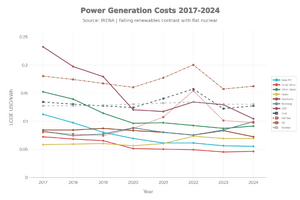
The good news is that meeting this demand is becoming more cost-effective and environmentally friendly. As shown in the chart above, the economics of renewable energy have shifted dramatically since 2017. Solar panel (Solar PV and CSP) costs have fallen to the point where fossil fuel is not as price competitive as it used to be; likewise, onshore and offshore wind have followed a similar downward trend.
By contrast, the prices of fossil fuels such as coal, natural gas, and oil are trending upward and remain volatile, as evidenced by spikes during Europe’s 2022 energy crisis, which has not yet fully stabilized.
However, the chart shows that the once-promised cheap and clean nuclear power continues to lose out in price year after year to other clean energy sources, such as hydropower, geothermal, and bioenergy. This is due to long construction timelines and rising costs. In practice, the challenge of powering data centres reliably and cleanly is being addressed less by ideology and more by straightforward economics, as illustrated in the chart above.
In many ways, data centres have helped accelerate the adoption of renewable energy. Their enormous, steady demand makes them ideal customers for large-scale clean energy projects, turning what was once seen as digital excess into a driver of energy transition.
Data centres and water security
Yet electricity isn’t the only resource under pressure. According to Ceres’ “Drained by Data” report released in September 2025, as data centre demand grows, water security has quietly become one of the sector’s most critical risks, specifically freshwater/drinking water security.
Here, the water is used in two main ways. Firstly, it is used to cool on-site servers to prevent overheating. Ceres’ “drained by data” report identifies water-scarce places such as Phoenix, Arizona, as being hit hardest, since data centres there can consume an estimated 3.7 billion gallons of water per year, enough to fill approximately 5,600 Olympic swimming pools.
Secondly, the Ceres report also notes that water is used to generate the electricity that powers these facilities. Sticking to the Phoenix, Arizona case, indirect water use has been estimated at nearly four times the direct cooling demand, amounting to 14.5 billion gallons of freshwater annually, sufficient to supply a city of 244,000 people for two years.
Related Articles
Here is a list of articles selected by our Editorial Board that have gained significant interest from the public:
Furthermore, the AI boom intensifies and complicates the problem, as running and training more AI models requires substantial computing power, which consumes large amounts of electricity and necessitates extensive cooling, thereby increasing water and energy demand. Yet, data transparency in this area remains limited, as only about 40% of data centre operators actively track water usage, leaving communities and policymakers with an incomplete picture of the true impact.
Ultimately, water security is a question of risk. Data centres tend to cluster in specific regions to share infrastructure, thus creating “pressure points” where they compete directly with communities for freshwater. For example, the UK could be projected to be in a daily freshwater deficit of 5 billion litres by 2050, according to its 2025 Water Use in AI and Data Centres report. Thus, this competition could catalyze a shift toward stricter water-use regulations, higher operational costs for data centres, and potential social conflict unless proactive water-sharing frameworks are established and enforced.
To close, as data centre demand accelerates, the bottleneck won’t be innovation; it will be resources. Companies and governments that master their clean power generation, grid infrastructure, water resources, and water efficiency will dominate in the AI era. Those that don’t will face rising costs, regulatory friction, and operational crises. The next stage of digitalisation will not be written in the world’s Silicon Valleys, but in water basins, power grids, and clean and reliable power generation.