This article was originally published by Development Alternatives Blog Series – Alternative Perspectives. The original article can be found here.
Sustainable Development Goals (SDGs) were adopted on September 25, 2015 by 193 countries as a follow up to the Millennium Development Goals. The SDGs focus to end poverty, protect the planet and ensure prosperity for all, as part of a new sustainable development agenda. A total of 17 goals and 169 targets are set to be achieved by 2030 and the realisation of the same calls for a collective effort from the government, the corporates and the civil society organisations.
India has also signed the declaration for sustainable development along with other countries. While the government initiatives in India are linked to achieving SDGs, local implementation and data validation becomes a challenge. To add on to the slow progress, India ranks 116 of 157 on the SDG index, thus calling for immediate action through a collaboration between the corporate sector, civil society organisations and the government. Corporates are now being seen as the key drivers of SDGs as they can apply their creativity and innovation in solving the sustainable development challenges and can play a strong role as facilitators to catalyse implementation of the SDGs.
This article talks about leveraging Corporate Social Responsibility (CSR) to achieve the SDGs for sustainable growth in a holistic manner for the people and the planet.
The Sustainable Development Goals provide a powerful framework for businesses to engage in corporate social responsibility. In India, the CSR policy under section 135 of the Companies Act (2013) came around the same time as the formation of the SDGs. CSR policy was established to address the various development challenges. CSR and SDGs together have tremendous potential to develop an interconnected model for sustainable growth. There is a lot of overlap in the thematic development areas of both the SDGs and CSR.
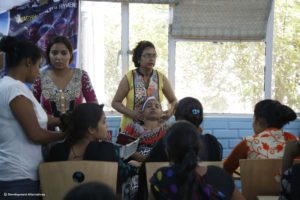
IN THE PHOTO: Practical demonstration for Assistant Beauty Therapist trainees at DA’s Ghitorni centre of Excellence, Delhi. CREDIT: Development Alternatives
SDGs have immense opportunities for the corporate sector’s participation. These goals are bringing private players from various sectors to achieve the common aim of sustainable development by exploring synergies between different stakeholders for cumulative synchronised growth. For example, when an organisation defines its CSR focus area on enhancing livelihoods through skill development training of women and youth, it is contributing to various SDGs like creating a means to end poverty, zero hunger, quality education, gender equality and decent work and economic growth.
While the Indian Government has made bold moves through its various schemes to reach out to the masses and contribute to achieving the SDGs, civil society organisations like Development Alternatives have initiated various innovative programmes in collaboration with the corporates to add to the impact. One of the key programmes of Development Alternatives is the ‘Skills to Livelihoods programme’ that is supported by many corporates. This programme has been designed to provide productive employment and decent work for all. Currently, it is being supported by a leading non-banking financial company called Fullerton India Credit Company Limited (FICCL) which offers various retail finance products for rural households and small and medium enterprises in India.
Through the ‘Skills to Livelihoods programme’, youth and women are trained in alternate vocations to build sustainable livelihoods that are a means to increasing their family income. This helps in reducing poverty, reducing inequalities and providing a means to decent work and economic growth, thus contributing to achieving SDGs 1, 8 and 10. Till date, through FICCLs financial contributions under their CSR, Development Alternatives has impacted 1000 individuals by giving them sustainable livelihoods through the skill development programme.
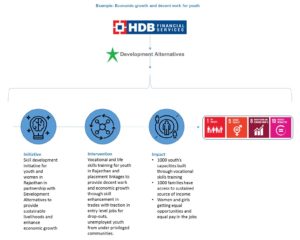
CHART CREDIT: Development Alternatives
Another company that Development Alternatives has partnered with is one of India’s largest FMCG companies (company not to be named, as per the company publicity guidelines). This company is committed to operate and grow it’s business in a responsible way by reducing the environmental impact of it’s operations and increasing positive social impact. The company redefined its CSR to achieve three big goals under the activities listed in the Schedule VII of Section 135 of the Companies Act, 2013. The first goal focusses on improving health and wellbeing of people. The second one is to reduce the environmental impact of making and using it’s products and finally enhancing livelihoods of a large number of people. The company has also identified water scarcity as one of it’s key areas and has initiated various water conservation programmes in India. Taking into account all it’s key focus areas, it has collaborated with Development Alternatives to undertake skill development programmes that focus on employment generation and entrepreneurship among youth and women, water sanitation and hygiene (WASH) programmes, nutrition for girls and all other types of target groups. The company not only manages to meet its CSR mandates but also helps in largely contributing to the SDGs as a final outcome. This FMCG company is an ideal example that showcases diligent and optimal use of its CSR resources in convergence with the knowledge, implementation and grassroots experience of civil society organisations like Development Alternatives to achieve the SDGs. Through the various programmes undertaken and implemented by Development Alternatives, this company has contributed to six key sustainable development goals of ending poverty (Goal 1), promoting sustainable economic growth and decent work for all (Goal 8), achieving gender equality and empowering women and girls (Goal 5) and reducing inequalities (Goal 10) through its skill development initiatives for youth, girls and women. It has also directly contributed to ensuring healthy lives and promoting wellbeing for all (Goal 3) and sustainable management of water and sanitation for all (Goal 6). This partnership between Development Alternatives and this FMCG company has till date impacted the lives of over 50,000 individuals, directly and indirectly.
The above cases strongly show how the convergence of corporate resources with the knowledge and expertise of civil society organisations are key in achieving the sustainable development goals seamlessly. Corporates now understand the value that can be derived from working towards the SDGs and a large number of corporates have already started taking measured steps in this direction. Along with strategic business benefits, SDGs also serve as a tool to manage increased scrutiny from various stakeholder groups over various social, environmental and labour issues. Although significant strides are being made by the corporates, the need still remains to engage in meeting the SDGs in a way that helps in developing strategies to manage the social and environmental performance of companies so that it results in developing smart businesses that capture opportunities and come up with innovative products and services to achieve the highest standards of sustainability.
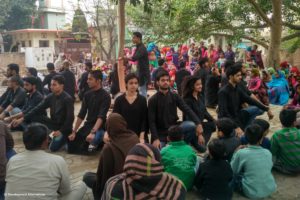
IN THE PHOTO: Street plays to create awareness on Girl Child Education. CREDIT: Development Alternatives
Editors Note: The opinions expressed here by Impakter.com columnists are their own, not those of Impakter.com