

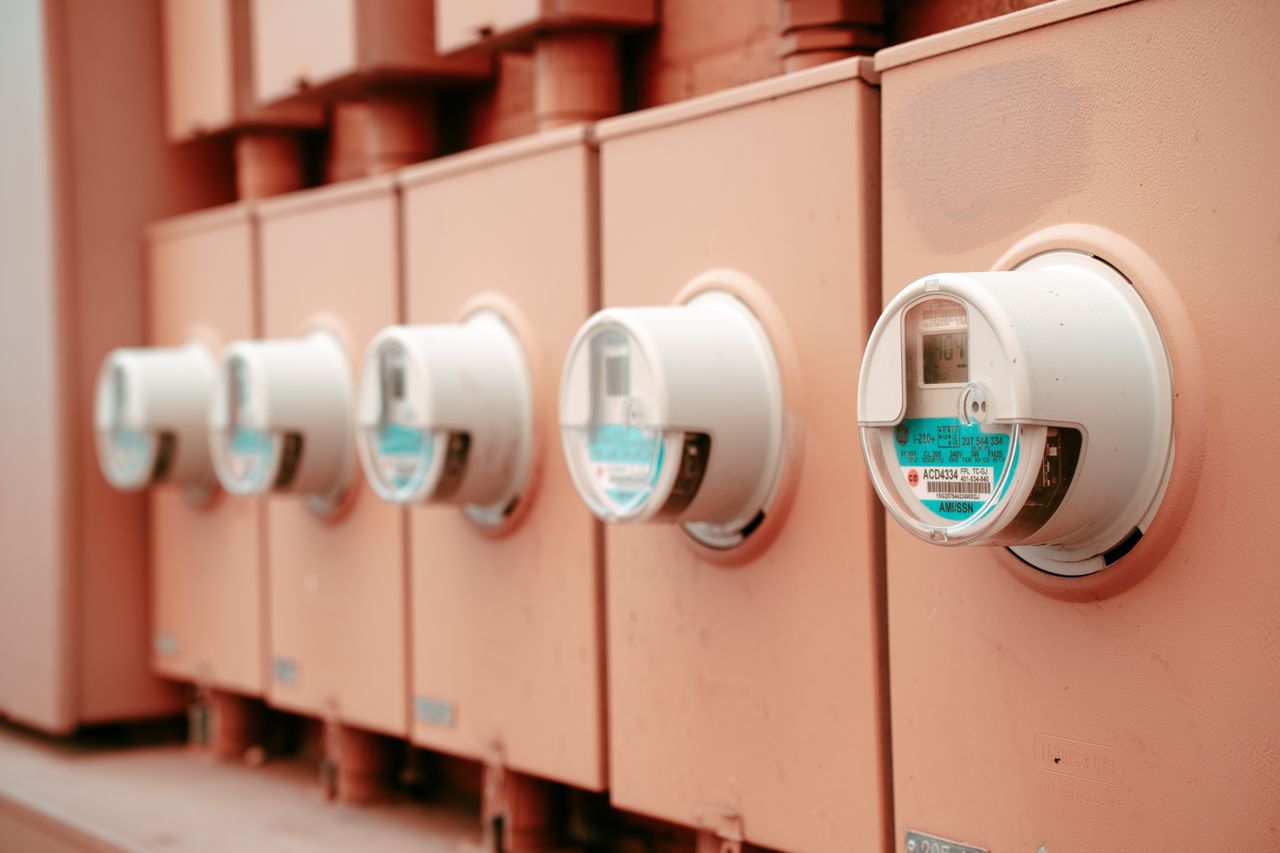
Utilities talk about data platforms, AI forecasting and virtual power plants. Far less is said about the thumbnail-sized component that turns electricity into a number in the first place.
Pry the cover off a modern electricity meter (a job best left to a utility technician) and the inside is a letdown. There’s a green circuit board, a radio module, a small chip that does the arithmetic, and a scattering of capacitors. Near the terminals, where the household supply passes through, sits a ring of metal wound with hair-thin copper wire, often sealed in black resin and soldered straight onto the board. It looks like the least interesting thing in the box.
It may be the most important one. That ring is a current sensor. The monthly bill, the 15-minute usage data a utility relies on to plan its network, and the payment a homeowner receives for letting a battery discharge during a heat wave all depend on it. If the sensor is off, every system built on its readings is off too, and nothing downstream can tell.
Over the past decade, utilities have fitted hundreds of millions of these meters to homes and businesses, and the rollouts haven’t slowed. Most of the public debate about them has been about software, data privacy and radio networks. Almost nobody asks how the meter knows what it knows.
What the meter is actually measuring
To calculate energy, a meter needs to know voltage and current at the same instant, many times a second. Voltage is the easy half. Current is harder, because the wire carrying it can deliver enough power to run an entire house, while the chip doing the math works with a tiny fraction of that.
The sensor’s job is to bridge the gap by producing a small, faithful copy of the current flowing through the supply. A current transformer does this with magnetism. The supply wire passes through a ring-shaped core, and a coil wound around that core picks up a scaled-down version of the current without ever touching the live conductor. That separation matters as much as the measurement, because it keeps mains voltage away from the meter’s electronics.
Different jobs, different sensors
There are other ways to sense current, and manufacturers choose based on cost, size, safety and the kind of electricity involved. Some basic residential meters use a simple resistor placed directly in the circuit, which is cheap and accurate but offers no separation from the mains. Equipment handling direct current from solar panels and batteries often relies on magnetic field sensors instead.
Where a device needs isolation in a small space, a common choice is a compact PCB mount current transformer, which is isolated from the mains and small enough to sit on the same board as the rest of the electronics. Versions of these parts turn up in apartment submeters, smart circuit breakers, EV chargers and solar inverters, most of which people don’t think of as measuring devices at all.
Small errors at grid scale
No sensor is perfect, and current transformers have a subtle limitation. Along with scaling the current down, they shift its timing very slightly, usually by a fraction of a degree. On its own that sounds harmless. But in appliances built around motors and compressors, such as air conditioners, refrigerators and pumps, current and voltage are already somewhat out of step, and a small timing error in the sensor gets magnified in the final energy figure. For a strongly motor-driven load, a tenth of a degree can shift the reading by roughly 0.3 percent.
That’s one reason meter standards, including ANSI C12.20 in the US and the IEC 62053 series internationally, define accuracy classes, and why reputable meters are tested against them before they’re installed. Even within those limits, small errors deserve attention because of how many meters there are. American households buy roughly 1,500 terawatt-hours of electricity a year. A systematic bias of 0.1 percent across all of it would come to about 1.5 terawatt-hours, worth around $240 million at typical residential prices. Nobody is suggesting the US meter fleet is skewed that way. The arithmetic simply shows why engineers argue over decimal places.
Holding up under interference
Accuracy also has to survive conditions the designer didn’t choose. Electricity theft costs utilities billions of dollars a year, much of it in countries where networks are already financially stretched, and some of it involves interfering with meters using strong external magnetic fields or unusual loads that older sensor designs struggled to handle.
Manufacturers responded on two fronts. They switched to core materials that keep measuring accurately when someone tries to interfere, and they added tamper alarms, so a meter under attack now reports the attempt instead of quietly under-counting. International meter standards test for this kind of interference, which has made resistance to it a baseline expectation rather than a selling point.
Measuring at the grid’s new edges
A home with rooftop solar and a battery behaves differently from a conventional one. For much of the day, its net flow sits near zero, flipping between importing power and exporting it. That keeps the sensor working at the bottom of its range, where accuracy is hardest to hold. And these are exactly the households that net metering and export tariffs are designed to reward.
Flexibility programs raise the stakes. A utility that pays customers to cut demand at peak hours settles those payments from interval data, often in 15-minute blocks. It needs to know what each battery and thermostat actually did. So does the customer expecting a check.
EV chargers ask sensors to do two separate jobs. The first is metering: counting the kilowatt-hours that end up on a driver’s bill or a fleet operator’s invoice. The second is safety. Many chargers must also watch for small leakage currents, including direct current of around 6 milliamps, and cut the power before anyone gets hurt. That second job falls under its own standard, IEC 62955, and often relies on a different, more sensitive type of sensor. A single charger can carry both. Chargers, meanwhile, are going up in driveways, office garages and highway stops at a fast clip.
From the meter to the sustainability report
Measurement accuracy matters well beyond the utility bill. Companies that report their emissions calculate Scope 2 figures, the emissions tied to the electricity they buy, mostly from metered consumption. In the European Union, the Corporate Sustainability Reporting Directive (CSRD) requires large companies to disclose their energy use. Investors increasingly expect those numbers to survive an audit.
One utility meter at a building’s entrance says little about where the energy goes once inside. Submeters on individual floors, production lines, server racks or heat pumps show the details: a ventilation system running all weekend, a chiller cycling more often than it should, a tenant whose consumption doubled after a lease change. They also let a company prove that an efficiency upgrade delivered what it promised. When an auditor asks how a claimed cut in energy use was verified, the answer is usually a spreadsheet of submeter readings.
More sensors, same materials
All of this adds up to more sensors. A house that once had a single meter may now have a smart meter, a solar inverter, a battery, a heat pump and an EV charger, each with current sensing of its own. That growth draws on the same materials as the rest of the grid build-out: copper, specialty electrical steel and advanced magnetic alloys. After 2021, when lead times for large transformers stretched to years, grid planners learned how quickly those materials can become a bottleneck. Small sensors get far less attention, but they draw on the same supply chain.
The analog foundation of a digital grid
The smart grid is usually described as a data challenge: collect more readings, move them faster, analyze them better. Data quality, though, begins before anything reaches the cloud. It begins with copper wire and a magnetic core sealed inside a meter.
That meter will likely stay on the wall for 15 years or more, through heat waves, hard freezes and a household that may add solar panels, a heat pump and an electric car along the way. Most of the attention goes to how accurate it is on the day it’s installed. The harder question is how accurate it still is in year twelve.
Editor’s Note: The opinions expressed here by the authors are their own, not those of impakter.com — In The Cover Photo: A row of electricity meters illustrating the measurement systems behind the smart grid. — Cover Photo Credit: Connor Scott McManus