In celebration of International Women’s Day 2018, a group of outstanding organisations working to empower women within the energy access sector are collaborating on a series of articles. We are sharing the stories of women’s empowerment from around the globe and in this fourth, and final, piece of our series we hear from Emma Colenbrander, Pollinate Energy co-founder and leader of the Energy Markets portfolio at Practical Action. Emma discusses the need for women’s meaningful participation in the global energy sector.
Over the past five years, I’ve read and heard a lot about gender in energy access. The focus has been on the importance of including and empowering women in energy access value chains, particularly as consumers and as sales agents, and how this can be achieved in practice. Energia summarises the rationale for this neatly: when women have access to energy, it contributes to poverty reduction; taking women into account in energy interventions means improved energy access and adoption, and having women in energy jobs improves energy supply chain effectiveness.
This is great – but there’s one big conversation we’re still not having, and that’s about women’s meaningful engagement and leadership in the global energy access sector.
Gloria Steinem once said that women get more radical with age, and this resonates strongly with me. As I get older and my career progresses I increasingly experience and witness biases against women. It’s well known that the mainstream energy sector struggles with an extreme gender imbalance. But I see first-hand that the energy access sector is similarly failing to engage and empower women as advocates, leaders and change-makers.
Energy access conferences are overwhelmingly male. I am consistently sitting through all-male panels (and no, sticking a female moderator on a panel with six men doesn’t count as gender diversity). Leadership in the sector is dominated by men, and this is particularly true of those organisations that hold the purse strings. This makes it hard for me to take conversations about gender in energy access projects seriously – after all, change has to start at home.
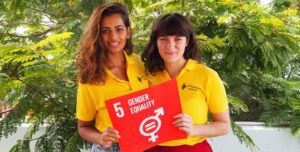
IN THE PHOTO: Pollinate Energy City Co-leaders Meenal and Eloise promoting Gender Equality, one of the official 17 Sustainable Development Goals. PHOTO CREDIT: Pollinate Energy
PEG Africa, a pay-as-you-go solar home system provider in West Africa, is setting a good example here. They have acknowledged the need to do more on gender, both from a fairness perspective and a business perspective, and are tackling this head-on by piloting gender-inclusive business practices. They’ve set out a Gender Action Plan with five key objectives that include increasing the number of women in decision-making positions. This genuine commitment to change is inspiring, and something we can learn from.
More good news: women in energy access are coming together, collaborating, sharing knowledge, and supporting each other to achieve new levels of impact. An example of this is the work I have done over the past year with four-women led social enterprises in Kenya, India and Nepal in exploring opportunities to collaborate in a meaningful way to reduce inefficiency and leverage each other’s respective strengths. This is rare: securing financing is dependent on being able to prove why your organisation is better than your competition, and this creates negative incentives to collaborate and fosters mistrust. But these four women-led enterprises (Pollinate Energy, Empower Generation, Essmart and LivelyHoods) have proven that we can break down these barriers to create a more transparent sector, reduce duplication of effort, and achieve greater impact.
As a result of these collaboration conversations, two of these organisations are now merging to achieve greater scale, while the others have entered strategic partnerships to share information and resources, co-apply for funding opportunities, and advocate on the global stage. This is a rare demonstration of partnerships in action, beyond the usual rhetoric of collaboration at global (male-dominated) conferences.
These conversations started when I was Executive Director at Pollinate Energy, and together we have gone on to lay the foundations for the Global Distributors Collective (GDC), an emerging initiative founded on the belief that for the energy access gap to be effectively bridged we need to change the conversation. Right now the sector is all about competition and picking winners. We want something new: we want sector-wide approaches that lift all boats and allow us to genuinely learn from and build on each other’s work. This is exactly what we’re working to create through the GDC. The GDC seeks to leverage economies of scale and process between last mile distribution companies, for example by centralising functions like procurement and training, and sharing learnings and best practices to optimise business models across the sector.
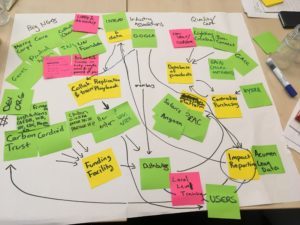
IN THE PHOTO: Mapping the last mile distribution ecosystem. PHOTO CREDIT: Pollinate Energy
I am excited by what I see as a fundamental shift in paradigms and ways of working in the sector. I am excited by women leading the charge to unlock the previously untapped potential for impact at scale.
So what can we do as a sector? Help facilitate these kinds of collaborations and conversations. Put women leaders in the spotlight and provide the right platforms for them to engage. Acknowledge what we’re not doing well within our own organisations and as a collective. Commit to implementing concrete actions to empower women in the sector. Stop letting fear of competition prevent meaningful collaboration. Take the Owen pledge.
And for god’s sake, put a woman on your panel.