In 2009, long before terms like “net zero” or even “climate change” entered the common lexicon, developed countries pledged to deliver $100 billion annually in climate finance to developing nations, starting in 2020. The goal? To help poorer countries ramp up renewable energy, boost energy efficiency, and fortify their infrastructure, agriculture, and ecosystems against intensifying climate impacts.
A figure of this level is neither insignificant nor unheard of when it comes to government spending, even on the climate. By comparison, US President Biden recently requested $100 billion in aid for states affected by the enormous 2024 US hurricanes — Helene and Milton — two climate disasters in one country within two months.
The 11-year grace period was designed to give wealthy countries time to recover from the 2008 financial crisis, the disaster caused by financial elites that governments bailed out. The delay also diminished the ugly political pushback that wealthy country governments often face whenever they’re asked to commit funds for developing countries and former colonies.
UN officials embraced the $100 billion pledge as a triumph, and Global North governments felt redeemed. Developing nations, having been there before, eyed the deal with weary suspicion. Their concerns? Too little money, too many loopholes, and much too much private sector finance driven by profit margins, not climate justice.
Sudanese diplomat Lumumba Di-Aping of the G77 group of developing nations voiced his assessment on the floor of the climate negotiations. “We have been asked to sign a suicide pact,” he stated emphatically. “It is unfortunate that after 500 years-plus of interaction with the West, we [Africans] are still considered ‘disposables.’”
By the mid-2010’s, it became obvious that commitments would fall embarrassingly short. Humiliatingly, wealthy countries were caught rebranding existing aid to the world’s poor as part of their new $100 billion pledge. Others padded their figures with loans, with Reuters reporting that “wealthy nations are reaping billions of dollars in economic rewards from a global program meant to help the developing world grapple with the effects of climate change.”
By 2020, rich countries claimed to have delivered $83 billion. Oxfam’s analysis suggested the real value was closer to a third of that. The gap between pledges and payments was glaring.
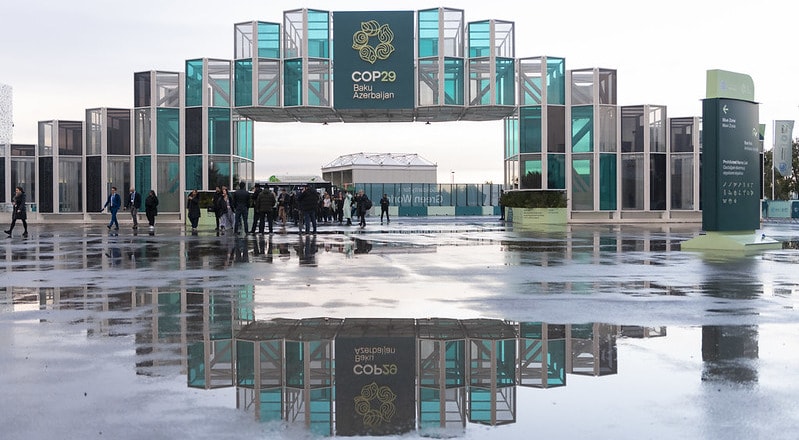
The purpose of COP29, the recent UN climate negotiations held in the capital of oil-rich Azerbaijan, was to fix this mess. Unable to pass up the chance to coin a new acronym, UN officials called for a “new collective quantified goal on climate finance” (NCQG) to replace the $100 billion figure. Pre-COP studies estimated that developing countries need between $500 billion and $1 trillion annually from international sources to reduce their emissions and increase their ability to withstand climate change’s impacts.
In addition to hoping for a figure within this range, many also came to the COP hoping for additional progress. Many hoped for agreement on a governance structure and funding levels for the 2022 Loss and Damage Fund, which was established to channel funds from historic climate polluters to countries that had polluted little while suffering irreparable harm. Others pushed for clarity on the timetable and uses for new finance and clear standards to measure how much countries actually give. Overall, the aim was towards less hocus pocus and more bankable substance.
As hopes hung in the balance, two narratives became evident as one walked around COP. In the minority were the voices of climate-vulnerable nations, Indigenous groups, and climate activists calling for more finance and less red tape. Listening to these voices and reading their materials, one could actually tell that climate change is happening, that it is inflicting grave levels of suffering, and that wealthy countries should commit funding as a matter of fairness and decency.
But these voices were overwhelmed by a surreal cacophony of messages from corporations and governments, rich and poor alike. Wealthy country booths, referred to as “pavilions,” exuded confidence as they runway-walked high-gloss technical climate solutions — many of which are unproven at scale and unable to deliver results in the vital fifteen years to come (viz. carbon capture and sequestration).
Many poorer countries, in a manner both awkward and sad, presented themselves as attractive destinations for clean energy capital, promising a friendly reception for offshore investors. Pakistan was notable for its willingness to remind its pavilion visitors that in 2022, fully a third of the country was underwater due to climate-induced flooding.
Related Articles: ‘We Lost’: How COP29 Ended With a Deal That Made the Whole World Unhappy | COP29: Weak Finance Deal Is a Setback for Climate Action | Are COP29 Food Pledges Going to Succeed? COP28’s Impact Holds Clues | COP29 in Trouble: Calls for Drastic Reform | Inside COP29 | Finance and Equity Should Be the Core of COP29 Talks | Will COP29 Reach Consensus on More Funds for Climate Finance? | COP29: Agrifood Systems Transformation Holds Solutions for the Climate Crisis
Then there were the corporate ads, plastered not only on COP booths but on airport walkways and advertising kiosks around the capital city of Baku. One showed a photo of a woman wearing stylish outdoor gear superimposed over a gleaming new gas refinery and pipeline. At the bottom of the ad, the phrase “Energy is a journey,” elided psycho-spiritual well-being and love of nature with fossil fuel expansion. Dignity and ethical seriousness were palpably absent in these messages, which led one to believe that the real boom in green jobs in Baku was among ad copywriters and image merchants hired to greenwash the event.
After developing countries walked out of the negotiations several times over the level of commitments under consideration, wealthy countries agreed to triple the annual target for climate finance from the current $100 billion to $300 billion by 2035, with the operative words being “target” (not commitment) and 2035 — as in ten years from now.
There was also fuzzy language about a total of $1.3 trillion of financing to be provided to developing countries by 2035 (there’s that ten-year delay again), but the agreement contained no obligation whatsoever on countries to meet this higher target, and private, profit-seeking finance was widely understood to make up almost the entirety of this amount.
Most developing country parties have rejected the idea of taking on more debt to pay for their greenhouse gas (GHG) emission reduction and climate change adaptation measures. This utterly reasonable position is on track for a head-on collision with the plans of wealthy governments and the financiers and corporates whose bidding they usually do.
The issue at hand is not a lack of money. Global North governments, financial institutions, and corporations have money and they spend it when they want to. The G20 nations spent trillions on their response to COVID within months. The US and Western Europe spent massive sums to defend Ukraine and had little trouble finding money within a matter of days. Less in plain sight but as relevant, a 2022 study showed that fossil fuel companies have secured profits of $3 billion per day for the past 50 years for a total surpassing $50 trillion.
“You can buy every politician, every system with all this money, and I think this happened,” said the study’s Belgian author, who is also a former lead author of an Intergovernmental Panel on Climate Change report.
And yet, if wealthy governments and financial institutions could truly recognize the clean energy revolution unfolding almost despite their efforts, this moment could transform from lamenting the darkness to celebrating the growing, renewable-powered light spreading across the globe.
For 100 days during 2024, for example, California — the world’s 5th largest economy — generated 100% of its electricity needs from renewable sources, a spectacularly hopeful achievement made even more poignant as the Los Angeles fires rage. Pakistan saw its national electricity supply increase by a third last year because individuals, fed up with waiting on an unreliable and insufficient fossil fuel-powered grid, bought up inexpensive Chinese solar panels and installed them on their roofs. Deployment of solar and wind power consistently blows past expert projections about their maximum growth rates. With a tripling of its current level of finance, renewable energy can get the world back on track towards the Paris Agreement’s 1.5°C target.
A much fairer, more humane future is within reach. But financial institutions, governments, and corporations need to pony up now. Not in ten years, maybe.
Editor’s Note: The opinions expressed here by the authors are their own, not those of Impakter.com — Cover Photo Credit: COP29.