By now, most countries around the globe have begun to take steps towards living in a post-fossil fuel world, driven by motives like environmentalism and energy security. Longstanding energy sources like coal and natural gas have begun to be replaced with alternatives like wind, solar, and hydroelectric power. In the US, renewable sources account for around 12% of all energy production, a figure that is as high as 53.9% in Sweden.
While there are many different types of renewable energy resources, not all of them are equal in terms of efficiency. In particular, wind power is more efficient than solar power, with one wind turbine capable of producing the same amount of electricity per kWh as over 48,000 solar panels. But with wind energy’s pros come its cons as well, like its traditional noisiness and the potential of turbines to harm flying wildlife.
Despite these challenges, Semtive decided to enter the space in an attempt to make an impact on the energy industry and the world. Unlike the turbines of old, Semtive’s products operate at very low speeds while emitting very little noise, and can convert energy to electricity through a simple outlet. I interviewed Semtive CEO and co-founder Ignacio Juarez to learn more about the company’s products, growth challenges, and its attempts to digitalize the energy industry.
What was the original impetus behind Semtive?
IGNACIO JUAREZ: The company was founded in Argentina several years ago, when we decided we had to do something in the energy industry to change how things were done. We created a company based on three main pillars; working to provide solutions that are affordable for everybody, working to help the environment by generating clean energy, and working to create social impact. We founded the company based on these three main pillars at the very beginning.
 In the Photo: A close-up of one of Semtive’s wind turbines. Photo Credit: Semtive.
It’s interesting to see how Semtive was founded with such a clear set of goals in mind, not all companies are like that.
IJ: We always use these pillars as the basis for anything. Even while closing a deal or something like that, we always try to see if there’s a better way to do it, and if we are not feeling comfortable about that or are compromising some of our principles we prefer not to do it. We’re not a conventional company, we believe we have to do things differently to really be a different and disruptive company.
How does Semtive’s wind turbines differ from those of the past?
IJ: One of the things we realized when we started this company was that wind turbines are not something commonly found in everyone’s household, so we tried figure out why everyone’s got solar panels instead of wind turbines even though wind is more efficient than solar. We realized that there were a lot of problems with the previous technology in the industry, and worked to figure out all the problems and solve them one by one.
After some years of R&D and being deeply involved in the industry, we realized that to create impact in the energy industry you have to focus on the cost. Because of that, we developed our turbines to generate more energy during the use of the turbine. At the same time, we also developed all of our manufacturing processes to be very affordable, because our objective is to democratize the access to energy and the only way to do that is to have a really low-cost option installed. Then we went on trying to develop better solutions, and now years later our controller is capable of creating a whole system that really can manage all energy sources. What we are doing here is digitalizing the energy industry.
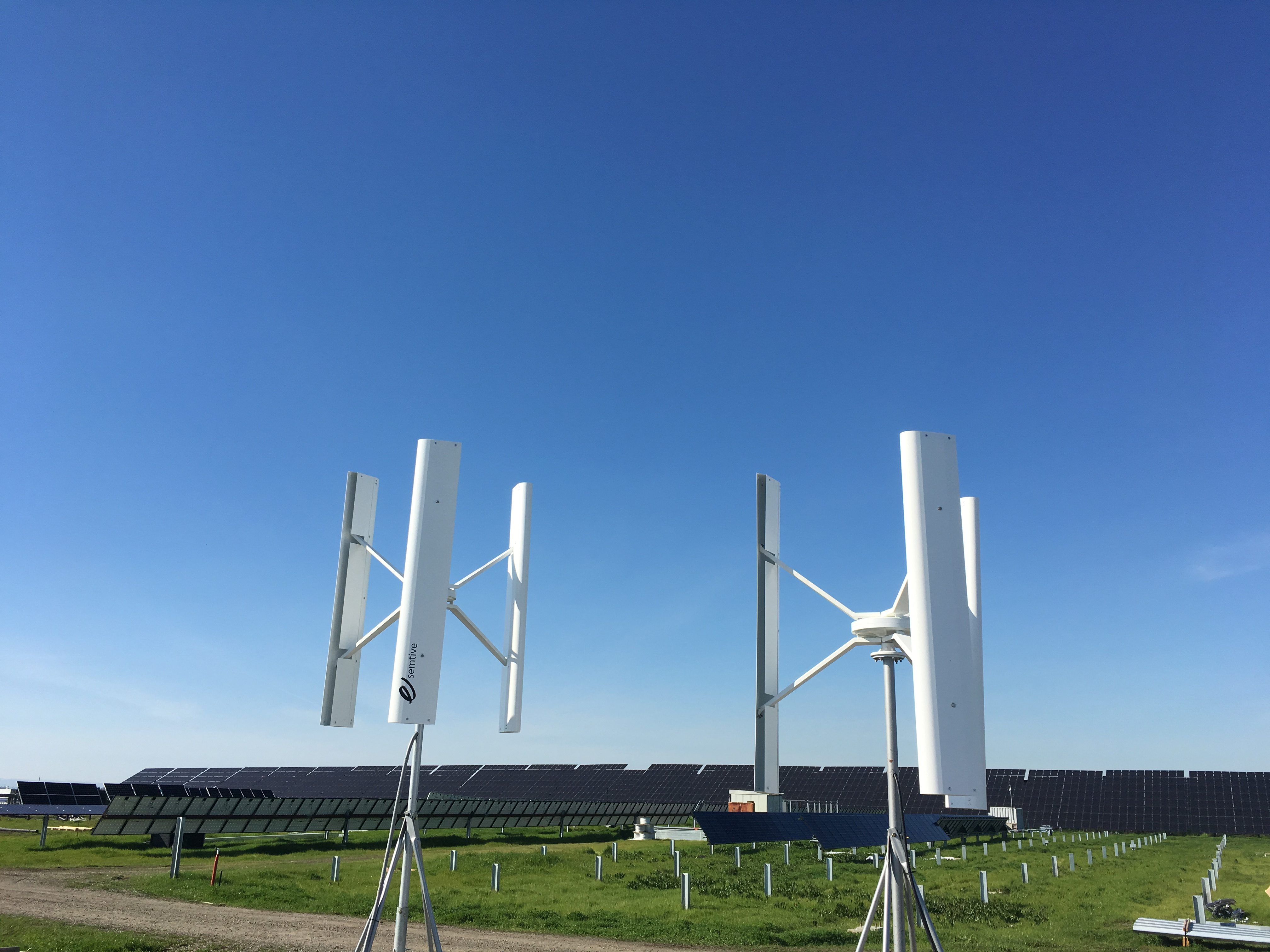
 In the Photo: A pair of Semtive wind turbines at work. Photo Credit: Semtive.
When you say “digitalizing the energy industry”, what does that mean?
IJ: First of all, the turbine is a very simple solution that makes clean energy effortless. It’s a solution that can be solved in less than an hour in a really simple way, and the only electrical connection needed is an electrical socket. That’s all you need. From there, the turbine becomes “smart” and is connected by WiFi or GSM to a cloud or between turbines themselves. The controller is a smart solution that uses a pretty powerful microprocessor, gathering data. From there, the turbine starts analyzing and forecasting weather conditions, and the data is used to forecast future energy generation. Different ways and different generation sources can be added to the same controller, meaning you can connect solar panels or storage devices to the controller, allowing you to have your own energy generation system in your house. You don’t need a centralized source sending you energy to your house any longer. The controller selects and chooses the best way to generate the energy that you’re using.
At the same time, because the controller is connected to the house, it learns from your behaviors and starts improving your energy efficiency, and if needed can also do energy management by controlling some of the appliances that you are using by itself or using different algorithms, including AI software that we include in the controller. We also include blockchain technology so that each turbine can share energy with another, and that can be tracked using blockchain technology. That’s what we mean when we say were are digitalizing energy.
What kinds of challenges has Semtive faced during its growth?
IJ: As a Third World country company trying to disrupt the industry as a whole, it has been really difficult for us to raise money, as well as make people believe in our technology. In the beginning there were a lot of energy companies that failed trying to accomplish things. We try to simplify everything and make things simple. In engineering if you do things simply you can really solve a lot of problems. Every time you make things more complex, you’re adding variables to the equation, so we always try to keep things simple. That’s part of our name too. We think that by doing that we were able to solve those challenges.
From there, it’s about raising money, trying to grow in every step, and trying to make people believe in our technology to prove that we are really doing what we are saying. It should also be noted people are usually more afraid of hardware as well. Everybody loves software because it has less complexity and doesn’t require as much R&D or investment.
 In the Photo: Semtive’s turbine hangar. Photo Credit: Semtive.
What does the future of Semtive look like in your eyes?
IJ: Our goal is to create the foundations for a 30-50 year company. We want to create energy and democratize access to it, so that everybody can have access to energy all around the world, in an affordable way but also with a solution that is healthy for the environment too. Just to give you an idea, we’re not only generating clean energy, we are also doing that with a turbine that is 98% recycled materials. This is a long-term journey, not something that are willing to work on today to get acquired by somebody else. We want to be here to really, really impact the world and do something for future generations.
It really hurts to know that in 2017 there are people that do not have access to energy, and do not have the benefits that come with it. We have evolved a lot as a human race, but today we still encounter those problems. We really believe that with our solution we’ll be able to give new opportunities to people who have not had the luck to access energy, and are convinced that our company will have a huge impact on people’s lives in the future.
At the same time that we’re doing that, we’re also being conscious of the environment as well. That’s another important part, everything has to come together. That’s why the social aspect is also important for us, because we know that the most important thing is to improve the quality of people’s lives, and to do that in an environmental way. We think that in the future we have to change our mindsets in all aspects to have a sustainable business.
RELATED ARTICLES:
Solar Em(power)ment is Lighting the Path to Sustainable Development
How to stop climate change and reverse global warming