The European Council on Foreign Relations (ECFR) recently published a paper titled “The European archipelago: Building bridges in a post-Western Europe.” In that paper, two experts push for the creation of a pan-European political coalition. This coalition, they argue, must recognize that the United States is no longer a reliable ally and then work to increase military spending in response.
The paper’s authors are ECFR Paris head Célia Belin and ECFR senior fellow Pawel Zerka. They base their arguments on a recent ECFR poll, which asked Europeans about key geopolitical issues. According to the authors’ interpretation, the poll results show Europe to be an “archipelago” with distinct “islands” of Europeans holding certain political views.
For Belin and Zerka, the future of Europe depends on building coalitional bridges between some of those islands. If European leaders don’t create a unified, pro-EU coalition, they argue, an anti-EU coalition could become predominant instead — with disastrous results.
What Is the ECFR?
The ECFR is an “award-winning international think-tank” with a mission to “conduct cutting-edge independent research on European foreign and security policy and to provide a safe meeting space for decision-makers, activists and influencers to share ideas.”
The organization says it does not take collective positions. That means the recent call for a pro-EU coalition reflects the perspectives of the paper’s authors, Belin and Zerka. Nonetheless, the ECFR’s status as a pan-European institution makes it a prominent platform for scholars working to promote a strong, unified Europe.
Poll Results Indicate Contrasting Geopolitical Sentiments
In making their argument, Belin and Zerka draw from an annual survey conducted by the ECFR. That survey polled 16,393 Europeans across 13 countries, asking for their opinions on the United States, military spending, and the European Union (EU).
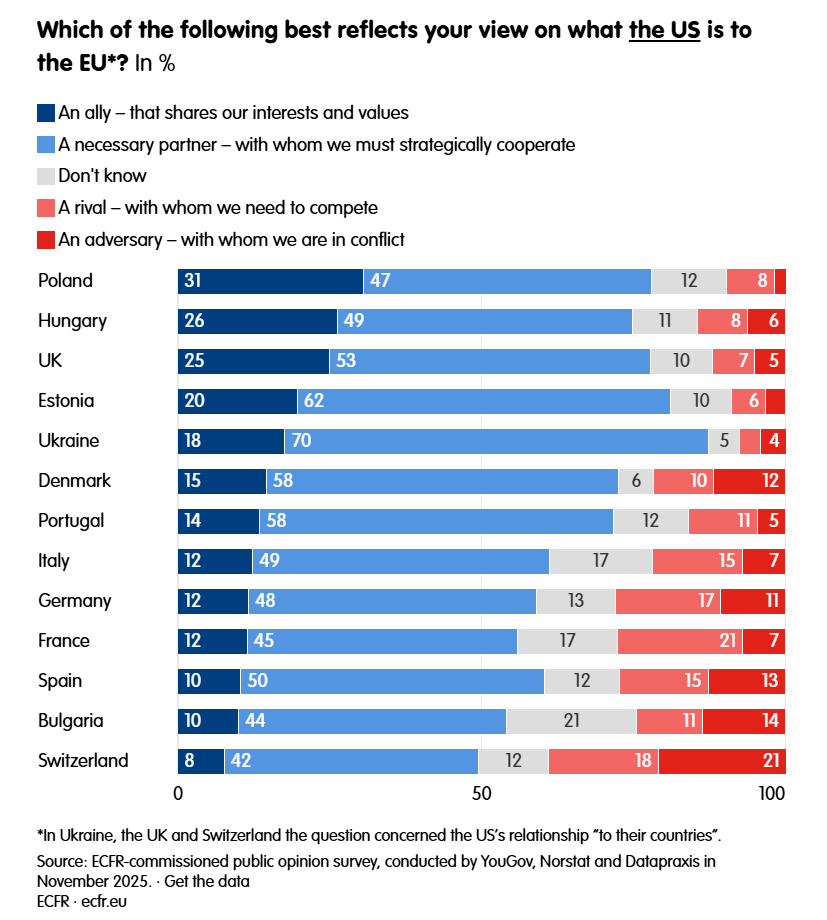
Relative to the previous year, Europeans displayed increased concerns over their relationship with the United States. Significantly more Europeans now consider the United States a “necessary partner” rather than a genuine “ally,” and many now see the country as a “rival” or “adversary.” Notably, this poll was administered before the most recent aggressive behavior by the United States, including an attack on the South American nation of Venezuela and sharpened threats to seize Greenland, a Danish territory.
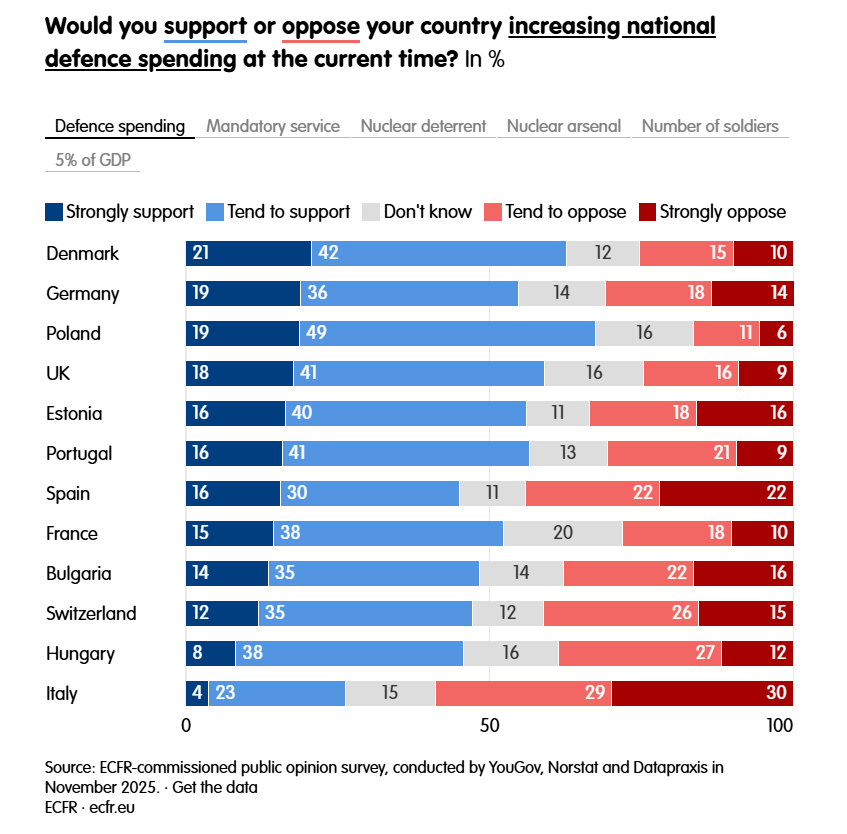
The poll also shows that more Europeans now desire a military buildup, with majorities in seven countries saying they would support an increase in defence spending in their country.
Despite these emerging areas of agreement, Belin and Zerka see a problem. Those who are wary of the United States and those who want a military buildup are, by and large, not the same people. Many who recognize the withering of U.S. support still oppose a military buildup, while many who support increased defence spending remain hopeful of U.S. backing.
For Belin and Zerka, the sound European policy is to increase defence spending in response to U.S. abandonment. But for that policy to become politically feasible, they argue, European leaders will have to form a new coalition.
An “Archipelago” of Views
After analyzing poll results, Belin and Zerka identified six factions spread across Europe, each with their own geopolitical perspectives. They call each of these factions an “island,” which together form the “archipelago” of geopolitical views.
The authors based their categorizations on three factors: people’s understanding of U.S. relations, their desire for more or less defence spending, and their sense of whether the EU is effectively “standing up for the values they consider important.”
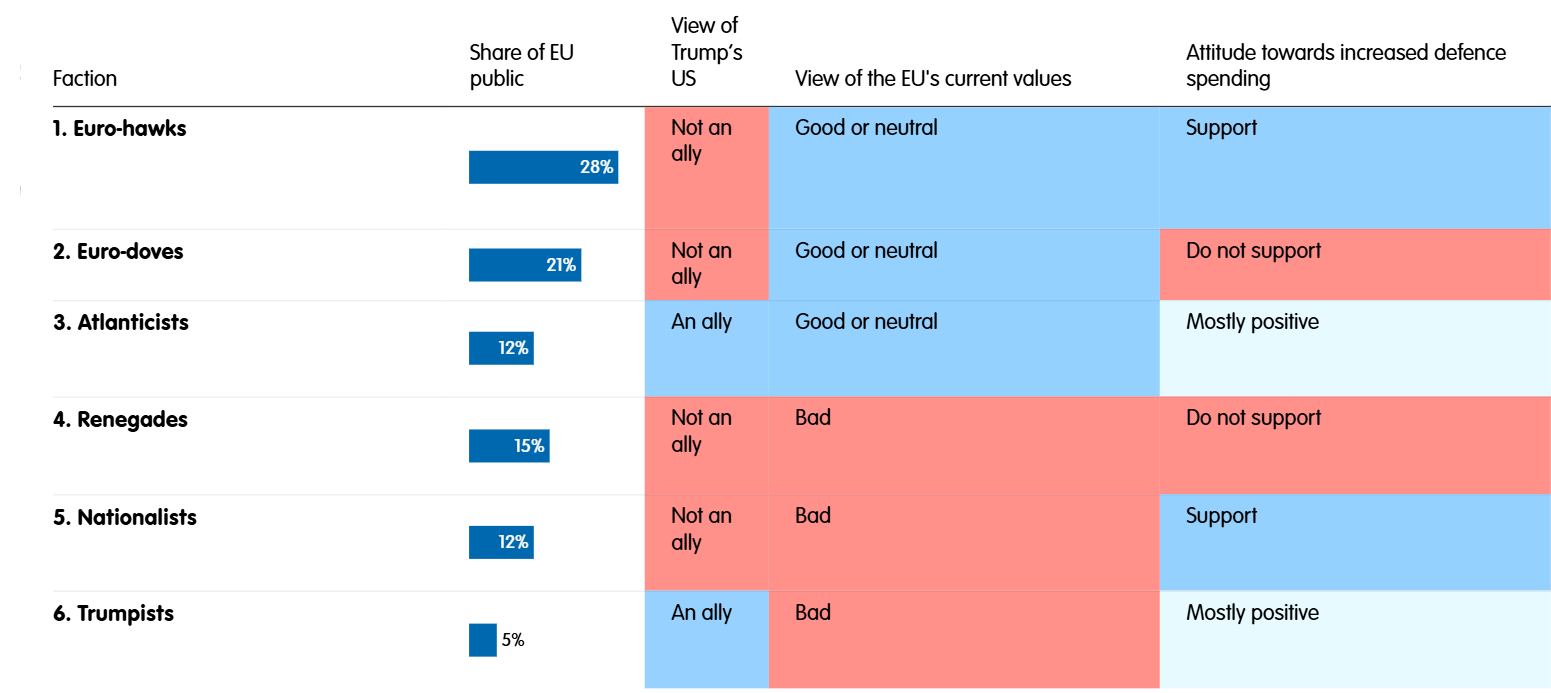
Here are the six “islands” as defined by Belin and Zerka, along with their percentage of the European population according to the ECFR poll.
- Euro-hawks (28%). These respondents align with Belin and Zerka’s policy preferences. They’re wary of the United States, they support increased defence spending, and they have positive or neutral feelings towards the EU.
- Euro-doves (21%). This group supports the EU and is concerned about the United States, but remains against a military buildup. Members tend to belong to the political left.
- Atlanticists (12%). These Europeans feel positively about the EU and the United States, suggesting a lingering — and, according to Belin and Zerka, naive — faith in the old Atlantic alliance.
- Renegades (15%). These “anti-system” respondents tend to “say no to everything.” They don’t consider the United States an ally, they don’t think the EU represents their values, and they reject increased military spending.
- Nationalists (12%). This group does not see the United States as an ally, feels sceptical about European cooperation, and desires increased military spending to defend their own countries.
- Trumpists (5%). This small cohort seems to feel a political affinity with President Trump. They continue to see the United States as an ally while harboring unfavorable views of the EU.
It’s by uniting certain of these factions that Belin and Zerka hope to form a lasting coalition.
Related Articles
Here is a list of articles selected by our Editorial Board that have gained significant interest from the public:
In Search of a Unifying Narrative
For Belin and Zerka, the first step towards building a robust, pro-EU coalition is telling the right story. So far, they say, leaders have responded to Trump’s aggression with “division and passivity.” For example, leaders failed to enforce reciprocal tariffs when the United States enacted a 15% levy on exports, and their response to the Greenland threat was “strikingly uncoordinated.”
A unifying narrative, Belin and Zerka argue, will help combine some of the continent’s geopolitical “islands” into a larger coalition. That coalition will give leaders the public support necessary to act with more resolve.
Belin and Zerka describe a few potential coalitions that could form. One possibility is termed the “bayonet coalition,” and would comprise the Euro-hawks, the Atlanticists, and the Nationalists. This group, the authors argue, might diverge in their views on the EU, but they could agree to increase military spending in response to U.S. aggression.
Alternatively, the Euro-hawk and Euro-dove “islands” could unite to form what the writers call the “values coalition.” This group shares a belief in the EU and a wariness of the U.S., but — according to the authors’ policy preferences — the hawks would have to convince the doves to increase military spending.
Belin and Zerka worry that, if neither of these coalitions arises, a “Eurosceptic coalition” could instead claim a dominant position. Composed of the Renegades, the Nationalists, and the Trumpists, this group could unite in their disapproval of the EU and undermine any attempt to strengthen European unity.
A Push for a Values-Based Coalition
After analyzing each of the potential coalitions in turn, Belin and Zerka ultimately state their preference for the values-based coalition. This grouping, they write, is the most “politically realistic,” and it aligns with the values of many current European leaders.
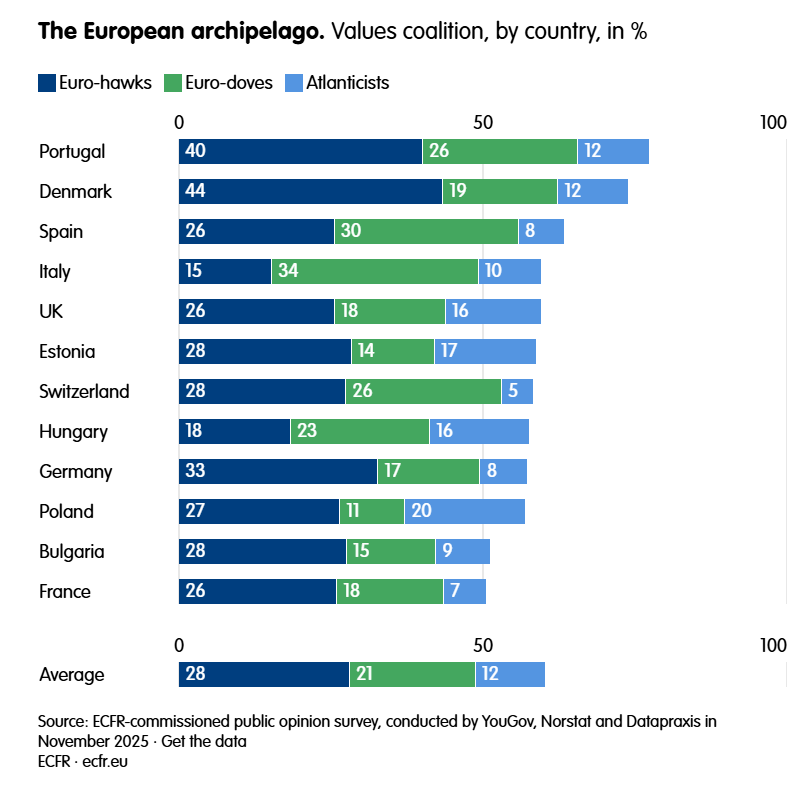
But for such a coalition to form, so-called Euro-doves across the continent will need to be convinced to increase military spending. And that, the authors argue, is where the storytelling comes in.
Belin and Zerka write that Euro-hawk leaders must “convince some of the more sceptical publics, east and south, that this is a collective effort in the name of a common goal.” If they can do that, the writers argue, they would restore Europeans’ confidence in the EU while creating “a more optimistic vision of the future.”
Editor’s Note: The opinions expressed here by the authors are their own, not those of Impakter.com — In the Cover Photo: An overhead view of Thwaites Glacier. Cover Photo Credit: Klaas Brumann