Impakter
  • Environment
    • Biodiversity
    • Climate Change
    • Circular Economy
    • Energy
  • FINANCE
    • ESG News
    • Sustainable Finance
    • Business
  • TECH
    • Start-up
    • AI & Machine Learning
    • Green Tech
  • Industry News
    • Entertainment
    • Food and Agriculture
    • Health
    • Politics & Foreign Affairs
    • Philanthropy
    • Science
    • Sport
  • Editorial Series
    • SDGs Series
    • Shape Your Future
    • Sustainable Cities
      • Copenhagen
      • San Francisco
      • Seattle
      • Sydney
  • About us
    • Company
    • Team
    • Partners
    • Write for Impakter
    • Contact Us
    • Privacy Policy
No Result
View All Result
  • Environment
    • Biodiversity
    • Climate Change
    • Circular Economy
    • Energy
  • FINANCE
    • ESG News
    • Sustainable Finance
    • Business
  • TECH
    • Start-up
    • AI & Machine Learning
    • Green Tech
  • Industry News
    • Entertainment
    • Food and Agriculture
    • Health
    • Politics & Foreign Affairs
    • Philanthropy
    • Science
    • Sport
  • Editorial Series
    • SDGs Series
    • Shape Your Future
    • Sustainable Cities
      • Copenhagen
      • San Francisco
      • Seattle
      • Sydney
  • About us
    • Company
    • Team
    • Partners
    • Write for Impakter
    • Contact Us
    • Privacy Policy
No Result
View All Result
Impakter
No Result
View All Result

Robert Rauschenberg’s Retrospective at the Tate

byOliva Sartogo
February 17, 2017
in Art, Culture
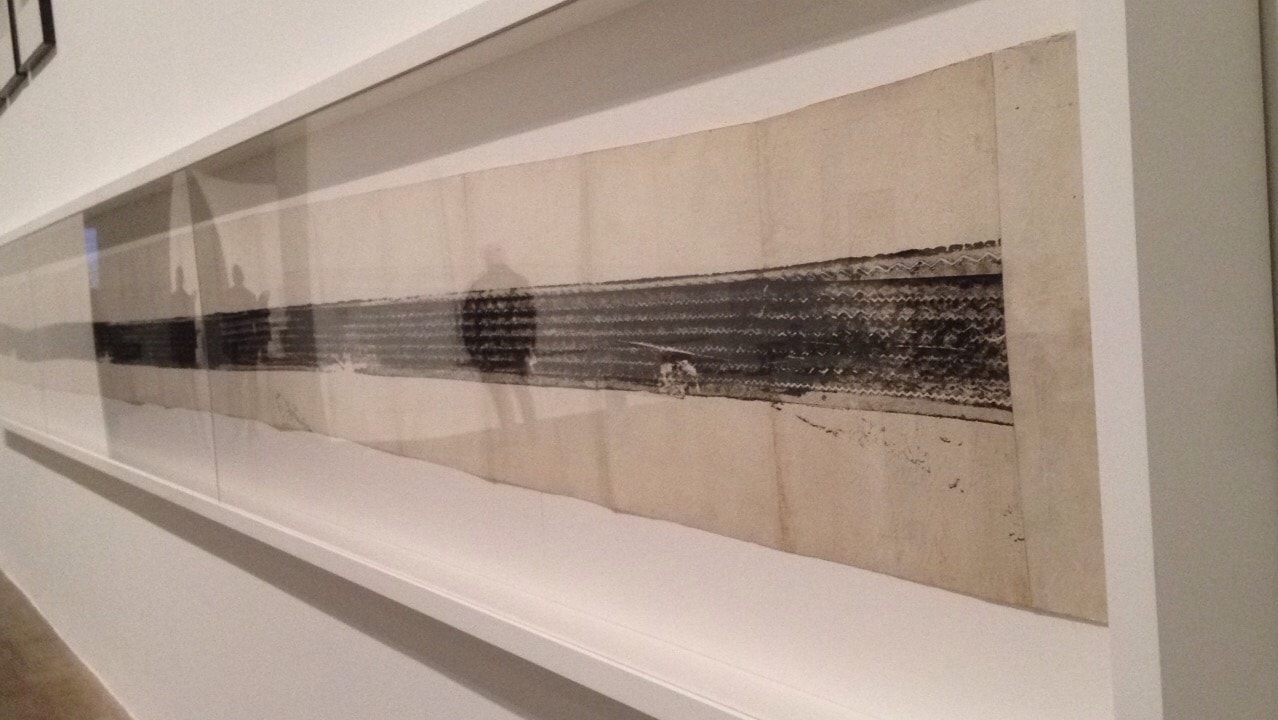
tire print

A car just passed and left a black mark on the ground. Following the line on the wall, the viewer starts his journey into Robert Rauschenberg’s art. Diving into the life-experience of an out of the ordinary, playful, unexpected artist. The black ink tire print welcomes your mind, plumbing it in an unconventional world where sculptures, paintings and industrials materials blend, and boundaries no longer exist.

In 1944, the young Milton Robert Rauschenberg embarked on his journey that took him miles away from the oil company town in Texas where he grew up. After traveling to Paris, he returned to the States and enrolled in the Black Mountain College, where he became the pupil of Joseph Albers, John Cage, and Merce Cunningham. Those teachers plunged him into creating using everyday materials, music, textiles, dances, and much more.

The retrospective exhibit, now at Tate Modern London, throws you right into Rauschenberg’s art journey from the end of the Black Mountain College to his life in New York with Susan Weil. (Fig.1 [below] Robert Rauschenberg, Automobile Tire Print, 1953, paint on 20 sheets of paper mounted on fabric, San Francisco Museum of Modern Art, purchase through a gift of by Phyllis C.Wattis)

tire print robert 1953

Figure 1: Robert Rauschenberg, Automobile Tire Print, 1953

The exhibitions starts with a black ink print of an automobile tire on 20 sheets of typewriter paper. The ink still seems fresh. Somehow you can still feel the noise of the car, as if the car was just around the corner waiting for you. It is a normal tire, made of rubber and petroleum, those very oil refined products he grew up with. This was the first step into Rauschenberg’s artistic statement: “I can make art from anything, the world was my canvas.”

 The following two works featured are somehow similar in their construction: there is no sign of a paintbrush or anything alike. On the one side, there is a black ink newspaper piece, where the relationship between the paintbrush and the canvas is avoided and where a viewer, you are confronted to yourself, your perception of this black ink space.
Figure 2:
robert rauschenberg white tile
Erased de Kooning Drawing, 1953
Figure 3:
robert rauschenberg newspaper
Untitled [glossy black painting], ca. 1951

Related article: ‘A POEM BY ADAM CLAY’


On the other side, you face a dirty white page, mounted on a gold frame. This comes from one of Rauschenberg’s most famous performances that lasted for more than a month. “The whole idea, just came from my wanting to know whether a drawing could be made out of erasing,” said Rauschenberg, when he asked to the abstract expressionist Willem de Kooning for a drawing to erase. It took Rauschenberg a month, and about forty erasers, to complete the job. It was then exhibited in 1955, where Jasper Johns, Rauschenberg’s partner at the time, placed it in a gold frame with a typed inscription.

file7Those extraordinary pieces introduce us to Rauscheberg’s universe in his early years in New York. At the time, he worked with materials that he could find easily and blend. For example, he created a series of “Elemental Sculptures” using materials that he scavenged from his neighborhood.

From those first pieces, where he conceptually approaches materials, the viewer is suddenly plunged into the re-appropriation of those very external elements. I am hereby referring in particular to the ballet settings which he was in charge of creating as palcoscenico for John Cage and Merce Cunningham ‘Minutiae’, or the red multi-material red painting Charlene. Not to forget, the electric lamp lighting the red colored surface where an umbrella, and other lost and found objects are combined.

Figure 4: Robert Rauschenberg, Winter Pool

The white lamp on the dark red gives a rhythm to the viewer’s eyes. It plunges the public into an unexpected new interpretation of the cubist collages, a way of creating and combining objects that you would never usually link. The most spectacular combinations then come along.

‘Winter pool’, a wooden ladder welcomes the viewer to climb between colorful canvases. An escalation towards a new unknown creativity that the viewer will discover, and as a good movie, I will stop the report of my journey in order to leave each reader to inspire and discover Rauschenberg’s world in his own way.

Every viewer can decide to climb that ladder and enter the most unexpected way to analyze the combination between art and everyday challenges, materials, mechanisms and images.

( Fig. 4 [above]  Robert Rauschenberg,Winter Pool, 1959, oil paint, paper, fabric, wood, metal, sandpaper, tape, printed paper, printed reproductions, handheld bellows, and found painting on two canvases with ladder Jointly owned by A. Cohen and The Metropolitian Museum of Art)


Recommended reading: “DOOMOCRACY: THE END IS HERE“


EDITOR’S NOTE: THE OPINIONS EXPRESSED HERE BY IMPAKTER.COM COLUMNISTS ARE THEIR OWN, NOT THOSE OF IMPAKTER.COM.
Tags: ImpakterOlivia SartogoRauschenbergWilliam Tate Museum of Art
Previous Post

Using Social Media to Meet Your Needs: Coping

Next Post

Let’s Talk About Periods

Related Posts

Personalised learning: a girl learning through dedicated video call
Culture

Empowering Educators with Attention Insights for Personalized Learning

March 6, 2026
Crowds and filmmakers on the red carpet at the 76th Berlin International Film Festival in 2026
Cinema

At Berlinale 2026, Artists Refuse the Comfort of Neutrality

February 20, 2026
News about Olympic athletes requesting to end fossil fuel sponsorships.
Environment

Winter Olympics: End Fossil Fuel Sponsorships, Athletes Say

February 17, 2026
Next Post
period-blood-impakter

Let's Talk About Periods

Recent News

ESG news regarding Trump’s planning first new U.S. oil refinery in 50 years backed by Reliance Industries, UK’s net-zero 2050 goal costing far less than critics claim, IEA proposing record oil release to ease global prices, and Elon Musk’s xAI being approved to run methane turbines despite opposition.

Trump Unveils 168,000 Bpd Refinery Backed by India’s Reliance

March 11, 2026
Space‑Based Solar Power test

Solar Power From Space: How Close Is It to Reality?

March 11, 2026

Impakter informs you through the ESG news site and empowers your business CSRD compliance and ESG compliance with its Klimado SaaS ESG assessment tool marketplace that can be found on: www.klimado.com

Registered Office Address

Klimado GmbH
Niddastrasse 63,

60329, Frankfurt am Main, Germany


IMPAKTER is a Klimado GmbH website

Impakter is a publication that is identified by the following International Standard Serial Number (ISSN) is the following 2515-9569 (Printed) and 2515-9577 (online – Website).


Office Hours - Monday to Friday

9.30am - 5.00pm CEST


Email

stories [at] impakter.com

By Audience

  • TECH
    • Start-up
    • AI & MACHINE LEARNING
    • Green Tech
  • ENVIRONMENT
    • Biodiversity
    • Energy
    • Circular Economy
    • Climate Change
  • INDUSTRY NEWS
    • Entertainment
    • Food and Agriculture
    • Health
    • Politics & Foreign Affairs
    • Philanthropy
    • Science
    • Sport
    • Editorial Series

ESG/Finance Daily

  • ESG News
  • Sustainable Finance
  • Business

About Us

  • Team
  • Partners
  • Write for Impakter
  • Contact Us
  • Privacy Policy

© 2026 IMPAKTER. All rights reserved.

No Result
View All Result
  • Environment
    • Biodiversity
    • Climate Change
    • Circular Economy
    • Energy
  • FINANCE
    • ESG News
    • Sustainable Finance
    • Business
  • TECH
    • Start-up
    • AI & Machine Learning
    • Green Tech
  • Industry News
    • Entertainment
    • Food and Agriculture
    • Health
    • Politics & Foreign Affairs
    • Philanthropy
    • Science
    • Sport
  • Editorial Series
    • SDGs Series
    • Shape Your Future
    • Sustainable Cities
      • Copenhagen
      • San Francisco
      • Seattle
      • Sydney
  • About us
    • Company
    • Team
    • Partners
    • Write for Impakter
    • Contact Us
    • Privacy Policy

© 2026 IMPAKTER. All rights reserved.