
“He was a very valiant man who first adventured on eating of oysters.” James VI & I is noted for keenly describing the first nutritional human interaction with the rather brutish looking bivalve.
Oyster consumption, cultivation, and distribution have been a long-time staple of many coastal communities across the globe, and even a bigger hit in the foodservice industry. The history of the “Oyster” has been, to say the least, an interesting one.
For starters, oysters are aphrodisiacs. Now, do we have your attention? The linguistic origins of the word aphrodisiac are traced back to the ancient Greek Goddess Aphrodite – the goddess of love – it’s a profound testament having somewhat of an association to the divine, even though it is through the evolution of language; but the interesting history of this bivalve is not limited to just consumptive purposes. The impact of oysters reverberates deeply through the economies and ecosystems they are a part of.
IN THE PHOTO: Note the dried eelgrass in the bottom right-hand section of the photo. Oyster reefs prefer sandy/muddy bottoms where eelgrass is not present. PHOTO CREDIT: Daniel Rossi
Oyster reefs are vital structures within saltwater maritime bay ecosystems. In an economic sense, many local communities found the Shellfish Industry to be a long, culturally rich, and prosperous trade.
Studies have shown when a wetland/bay ecosystem has a strong oyster presence the water quality increases.
Many fish and marine mammals (i.e. otters) are reliant upon intercostal brackish water tributaries for a variety of reasons. Tributaries and rivers struggle with pollution from runoff. The further effects of residential runoff go on to negatively manipulate the environment as a whole. Often these issues are compounding out of control and are catalysts for a boatload of other environmental problems. The outcomes from this are negatively contributing to water quality, aquatic ecosystems, weather patterns, and even climate change. Can oysters help? Well, without oysters, a lot can go wrong when it comes to the food web in the oxygen-rich wetlands.
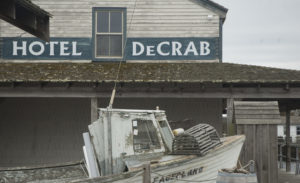
IN THE PHOTO: Tuckerton Seaport Museum, New Jersey, USA. The museum shows how life used to be for those who took to the bay as their livelihood. PHOTO CREDIT: Daniel Rossi
So, what is aquaculture? How can this subdivision within the agricultural industry bring both ecological and economic benefits to regional and local areas? Aquaculture, in its simplest form, is the cultivation of plants or animals in an aquatic setting. Oyster farming falls into this category. Aquaculture as a whole has been cited as being negative for the environment, but in the case of oyster farming, the local effects have been the opposite.
However, there is an important distinction to be made between the Shellfish Industry at large and Oyster Farming. Oyster Farming is full circle. Specialists in this field cultivate, raise, harvest, and sell their oyster when they are fully mature (2 years old). Whereas the Shellfish Industry is more oriented towards the harvest and the ability to sell their catch; they are not concerned with the cultivation process.
The Shellfish Industry does include other species of edible maritime fare, but for an easy comparison, the focus will be parallel to oysters. For the purpose of this article, the industry is defined as the association with the gathering and harvesting of molluscs and bivalves. Although crustaceans make up a large volume of livestock sold within the industry, our evaluation will not be focusing on these tasty devils. Even describing the catch as a harvest sounds more along the lines of the actual full-cycle agricultural farming process.
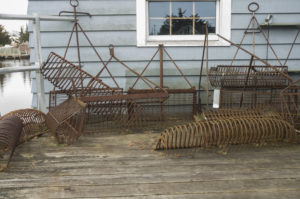
IN THE PHOTO: Tools of the trade: Clam and oyster rakes such as these were the tools of choice to collect bivalves in the golden age of commercial oyster harvest in the early 1900s. PHOTO CREDIT: Daniel Rossi
The main difference now is that there are not enough naturally occurring oysters around anymore to just harvest. From a sustainability point, oysters have to be reintroduced into their natural ecological environment.
The ecological ramifications of the oyster cultivation process are strongly correlated to the biodiversity and well-being of wetlands, saltwater bays, and major tributaries.
What is the oyster’s role in the ecosystem? These simple organisms, easily mistaken for rocks, that farmers are growing have a huge responsibility.
Just one unit can filter 50 gallons of water per day. In rivers high in nitrogen from runoff, large destructive algal blooms thrive. During the constant filtration, oysters feed on these blooms. The oyster’s source of nutrition is not in short supply.
Why then, are oysters not thriving and purifying the water to boundless ends? The major oyster reefs of the Greater New York area are gone. Simply put, they were overfished to a regional commercial extinction. At one point, shore communities were overstocked and dotted with outposts harvesting oysters that were selling catches for top dollar. Boats were filled to pilothouse roofs with oysters set for freight rail to Philadelphia or New York City.
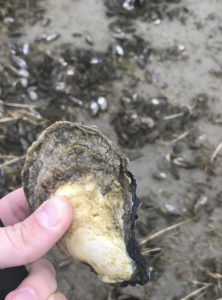
IN THE PHOTO: The Eastern Oyster Crassostrea virginica. PHOTO CREDIT: Daniel Rossi
Pre-industrial America, for a long time, provided the opportunity for bay-orientated/coastal lifestyles associated with living off of what their region offered. Many individuals who took to the sea where skilled labourers in pound fishing and, or, saw themselves participating in the fruitful shellfish harvest. As development swelled through the gilded ages and well past, the shellfish harvest connected shipping routes, newly incorporated municipalities, fish markets, and upscale restaurants in major metropolitan areas. The introduction of the steam engine created an explosion in how goods were shipped throughout the world. Much of the haul of oysters were shipped by freight locomotives creating a dynamic web of tracks stretching to reach these newly incorporated shore villages. As time marched on, people started to reverse ride the train lines into these shore communities for a summer vacation, transforming the micro-economy from aquaculture to tourism. The overload of the population, local economy, and lack of overfishing regulations to curb losses forced the oyster shellfish industry to fall by the wayside.
Towns now in these regions on Long Island, NY and the New Jersey coastline are almost entirely focused on tourism as the main industry. Don’t get us wrong, entire countries are run strictly on tourism. It works. But for the Greater New York Area, tourism is in only the summer months. During the business season, these localities are provided with a dynamic population and businesses offer a variety of services and goods to complement the summertime experience. The issue lies now in the off-season. Other than residential property taxes dollars floating municipal budgets, new money coming into town during these months is sparse. Although preparation for the summer months is crucial for towns and businesses to maximize their limited window of opportunity, it creates an extremely heavy imbalance. And you know the old saying, “balance is everything.”
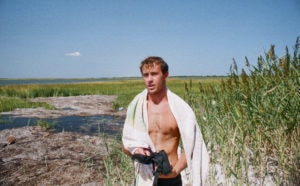
IN THE PHOTO: Bivalves are also harvested for recreational purposes as well. After a long day out on the water a break to do some bird watching is necessary. John here prepares his binoculars. PHOTO CREDIT: Daniel Rossi
These towns now need economic stability. While some towns and their legislatures opt for a more residential approach there needs to be a side-car industry offering economic mobility completely independent of tourism; a resurgence of aquaculture, specifically, Oyster Farming frees up some avenues for applied development. This also could positively increase the permanent populations within these areas. The new oyster farming industry can feed the food service industry which, in-turn, literally feeds the population. A large restaurant circuit is a staple in resort towns that spills over into the winter months. In addition, these restaurants now have an option to buy another locally produced item.
Taking this to the next level, there is even an emerging recycling market for the discarded shells.
Just like any other recycling market, there is a demand for the material. However, there is a critical difference between recycling shells and plastic. For example, after plastic reaches its final destination it’s repurposed and manufactured into new goods, but for oysters and clam shells they are used to create new oyster reefs. These recycled shells provide structure for oyster spat (juvenile oysters less than 25 mm) to adhere to. Long Beach Township, NJ, USA, was reported as one of the first municipalities in the state to implement a shell recycling pilot program. Essentially, having a program ready to properly reuse the discarded shells after consumption reinforces the sustainability aspect of the net positive environmental results. The chain reaction of incorporating another economically and environmentally enabling industry can have rippling results across the board complementing the bigger picture of fueling the labour market. Simply put, population growth; job opportunities in either the cultivation process, shipping collective, and food service seem far from an abysmal plan for continued growth with net positive environmental impacts. By pairing this with tourism, a sound framework is created for revamping municipal economic growth models.
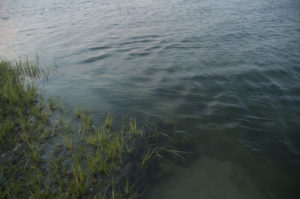
IN THE PHOTO: Oysters and bivalves filter the water resulting in improved clarity. PHOTO CREDIT: Daniel Rossi
While this can be portrayed as an Edenic situation for both the economy and the environment, our old friend bureaucracy is there to muddy the mix. Creating an Oyster Farm is easier said than done. It’s not as simple as getting a local mercantile license, approval from the state’s division of consumer affairs or like-agency and setting up a tax identification number; the process for most new businesses. Aquaculturists must be able to take their specific field knowledge and apply it in a precise but ambiguous way. The ability to see the bigger picture of the operation is what leads to the success of their operations. Further, when rolling out a business plan to incorporate they are bombarded with sloughs of government regulations followed by a bureaucratic maze of paperwork with vaguely limited points of contact for inquiry. The pronounced web of regulations and government agencies involved is far more advanced than the average small business owner would normally have to deal with. The State and Federal Department of Agriculture have their hands on the pearl along with the locality the farm is operating in. While some institutions are easier to navigate than others, a headache is a headache.
Since major back bays, saltwater estuaries, and ecosystems are within public waters they are owned by the state. Acquiring a land lease within a bay/river/tributary is a major step in the incorporation process and is mandatory in New York and New Jersey. The leasing process is dependent upon many factors. State entities such as the Department of Agriculture are usually the ones to grant the land and outline the terms and conditions of the agreement. State governments regulate how many shellfish leases there can be in one area/region. However, the pre-defined areas available for a lease may not be ideal grounds for the cultivation of oysters. Oyster farmers are working hard to fit the right piece into the puzzle. With all this being said, it does work. There are many successful Aquaculturists and Oyster Farmers today. The numbers show. The US Department of Agriculture (USDA) reports the number of farms in New Jersey, USA has decreased since 2007, but the sales have increased. Although the total number of physical farms have decreased the ones still left have stepped up the pace. Below a graph briefly describes the change in farms and sales.
There are also other Non-Governmental Organizations focused on simply just restoring the oyster population. Maybe some of you have heard of The Billion Oyster Project; their goals is to fill New York Harbour with 1 Billion Oysters and over 100 acres of reef by 2035. Other oyster farms have been passed down from generation to generation such as the Maxwell and Parson Oysters Farms. The recent growth in the half shell market has created a demand for oyster collectives to connect multiple oyster farms and restaurants via geographical region. Now Barnegat Bay Oyster Collective works with its partners like Forty North Oysters and Sloop Point Oysters to increase the availability of oysters for market consumption.
Oysters are not the end all be all solution, but the research is growing and sustainable business practices are in high demand. The thriving half-shell market is consistently keeping local farmer’s stock back ordered. The numbers of farms are still in the double digits with gross sales receipts increasing since Hurricane Sandy. With the proper advocacy groups and strategic planning, oyster farms can flourish alongside tourism within seasonal towns. The introduction of a recycling market for increasing natural oyster reef growth plus the net positive environmental benefits provided by the residential farmers have the potential to return the saltwater bays to their original pristine condition.
To learn more:
Anderson, A. (Producer), & Ruff, C. G. (Director). (25 March 2018). The Oyster Farmers.
[Motion Picture/Documentary] USA. Retrieved from https://jettylife.com/pages/the-oyster-farmers-film
New Jersey Division of Fish and Wildlife. (2018). Shellfish Aquaculture Leasing Policy of the
Atlantic Coast Section of the New Jersey Council. [Government Publication]. Retrieved
from https://www.nj.gov/dep/fgw/pdf/marine/shellfish_leasing_policy_atlantic.pdf
 Photographer
Daniel studied Fine Art Photography at Pratt Institute in Brooklyn, New York USA. He is a freelance photographer and set dresser on T.V and Film production in New York City.
Daniel is an avid fisherman, surfer, sailor, and environmentalist who uses photography to raise awareness for maritime issues.
Editors Note: The opinions expressed here by Impakter.com columnists are their own, not those of Impakter.com