What do Boeing and the World Health Organization have in common? The question might appear whimsical or even irrelevant. Yet there is an instructive parallel in their recent history although the outcomes, for now, are widely different. Boeing has emerged from what was perhaps its most profound existential crisis while the WHO appears to be entering into it, as Trump is cutting funding from WHO.
Looking into the parallel between WHO and Boeing we can better understand what the stakes are and how this is all likely to end.
The Parallel between WHO and Boeing
First the similarities. Both Boeing and WHO are the premier leaders in their respective fields, and for decades.
Each has a history of important successes that changed our world: cheap travel for one, eradication of past major disease threats for the other. One of WHO’s major successes was the eradication of smallpox after decades of efforts, from 1955 to 1977 – a disease that, as recently as 1967, was estimated to affect 10-15 million people each year, killing from 1.2 to 2 million.
As Dr. Gareth Williams, medical historian says, this was a “great endeavor, where human intelligence and goodwill across the world came together”. A deeply moving story and one of the big successes of 20th-century medicine – proving that overcoming a virus is possible.
However, the WHO and Boeing, to be effective, both depend on individual and global public trust. Both delayed moving on a critical life or death issue as a result of internal debates between competing factions.
On the one hand, Boeing hesitated between share price and safety warnings after the first accident. Boeing has made some essential safety features optional and low-cost carriers tended not to buy them or if they had them, not to train the pilots on how to use them – hence the two crashes of 373 Max planes in Ethiopia and Indonesia that made headlines.
For WHO, it was those who worried about political ramifications resisting those who wanted to send the COVID-19 alarm immediately based on technical reasons.
Both had a big government complicit in their delayed decisions.
In the case of WHO it was a key member State namely China wanting to keep the extent of the COVID-19 outbreak quiet.
In Boeing”s case it was the willingness of the U.S. FAA to take the company’s word they “fixed the problem” — so as not to undermine the US most important exporter at a time of growing prosperity.
In Boeing’s case, there is no talk today of abolishing the company or stopping Exim Bank or new financing. Do a good job dealing with 737 Max safety issues, we will financially help you out of the costs of reduced demand for planes, and let’s go back to selling.
In the case of WHO some of the U.S. political class are pressing to defund whether it be conservative commentators, newspapers, the Administration, or some Senators.
They and we need to keep in mind that there have been at least 6 cross border infectious disease outbreaks globally in the first 20 years of this century. A recent study led by the University of Cambridge identified 20 known infectious diseases that have re-emerged or spread geographically, including dengue, chikungunya, typhoid, West Nile, artemisinin-resistant malaria and the plague. Other known threats – such as influenza (i.e. H1N1 Swine Flu), MERS-Cov, and Ebola – are high threats, especially in densely populated areas. And of course, now COVID-19.
Many have affected the US. and more outbreaks in the future, like COVID-19, are essentially guaranteed.
Is WHO always as ineffective as it was in the West Africa Ebola outbreak in 2014-2016?
The answer is no. Yet, at the same time, there is a need for reform.
The upcoming World Health Assembly in May 2020 will be an opportunity to take up as a priority more rigorous infectious disease early reporting by member States and more stringent rules for the Director-General when to declare a “public health emergency of international concern” or pandemic.
This will require cooperation from member States to do common cause at a difficult time– not a time to withhold funding. We know that with adequate and sustained funding WHO can function and function well in a crisis situation. One need only consider the WHO response to the 2019 Ebola outbreak in the Democratic Republic of the Congo.
WHO emergency teams were quick to risk their health and lives and stay the course. WHO was on the ground administering new Ebola vaccines and treatment under very challenging circumstances, and applying new technologies to better protect frontline health workers, and making effective use of information management techniques.
WHO’s coordination with– yes, the U.S. and China—will mean this Ebola outbreak is likely to end in the very near future. The latest news is that one more case has just extended the period before a final victory can be declared but there is little doubt that the handling of this outbreak was exemplary.
To under-fund or defund WHO is to take away any real possibility of a coordinated global response to the next epidemic, one which then morphs into a pandemic. A virus like COVID-19 knows no frontiers: A coordinated international response is the only means to control it and eventually overcome it.
We do need Boeing to manufacture a safe new efficient plane; we do need for WHO to protect our health.
EDITOR’S NOTE: The opinions expressed here by Impakter.com columnists are their own, not those of Impakter.com
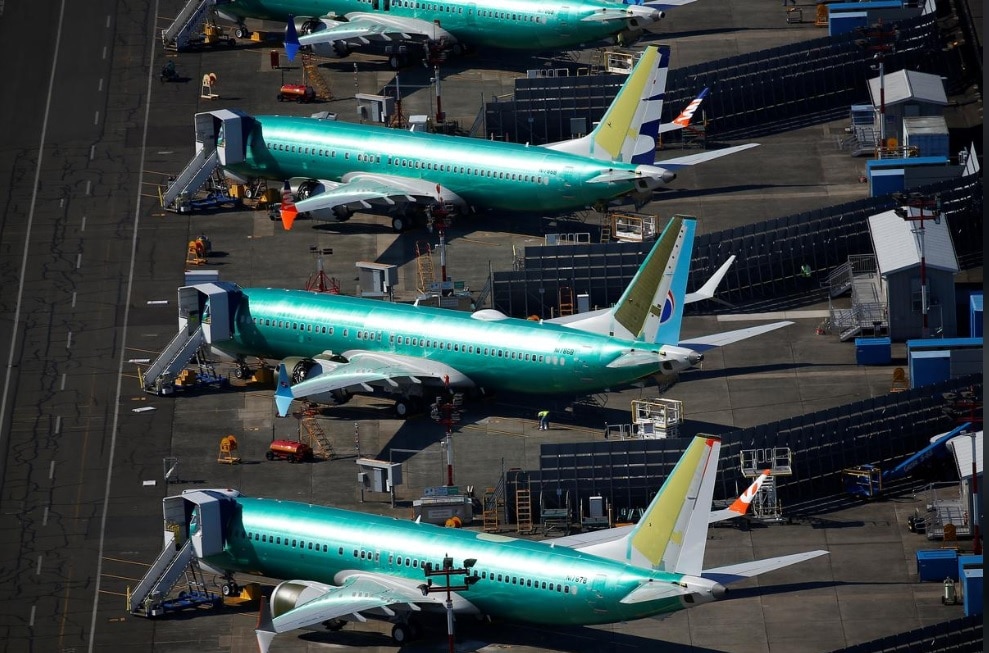
Featured Image: Boeing 737 Max cancellations pile up during coronavirus-induced production halt. Boeing Co (BA.N) on 14 April 2020 reported another 75 cancellations for its 737 MAX jetliner in March – reported by Reuters. FILE PHOTO: Unpainted Boeing 737 MAX aircrafts parked in an aerial photo at Renton Municipal Airport near the Boeing Renton facility, Washington, U.S. July 1, 2019. Picture taken July 1, 2019. REUTERS/Lindsey Wasson