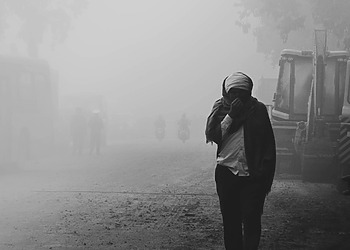
Panchanan Dolui, who lives on Mousuni Island in the Indian Sundarbans, has shifted homes three times due to floods and river erosion. Each time he moves further from the shrinking edge to avoid displacement. He has watched the river eat away vast tracts of land. “Where do we go? There is nowhere to go,” he laments.
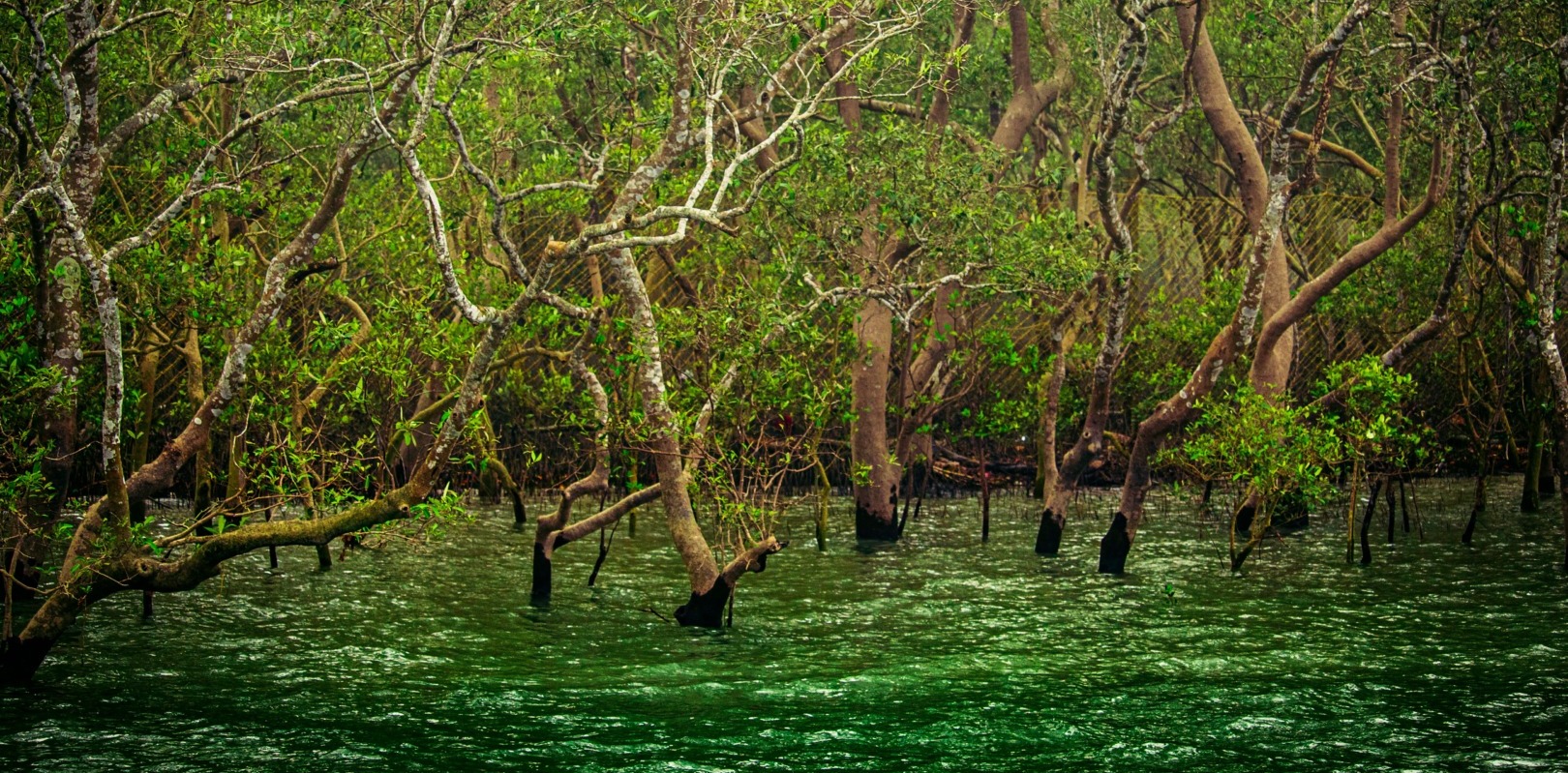
Located in West Bengal, the Sundarbans forest system is a cluster of low-lying islands, and represents the largest mangrove ecosystem in the world. It is home to several endangered species, and acts as a natural barrier against cyclones, storm surges and other environmental hazards. The forests are also natural agents of carbon capture and sequestration.
But things are changing fast.
As Kalyan Rudra, Chairperson of the West Bengal Pollution Control Board, says of some of the islands: “They are not safe for human habitation because of erosion.”
The four cyclones that hit the eastern coast of India between 2019-21 – Fani, Amphan, Bulbul and Yaas – point to the increasingly unpredictable weather events in the Sundarbans caused by climate change and sea level rise.
Sundarbans inhabitants have faced climate-induced displacement for decades. Lohachara was one of the first inhabited islands to disappear under the sea in 1996, forcing residents to relocate to neighbouring islands, often without documents or property deeds.
In the face of limited livelihood options, and without sufficient development in the region, migration has become a coping strategy for many residents. There have been several waves of migration within the Sundarbans, often on the same island, to avoid flooding from embankment breaches, tidal bores and storm surges.
Since Cyclone Aila in 2009, distress migration driven by economic vulnerability has resulted in men taking up work as informal migrant workers across India where labour laws are often weaponised against them.
Women-led households in the Sundarbans are more common than in any other area in India because of distress migration. But these households are often marked by debt burdens, a high number of dependents, lack of economic power and limited livelihood options.
Meanwhile, increasing land salinity – due to severe cyclonic storms and tidal wave action, which carries sea water from the Bay of Bengal into the Sundarbans delta – impedes soil productivity in the area.
Increased salinity forces farming changes
Salinity-resistant paddy farming is an important form of climate change adaptation in the area that has become increasingly popular over the past decade. Increased salinity, however, has also led to brackish water shrimp farming on a commercial scale, causing land degradation and negatively impacting the sustainable development of the area.
Significantly, the health of women who perform the poorly-paid marginal labour of prawn seed collection – which involves standing anywhere up to six hours in saline water – is adversely affected.
Increasing salinity is a leading cause of reproductive health problems among rural women in the Sundarbans, including pelvic inflammation and urinary tract infections. The intersection of salinity, women’s health, and its effect on family systems and local economy remains an under-researched area that deserves urgent attention.
Increasing salinity has also led to a severely degraded mangrove ecosystem, affecting biodiversity and loss of forest reserves which sustain local communities.
The ire of the tigers
The pressure on forest resources also amplifies man-animal conflict in the area. The Sundarbans, both in Bangladesh and West Bengal, are home to tiger widows, women whose husbands went into the Sundarbans reserve forest area for fishing or honey collection and were killed by tigers.
There is no official recognition for such deaths since entry into the reserve forest – where activities like fishing and honey and crab-collecting were carried out — became “illegal” for forest dwellers once the area was declared a Tiger reserve in 1973 and came under the Wildlife Protection Act.
Pradip Chatterjee, ex-president of Dakshinbanga Matsyajibi Forum or the West Bengal Fishers’ Union, calls these tiger deaths be-aini mrityu or illegal deaths, marked by the erasure of the person’s existence. He notes that the local police station refuses to make entries of the tiger deaths because of their “illegal” nature, hampering the process of applying for compensation – a bureaucratic labyrinth which requires the deceased’s kin to produce a police report and death certificate.
Recently, the Calcutta High Court acknowledged tiger deaths in prohibited wildlife zones in a landmark decision, ordering the State Forest Department to pay full compensation to two tiger widows.
The poorest people live in an adversarial relationship with the Forest Department, which is in charge of conferring these certificates. Forests become sites of exclusionary environmental governance where conservation is prioritised over people’s rights. The perception among conservationists that local people are hurdles in the path of conservation enables a form of sustainable development that erases the human element from the process of risk management.
How the marginalised are sidelined
Climate disaster not only slows down the scope of recovery but exacerbates pre-existing vulnerabilities along the lines of caste and gender. For example, state relief in the area following climate disaster is often selective and contingent on existing land holdings, as research interviews with women who have witnessed state relief measures after Cyclone Amphan in the Sundarbans suggest.
“Our two-room house collapsed and trees had fallen on them. We couldn’t enter our house anymore,” former Sunderbans resident Neela Ghosh told this researcher. “But relief workers went to those houses that were unaffected and where the owners don’t live. We are sitting outside our broken home and receiving very meagre funds.”
As erosion across the Sundarbans continues, officials struggle to agree upon areas suitable for relocation of the most vulnerable residents.
West Bengal recorded the longest stretch of shoreline erosion in India, at 63 percent, with 99 sq km of land lost due to coastal erosion between 1990 and 2016. This has a direct impact on the landless, marginal residents of the Sundarbans who reside closest to the riverbank.
Related Articles: Climate Change & Rising Sea Levels are Claiming Their First Victims: Islands | The Post-Pandemic Opportunity To Reshape Island Economies | UN & SID States Most Affected by Climate Change Unable to Reach COP26 | First Security Deal Between China and Pacific Island Was Motivated by “Climate Change and Domestic Threats” | How the EU Is Helping Power its Islands’ Green Transition
In a phone interview with this researcher, a Forest Department official says prime land was already occupied in the Sundarbans and people located on the edge – usually the most marginalised and vulnerable – would only be relocated to another edge. The remaining public land is not fit for habitation or agriculture, meaning the only area that could be converted into habitable or agricultural land was forest land, the official added. Thus, in responding to residents’ need for migration due to erosion, government policy will have to walk a fine line in not claiming more forest land for relocation.
Decisions around where to relocate residents are made more difficult by the fact that some islands, including Sagar Island, to which planned relocation has been taking place, are “not safe for human habitation because of erosion,” according to Kalyan Rudra, Chairperson of the West Bengal Pollution Control Board.
However, there are some areas of the Sundarbans where accretion (sediment build-up) is taking place – which presents possibilities. “We can identify such areas which are less vulnerable and relocate some people there who are really vulnerable,” Rudra says.
But he emphasised the impossibility of rehabilitating the entire Sundarbans population of more than 4.5 million people – and adds that since erosion will continue, relocation is not a sustainable solution. “We have to live with this kind of disaster,” he says.
The Sunderbans’ future hangs in the balance
In December 2023, the West Bengal capital, Kolkata, became one of the first claimants for climate change-induced loss and damage from the UN’s Loss and Damage Fund, which was agreed upon during the COP28 summit. The fund will include coverage for climate-displaced populations from the Sundarbans.
Besides financial assistance, climate resilience can be built only with recognition of the rights of islanders to compensation and rehabilitation; equitable access to forests; participatory management of forest resources and decision-making at the block level; and community cohesiveness. Also essential is investment in climate-resilient infrastructure including storage options for small-scale fisheries and prawn seed collectors, sustainable water management and more planned relocation from flood-prone areas with livelihood provisions.
In response to increased threats due to climate change, India’s National Disaster Management Authority developed a draft policy in early 2023 – which it refers to as the bedrock of India’s climate change adaptation – to include coastal and river erosion.
The new policy will inform mitigation and resettlement of those displaced by such forms of erosion, with the intended outcome of reducing loss of land, enhancing economic resilience and minimising vulnerability. However, uncertainty surrounds the future of climate resilience in this area as fund allocation and disbursement is subject to the sway of politics.
The Centre and the West Bengal government share a contentious relationship, which escalated during the review of the damage caused by Cyclone Yaas in May 2021 and became a commentary on the poor state of federal cooperation. The efficacy of the new policy in creating climate-resilient communities on the frontlines of climate change remains to be seen.
** **
This article was originally published by 360info™.
Editor’s Note: The opinions expressed here by the authors are their own, not those of Impakter.com — In the Featured Photo: The name Sundarbans is derived from the name of Sundari tree which has adapted to the high tides in the Ganges, Brahmaputra and Meghna rivers delta. Featured Photo Credit: Maitheli Maitra.