Odessa has gone through highs and lows, much like we all have experienced in every major historic city. From its early days, it was seen as valuable property, to a large degree because of its location on the Black Sea. Now its future is murky, dependent on the direction and ultimate outcome of the Russian invasion.
Understanding its strategic importance by looking in the rear-view mirror of history, and comparing it to current times, will help us understand what may lie ahead.
The history: Odessa, founded over 200 years ago, was Russia’s historic gateway to the Black Sea
Odessa, a gateway to the Black Sea and beyond, was founded in 1794 by Catherine the Great on the fringes of the Russian Empire. It wasn’t her idea at first, it was proposed by a Neapolitan of Spanish origin, José de Ribas, a naval officer in her service who had just helped Russia win a war against the Ottoman empire in 1792.
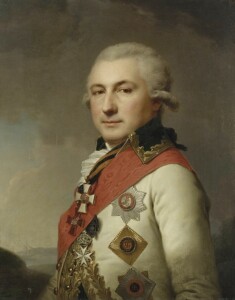
He suggested the site of the Turkish fortress Hacibey or Khad Zhibei, itself built on an ancient Greek settlement, that he had conquered without fighting in 1789 and he came up with the name of the new port, Odysseum (Homer’s Odyssey), a reference to the long history of Greek and Roman trade links to the Black Sea. Catherine opted to feminize the name and Odysseum became Odessa.
Thus 1794 marked a renewal of ties with Europe, and de Ribas called fellow Italians to the burgeoning town; merchants flocked, and Italian architects helped plan and build all the administrative buildings.
Since that time, Odessa has experienced booms and busts, including diseases.
The Black Sea is a major hub and turning place between Europe and Asia as author Neal Ascherson shows us in his Black Sea, a strikingly original and searching investigation of the universe of the Black Sea, from Jason and the Golden Fleece to the fall of Communism. Moreover, large-scale epidemics such as cholera and plague were a fact of life around the Black Sea, because the warm climate, lush landscape and booming trade coupled with variable immunity as people of all backgrounds, religions, and regions intermingled.
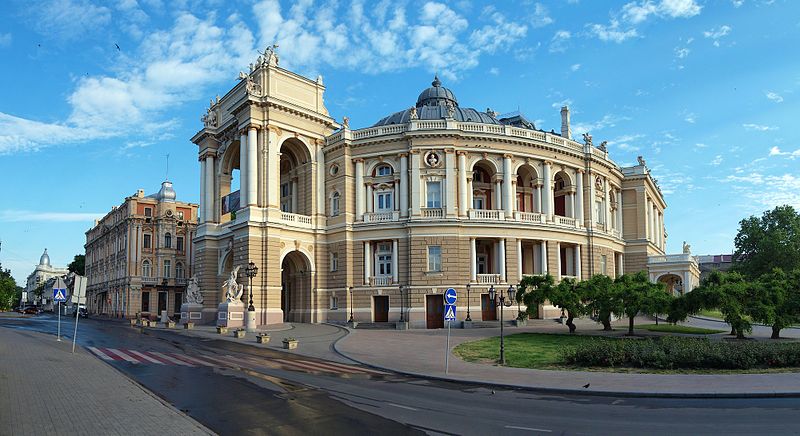
Exports through the port of Odessa tripled in value between 1804-1813 as the town thrived, with a growing community of foreigners. That was the time that Odessa got its first opera house which opened in 1810.
This rapid growth took place even in the face of the bubonic plague which broke out in August 1812.
At that point, this Russian city was managed by a Frenchman, Armand-Emmanuel de Vignerot du Plessis, 5th Duke of Richelieu and descendant of the famous cardinal (later, following the Bourbon restoration, he became Prime Minister of France).
Richelieu vigorously addressed the plague, shutting down every public institution and ordering the population to remain home; the city was segregated into five sealed districts, each with a doctor and an inspector. In a seminal book on Odessa, Odessa: A History, 1794-1914, the historian Patricia Herlihy explains how the plague was managed: “convicts dressed in black leather suits soaked in oil, and still wearing chains, were sent into the contaminated houses to clean them twenty days after the dead were removed”.
The Crimean War (1853-1856) in which Russia lost to an alliance of France, the Kingdom of Great Britain, the Ottoman Empire and Piedmont-Sardinia, was a turning point. It brought maritime trade to a halt and marked the beginning of Odessa’s decline.
That changed later in the nineteen-century when foreign capital came to develop Odessa as the main port for the hinterland, i.e. Ukraine; the Belgians, in particular, were very active, establishing sugar-beet refineries, investing in the vast coal and iron deposits in the Donets Basin, and, with famous Baron Empain, a pioneer in electric transport, building the first electric tram network; the British built waterworks, solving the Odessans’ problem with drinking the foul water from the Dniester estuary which caused cholera outbreaks every summer; the Germans provided gas lighting.
By the late nineteen century, Odessa was the most diversely populated city in the Russian Empire, with Greeks, Italians, Jews, French, and other Armenians making it a highly cosmopolitan and lively cultural center.
Revolutionary agitation brought about change, with perhaps the story of the Battleship Potemkin a pivoting point. Sailors on this ship in 1905 mutinied aboard a Russian naval ship, killed their Tsarist officers, and then ensued a rebellion in the city and it ultimately became a symbol of the subsequent 1917 Russian Revolution. A movie by Sergei Eisenstein is considered a classic.
The two World Wars had a significant impact on Odessa’s decline, ultimately recovering, growing to one million people, and its economic revival as a critical warm water port. Up until this year it was probably, the largest ports in the Black Sea Basin, whether for grains, oil, or dry cargo.
The Present: The COVID-19 Pandemic
Before the invasion and now, Ukraine was and has been affected by COVID-19. Unlike Richelieu in 1812, this Government did not close public institutions or lockdowns but rather sought to increase vaccine acquisition and uptake, with limited success.
According to the OECD “The COVID-19 Crisis in Ukraine” report dated February 25, 2022, the new Omicron variant hitting Ukraine reached a peak on February 4; the wave was expected to last until April 2. And according to the World Health Organization, there were 4.4 million Covid cases in Ukraine since the start of the pandemic, resulting in over 105,000 deaths by February 25.
With regard to vaccination, WHO estimated that Ukraine was doing poorly before the war started: “As of 25 February, Ukraine has fully vaccinated 34.07% of its population, making it the least-vaccinated country in Europe.”
COVID-19 data as available specifically for Odessa was 325,000 cases with nearly 6, 000 deaths.
What is left unsaid and virtually incalculable is the over 4 million Ukraine refugees, now generously accepted by host countries. It is a credit to them that their humanitarian feelings have overcome COVID transmission concerns. It is also a fact that at most reception areas set up on the border for Ukrainian refugees, testing and vaccination were made available. Moreover, the European Centre for Disease Prevention and Control (ECDC) on March 18 recommended that all European countries receiving refugees from Ukraine should provide free COVID-19 testing and vaccination to avoid outbreaks.
The Economy: A major Black Sea hub linking Ukraine with Europe
The costs of shutting down (or scaling down) the port in terms of exports and imports are very high.
One aspect has been given extensive attention, namely the export of grains, especially wheat. This has consequences, particularly for many developing countries that have relied on shipments coming out of the Odessa area. This issue was addressed by Impakter in a recent article, exploring the impact of the war in Ukraine on food.
Another aspect concerns oil and chemical facilities. Odessa has a major oil terminal situated in Port Yuzhne, one of the city’s suburbs, and another notable port, Chornomorsk located in the same oblast, to the southwest of Odessa. Together they form a major transport hub integrated with railways across Ukraine connected to the European networks, and, at least until the war started, with Russia’s strategic pipelines.
Finally, Odessa is also a logistics hub for international trade: Although container shipping in the Black Sea is a relatively niche market on the global scale, Odessa is unquestionably one of the largest container terminals.
If Russian forces cut it off, putting a stop to the flow of Ukrainian imports and exports, the impact on Ukraine’s GDP would be considerable and it would have potentially dramatic humanitarian consequences.
These are not idle speculations. The IMF has already estimated (on March 14) that the war is likely to shrink Ukraine’s economy by as much as 35 percent.
Threats to Odessa
When the invasion began on February 24, 2022, and until this past month, Odessa had not been extensively targeted albeit the Russian navy’s proximity was felt from the outset. This is now changing as Russian artillery and other weaponry hit the city and its facilities.
If Putin’s plan is to be understood, he sees this city as essential to control, not just because it is Ukraine’s southern capital and therefore subjugating it would be breaking key resistance. But it would have more far-reaching strategic consequences: With Odessa in the hands of Russia, the flow of East European exported goods from the Black Sea and the complementary imports from elsewhere would be entirely under Putin’s control.
The converse is also true: Ukraine losing Odessa would mean, inter alia, an economic injury from which it would be hard to recover.
Ukraine Identity
It is patently clear that Odessans overwhelmingly consider themselves Ukrainians, not Russians. While the multicultural nature of the city has been hammered by various temporary rulers, the polyglot character, its art, music, and writers continue in that tradition.
In sum, Odessa’s past, Ukraine’s future, cannot be disconnected. Odessa is an indispensable metropolis for Ukraine.
Editor’s Note: The opinions expressed here by Impakter.com columnists are their own, not those of Impakter.com In the featured image: Odessa center, including the Opera House (in the background), is fortified by the military, getting ready for invasion Source: Screenshot of NBC News video (out on April 3, 2022)