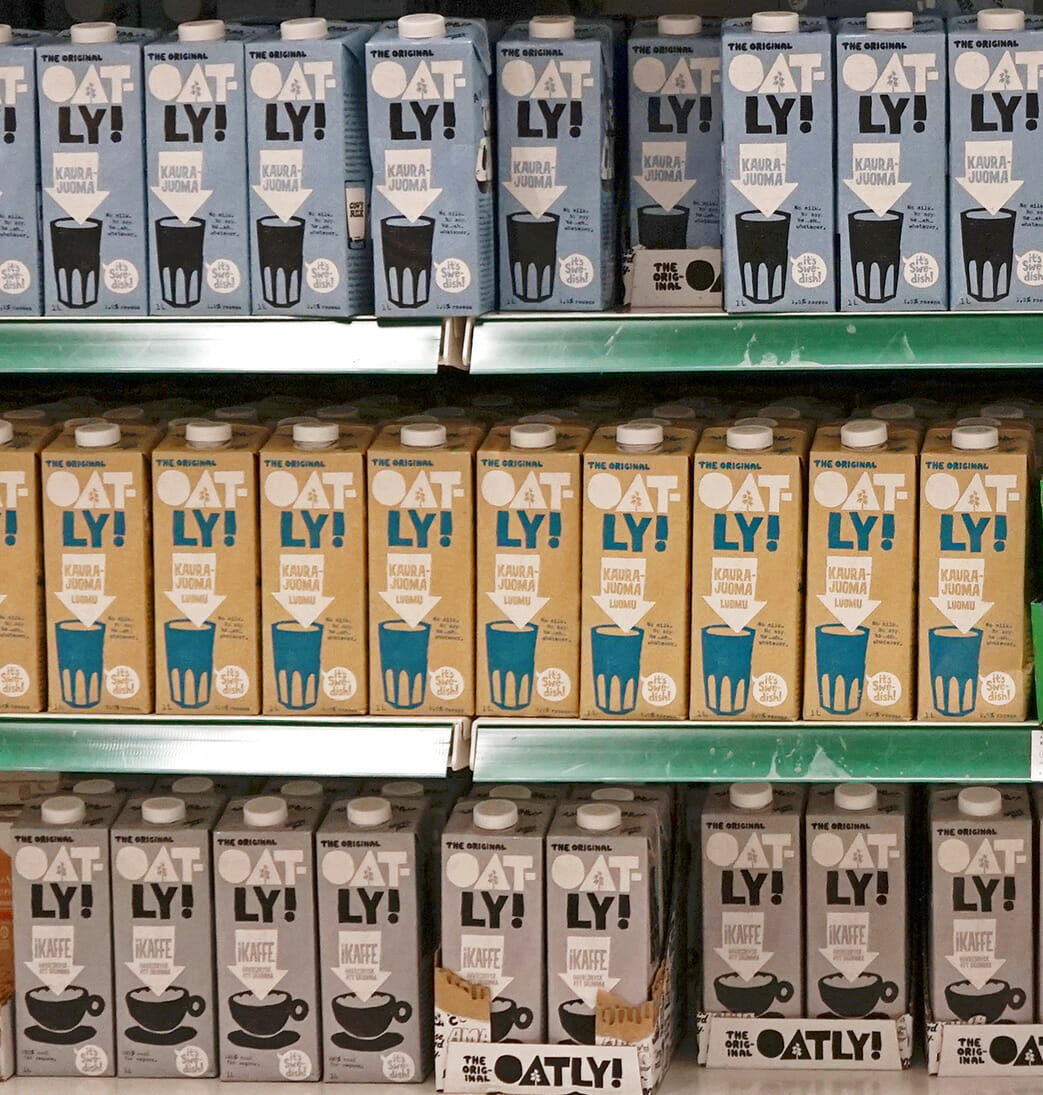
Popular Swedish oat milk brand, Oatly, has been told by the Advertising Standards Authority (ASA), a self-regulatory organization of the advertising industry in the UK, to stop the continuation of five ads that have promoted unclear and false information.
Based out of Malmö, Sweden, Oatly was formed in 1994 by scientist Bjorn Oste and his brother Richard Oste. With the goal to create a more sustainable milk, they landed on oats because of their low environmental impact. Now in 2021, Oatly is the second most popular oat milk brand in America and is expanding globally.
Priding itself on being an eco-friendly and sustainable company, Oatly has devoted countless research efforts to prove cows’ milk production has a considerably higher carbon footprint than oat milk — although many of these claims have now come to face scrutiny.
Published on the 16th of January 2021, the Oatly TV advertisement, using the slogan “Need help talking to dad about milk?”, compared the carbon footprint of Oatly’s milk to dairy milk, yet failed to be precise about the parameters.
After 109 individual complaints, the ASA found that the oat milk brand failed to provide appropriate scientific evidence to back up the claims.
In the commercial, a father is featured sneaking regular dairy milk into the fridge when he is questioned by his son on his choice of milk. Text then flashes on the screen stating “Oatly generates 73% less CO2e vs. milk, calculated from grower to grocer”.
A second related commercial with the same basis — the commercial containing a boy talking to his friend about how ‘crazy’ things are at home with his dad drinking cows milk — also appeared on the same day, making the same claims.
Although the information seems factual, the ASA announced the claims were “misleading,” as they only compared Oatly Barista Edition milk with full cream milk. The ASA ruled that it would lead consumers to believe all of Oatly’s products were included in the claim.
On the week of January 23rd, 2021, two more paid ads appeared on Twitter and Facebook, the brand stating that “The dairy and meat industries emit more CO2e than all the world’s planes, trains, cars, boats, etc., combined.”
The ASA investigated the claim and found it didn’t take into account the full scale of transportation emissions relative to the full-scale emissions of the meat and dairy industry — citing it compared the full life-cycle of the meat and dairy industry including emissions from producing feed, fertilizers and transportation, to emissions only coming from vehicles.
Alongside TV ads and social media campaigns, Oatly published two newspaper ads — one on January 16th in the Guardian Weekend Magazine and one on the 23rd in The Sunday Times Style Magazine.
In the Guardian Weekend Magazine, an ad featured the headline, “No egg-scuses” and then made the claim that “Climate experts say cutting dairy and meat products from our diet is the single biggest lifestyle change we can make to reduce our environmental impact.” The ASA concluded this information was misleading as it was based on one climate activist, while consumers would believe it to be based on a scientific consensus.
In The Sunday Times Style Magazine the second Oatly ad stated: “Today, more than 25% of the world’s greenhouse gasses are generated by the food industry, and meat and dairy account for more than half of that.”
The ASA again found the ad to be deceiving on the basis that Oatly held meat and dairy to include fish and eggs — when consumers could construe the claim with a narrower definition.
At a time when greenwashing ads are becoming more and more common — with the rise of consumer preferences favoring environmental friendly products — in September of 2021 the ASA announced it would be taking a firmer look to mitigate advertisements making environmental claims regarding energy, waste and transportation — Oatly itself being one of the latest big brands to be called out by the ASA’s crackdown.
Just recently, the ASA ruled against a Lipton Tea ad that claimed its bottles were “100% plastic free”, when the small print stated the lid and label were not included.
Other recent ads the ASA identified as “greenwashing” include a ruling in December of 2020 when food company Gousto asserted their packaging was “100% plastic free and recyclable” — when in actuality this was false.
The European Commission (EC) is also cracking down on greenwashing advertisements and companies can check out green guidelines by the FTC
Last year, the EC published a report that looked at 344 suspicious claims related to greenwashing. The analysis found that 42% of the cases could be seen as false or deceptive. The report also noted 37% of cases included vague statements about being “eco-friendly” and “sustainable” — implying that there were no negative impacts on the environment whatsoever.
Research suggests roughly 60% of Europeans proactively buy sustainable products, while 64% of Americans think it’s important for companies to be sustainable.
With the overwhelming amount of evidence that ‘42% of ads are classified as greenwashing’, it leaves many questions about whether people who are buying and making the effort to buy eco-friendly, are actually put in a position to do so.
One of the ways the American Federal Trade Commision (FTC) is helping companies avoid greenwashing is by providing Green Guidelines that help marketers make wholesome and clear claims.
Oatly under accusation: The way forward
As for Oatly, this isn’t the first time the brand has been in the hot seat.
In 2020, Oatly sold a 10% stake to Blackstone, an investment firm linked to deforestation in the Amazon rainforest.
For a company priding itself on eco-friendly merit, many Oatly consumers who agreed with their sustainable views were appalled with the stock sharing, calling for a boycott via social media on all Oatly products.
Despite this, Toni Petersson, chief executive officer of Oatly, told Forbes magazine Oatly’s involvement with Blackstone is to inspire environmental change in a company known for quite the opposite.
“This is what sustainability is about. If you’re going to reduce the carbon footprint by 50% by 2030, you better include everybody,” Petersson said. “We are the benchmark. We are here to prove that it’s more profitable to do good for the world.”
As a company that has been cited to have made several deceiving and misleading advertisements, their credibility as an eco-friendly company seems to be withering away as the years go on.
Although overwhelming evidence supports oat milk being the more sustainable choice than cows milk, these repetitive and “false” claims by Oatly should make consumers think twice when it comes to picking out which “sustainable” brand to support at the grocery store.
With greenwashing brands appearing more frequently, certification systems that verify sustainable brands are also adapting toward market changes. Such as the case with Impakters own Sustainability Index that so far covers a limited number of products, but is set to expand.
Likewise, new certification systems may be established in the near future, most likely in Europe with support from the EU Commission’s €800 billion Next Generation Eu — the Covid recovery maxi-plan designed to relaunch the European economy.
As for now, when it comes to buying sustainable products — in the absence of established certification agencies independent from the industry — the most consumers can do to avoid ‘greenwashed’ brands, besides reporting ads to the ASA, is to read the fine print.
Editor’s Note: The opinions expressed here by Impakter.com contributors are their own, not those of Impakter.com. — Featured Photo: Oatly products on grocery store shelf on August 26, 2018. Source: Tiia Monto, Flickr.