Disclaimer: The below piece is written from my perspective and my experience in the UK, following Brexit. So, if your experience has been different and more positive, I would love to hear from you. I want to be clear; I still have many English friends. I even have friends who voted for Brexit, but we never talk about it, the hatred or the fact that Brexit has been hostile towards people like me.
Brexit has not been a victory for anyone. It is terrifying to witness all the worst-case scenarios materialising with such speed, with rising inflation and the threat of a very cold (and expensive) winter coming. Recent polls indicate that Brexit no longer has the backing of a majority of the British themselves: Some fifty-five percent of the people said they believed Brexit had gone badly with only 33 percent saying it had gone well.
Can a European thrive in the country that chose to leave the European Union family? How much has Brexit influenced the current British depleting economy and shrinking human and financial resources? Is the ill-faith experiment worth sticking around for?
Let’s take a step back to when it all started.
2016
2016 was a busy year for our family; we finally managed to buy our first property in the UK. The process was unbelievably draining physically and emotionally. I would have given up right at the start if it weren’t for my husband. The English property system is archaic and expensive, and it seems to aim at keeping as many people out of the property ownership market as possible.
In our case, we needed to buy a place to live as the rental prices in 2016 were already becoming unaffordable for many Londoners. Owning the property was cheaper and the only way for us to live in London.
I spent the first three months of 2016 silently hoping nothing would collapse in the chain.
Unfortunately, on the day of the exchange, we were faced with a choice to start looking for another property or give our sellers more time, as a person they were buying their property from, pulled out of his agreement on the day of exchange. That is a very common practice and can be done without any notice or extra costs to the person who breaks the arrangement.
Because I was so spent trying to navigate the system, I paid very little attention to the Brexit campaign. I was also 100% convinced that no one in their right mind would vote for Brexit.
When the Brexit vote came in, I was mortified. My brain went into an instant overdrive, trying to comprehend what had happened and what all that meant for us, Europeans who decided that the UK was our home. But was it?
In any democracy, one must accept the majority’s vote, regardless of personal beliefs. However, what still angers me is the fact that the Europeans who lived in the UK and paid their due taxes weren’t even allowed to cast their votes, despite being contributing members of society. I felt shunted by the politicians and reduced to “just a taxpayer and the consumer”, who graciously was allowed to keep the economy going. At the same time, I had no say during the life-changing referendum.
David Cameron did a horrible job engaging in the conversation with the public and explaining what being a member of the European Union meant to the country, businesses, and individuals. He was lazy and overconfident.
The Labour party, on the other hand, was undecided and unable to see above its political future. They wanted to bow to the Brexiters but simultaneously keep the Remainers on their side. Unfortunately, they lost that gamble, handing over the power to the Tories for the foreseeable future. Tories are still in power in the UK, and the next general election is supposed to take place only in January 2025.
The pro-Brexit campaign was built on lies. I still try to understand how so many business owners were persuaded into thinking that Brexit, with all its red tape and massive amounts of extra taxes, was the right way to build the future.
I remember very clearly articles I read about farmers in Kent, who voted for Brexit and believed that they could easily “find” cheaper/cheap seasonal workers from Ukraine or Romania. Or a cafe owner, also voting for Brexit, who knew that they would have to pay more for their coffee beans imported from the EU. In his interview, he said that he had stocked up on the coffee and was prepared to pay extra taxes, but he wanted his freedom back.
Freedom from what? Only people, who have never been oppressed before, misunderstand the concept of freedom. I sometimes wonder how those people are doing now, and I want to shout, “WE TOLD YOU SO!”
You can’t build a global country and a global economy by closing the borders to talent, cooperation and dialogue. In the modern world, no country can survive on its own.
2022
So much has changed in the past six years, Brexit, the pandemic, inflation, and the Queen’s death.
Only now, and only slightly, the UK is waking up to the fact that maybe Brexit wasn’t such a great idea after all. When the borders were still open between the EU and the UK, the public, as well as businesses, didn’t have a clue what a bureaucratic nightmare was going to befall anyone who wanted to trade between the UK and the EU. The end of free movement also meant that the Brits couldn’t just move to Spain on a whim.
Buying anything from a British company when you are based in the EU is mostly not worth the financial and human resources it requires. The European customers are subjected to local taxes, and if the goods arrive in two separate packages, the customers are expected to pay double taxes.
The British companies exporting to mainland Europe need to deal with a ton of paperwork and selling some products such as alcohol is no longer viable.
The businesses lost enormous amounts of money, the country lost talent, and I never felt more European than I feel now. My longing for the continent becomes stronger each year.
The UK’s detachment from the European Union made me question my decision to build my life in a hostile place. At least not welcoming for people who speak with a foreign accent. For Britons it doesn’t matter how long we have lived in the country; we are still regarded as immigrants. Funnily enough, they call themselves ex-pats when they move to another part of the world. It is ironic, considering how they colonised half of the world, destroying the native populations and culture in the process, all in the name of “civilisation”.
Since Brexit, none of my films have been selected for British film festivals. I have never received any grants to support my practice in the UK. None of the creative jobs I have applied for was ever offered to me, despite my many years of experience, inside-out knowledge, hard work and can-do attitude.
It feels like the employers don’t see me as a person; for them, I must be just another European alien, who wants to take away the funding or jobs from the native creatives.
The creative and the arts industry has always been elitist in the UK. Since Brexit however, it feels that it has become even more cliquey and driven by discrimination. Don’t be side-tracked by the “beautifully” worded statements about equality of opportunities. The equality of opportunities is reserved for a very selectively chosen group of people. The rest can struggle; at the end of the day, no one asked the Europeans to build their creative practice in the UK.
Another issue that drives me crazy is the lack of ID documents in the UK. As Europeans, we need to prove our immigration status every time we change employment, go to a university, want to rent a flat, open a bank account, etc.
That nine letters and numbers that allow others to check our immigration status remind me of a harrowing European past, and each time I must generate a new code I get angry at myself that I keep putting myself through that. However, unless I’m prepared to apply for British citizenship, there is no way around that system.
From what I know and have read, the British Settlers in the European Union were issued ID cards. I would rather have an ID card than be just a number.
A few years ago, my son was diagnosed with profound dyslexia. According to the disability and equal opportunities law, he should receive adequate support for his dyslexia at school. Regrettably, as much as I understand the system is overwhelmed with unsustainable demands and a shortage of money and special educational needs teachers, I also don’t care about the excuses I keep hearing all the time.
The school doesn’t share my sentiment that my son has the right to receive help for his difficulties, and for the past two years his needs have been largely ignored. In his school, British kids have easier access to gaining special educational needs support than he has ever been offered.
In all fairness, the primary school he attended for his final year (year 6) was brilliant and offered him support right from the start. I also received support from the Disabled Students Association for my dyslexia and dyspraxia last academic year. I have also received more support this academic year, while I’m doing my MA. I was never offered any learning support in Poland when at school, even after my dyslexia assessment.
Just right after the Brexit vote, the tensions were high even in London. The Brexiters believed and hoped that all the Europeans were going to go back to Europe the day after. Some of those dreams materialised, and many Europeans left during the pandemic. I have not heard of an industry that hasn’t been struggling to hire or retain people in the past year.
The same Brexiters, keen to see us go, were the first to complain that there aren’t enough nurses, doctors or truck drivers.
Of course, the Great Resignation and Quiet Quitting play part in the current shortage of employees. But the nationwide re-training of people across all age groups and leveling up Johnson’s government promised hasn’t happened. Besides, training for some professions is not achievable for many people.
After the Brexit vote, the prices didn’t reflect the socio-economic change looming over the United Kingdom. But since 2020 the prices of goods and services have started rising, and now with the inflation, and the crazy petrol and electricity prices, is suddenly making many Brits wonder how come Europe is doing slightly better under the same circumstances.
Being cut away from the European community and the European Union’s financial support adds to the British distress. Of course, the European Union is suffering a lot as well. Still, at least EU countries are in it together and working hard to implement constructive change that can ease the effects of the energy prices now, not some time in the future, if feasible at all (aka fracking).
The pandemic pushed the already tired and overwhelmed NHS over the board. For a bit of context, most Britons don’t realise that health systems across European countries are very good and robust. Patients don’t need to wait for years to have their teeth extracted (this has been the case recently in the UK, check out ITV’s investigation). A lot of Brits believed, maybe they still do, that many Europeans were so-called NHS tourists.
In all these years I have lived in the UK, I have never met a European who told me that the NHS was what kept them in the country.
Having said that, giving birth to my daughter in the UK felt more human and amazingly beautiful compared to the same experience I had in Poland.
Still though, when we travel to Poland for the summer, we always have all the check-ups done and see all the specialists any one of us needs to see. We don’t mind paying for private medical care and are not prepared to wait for years to have an appointment.
Unfortunately, after the pandemic, getting an appointment with a specialist or even a GP in the UK became almost as difficult as winning the lottery.
Before the pandemic, I saw a specialist in my local hospital a couple of times. But all of a sudden, I was dropped as a patient, and the only way to get in touch with the specialist was through a GP. Getting back on that specialist’s list might take years.
The Long Covid clinic the British government was so proud to set up saw me twice. After the second visit, an appointment with a “specialist”, I started seriously questioning the motives behind hiring incompetent “specialists”. Was it to scare the patients back to health?
It took two years for my son to see an Ear, Nose, and Throat specialist. Our several appointments were postponed last minute. A day before an appointment, I would receive a text message saying that the appointment was canceled. We only got an appointment after complaining about discrimination against our child. If we hadn’t done that, I think we would still be waiting for an appointment.
My sister, who also lives in the UK, is still on the waiting list for surgery after two years of living on painkillers and barely eating anything. The specialists in her local hospital kept telling her that she was fine and should stick to taking painkillers if in pain; someone would be in touch with her at some point.
I know she is one of the 6.8 million of people waiting for a consultation, appointment, or other medical treatment. NHS has been struggling since I moved to the UK in 1998 and closing the doors on European doctors isn’t going to help ease the backlog of appointments.
My Observations in a Nutshell
The UK after Brexit is decomposing from the inside, and the process is very painful for those affected on any level by Brexit. I can see people distressed; everything takes forever to sort out; and the talent, money, and jobs are leaving. Unfortunately, those in power aren’t even remotely prepared to face reality.
The British Government
Historically the Tories have served the upper class and the big businesses, and nothing has changed. Their growing discontent with the working-class people and the need to destroy any type of social security is appalling. But even more shocking is that the working class keeps voting for them.
World events that happened after Brexit was implemented in 2020 (the pandemic, and the war in Ukraine) have helped the British government to create a long list of excuses for the real mess Brexit has created for businesses and individuals.
Those events have also conveniently created a smoke screen, hiding the fact that the UK’s long-term sustainability is jeopardized: It is, after all, a relatively small island that heavily relies on food import from the European Union and beyond, as well as on the labor inputs from seasonal and professional workers, who, once the borders closed down, have been unwilling to come back or to choose the UK as their new home.
Editor’s Note: To view the above video about post-Brexit UK (out on October 1, 2022) in your preferred language, go to settings to set the subtitles/CC from French to English or any other language (they are listed in the drop-down menu).
My take
All the discrimination I feel I’m being subjected to is very settled and isn’t “newsworthy”. But it does exist, and its main objective is to quietly push people like me, Europeans, out of the country, jobs and opportunities.
You may wonder why I still live in the UK then. Well, if I were single, I would most definitely move someplace else.
However, I have children, one of which has profound dyslexia, and putting him through another educational system and another language to learn isn’t something I’m prepared to do. Of course, I could pay for a private English school someplace. But still, we would need to learn the language to be able to communicate, call a doctor or go to the bank to sort out whatever we needed sorting out.
Poland is out of the question as long as the current far right-wing government is causing a tsunami across the country and the continent. Besides, it will take generations to repair the damage the Polish government has done to the country. I’m just grateful that this hateful, moronic bunch didn’t govern Poland in the 1990s, right after the collapse of the Soviet Union.
But how much longer I’ll be able to live in a country that is hostile towards people like me, people who speak with an accent and have a foreign-sounding surname, regardless of how much they have to offer? I literally have no idea. I have plans right after I finish my MA, and hopefully, after that my limbo state will end.
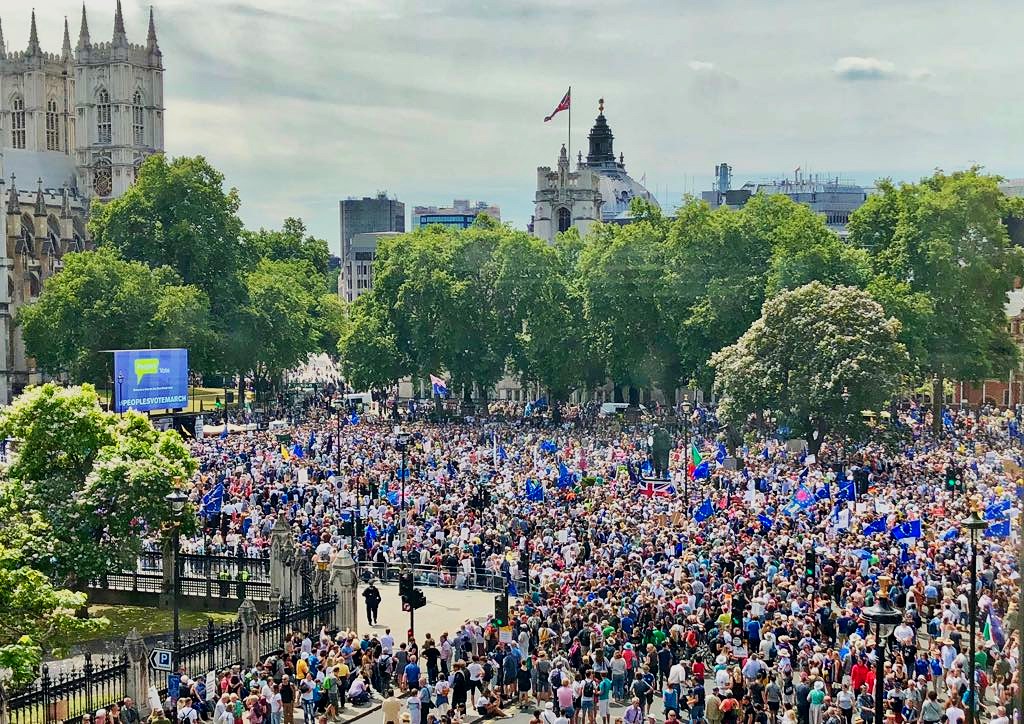
EDITOR’S NOTE: The opinions expressed here by Impakter.com columnists are their own, not those of Impakter.com IN THE PHOTO: Many blue EU flags at People’s Vote march organized in June 2018 in London. PHOTO CREDIT: People’s Vote.