Waste can be considered both a problem and a resource depending on the angle you look at it. For the majority of fashion creators, by-products, unsold products and redundant products are tarnishes for a reputable business name. Resource recovery is the selective extraction of disposed materials for a specific next use, such as recycling, composting or energy generation in order to extract the maximum benefits from products, delay the consumption of virgin resources, and reduce the amount of waste generated. In business terms companies who utilise resource recovery hold the sustainability equivalent of the ace of hearts, giving their consumers ease of mind on purchase and use.
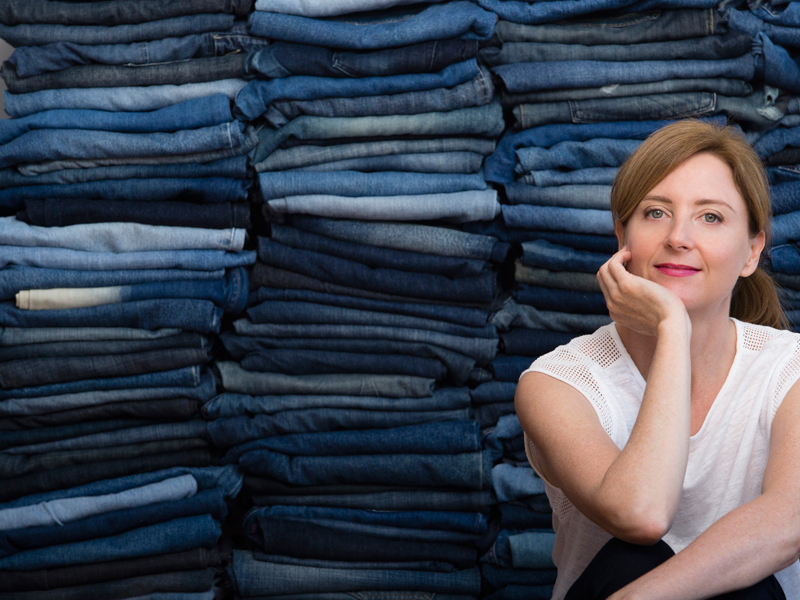
KT Doyle, Founder and Designer of JEANBAG, maintains a razor-sharp focus in diverting denim waste from landfill sites. She utilizes her business to combat the issue of denim waste, rather than trying tailor the problem to best suit her business. I spoke to KT Doyle about JEANBAG’s business model, its challenges and remaining sustainable.
Q: How did the idea for JEANBAG originate? And how does sustainability fit into the equation?
KTD: For a long time, working as an artist and surface designer was the perfect way to express myself. But gradually, I felt like something was missing. I wanted to do more. I wanted to make a difference. I learned about a local recycling competition and entered it. The brief was to make something useful and beautiful to inspire greater awareness and action around recycling in the community. I found a pile of pre-loved denim jeans at one of our city’s recycling centres and created the original JEANBAG beanbag. It was so well received, I thought perhaps I can do some good diverting denim waste from landfill by giving old jeans a second life as equally beautiful and useful products. Starting JEANBAG gave me a purpose greater than fulfilling my own needs. A purpose defined by the needs of my community.
Prior to starting JEANBAG, I was creating surface designs for sustainable wallpaper and textiles. It took me years to come around to working with manufactured product as I didn’t want to contribute to the massive problem we have of over-production and over-consumption. When I realized I could offer a more sustainable alternative to commonly available synthetic products, and be part of a generation of designers creating change from within the industry, I dived right in.
I feel strongly about our responsibility as creatives to ensure that what we put out into the world is sensitive to the environment, and to the people making and using our products. JEANBAG has been a natural extension within my design practice, allowing me to do something to address the issue of textile waste and more importantly advocate for recycling and reducing material consumption.

In the photo: The JEANBAG Photo credit: JEANBAG
Q: How does JEANBAG adhere to its values and mission while also staying competitive? Is there a unique business model that you use?
KTD: We care about people and that’s why we care about the planet. We believe that everyone should have access to clean water, clean air and a healthy environment, but not everyone does.
One of the biggest issues of our time is environmental pollution from overconsumption. Rather than getting overwhelmed (which is easy in a world of seven billion), we thought: how can we be part of a solution to the global issue of waste?
We’ve chosen to see waste as a resource and harness its inherent value. And, more brands are now transforming waste into beautiful and useful products, instead of relying on virgin materials. Being faced with global environmental issues from plastic pollution to textile waste, we are finding smarter solutions to old ways of doing things. It’s no longer enough to compete. We need to be radical and innovate. We’re part of a new mindset, not focused on profit, but on the health of the environment.
We’re evolving organically and we like to keep things simple. Instead of focusing on our business model, we focus on our process: Have an idea; believe in it wholeheartedly, vet it and test it, do it, connect with people, make mistakes and try something else. Repeat.

In the photo: JEANBAG cushions Photo credit: JEANBAG
Q: Are there any unique challenges for sustainability in the fabric/home decor industry? How does JEANBAG overcome these challenges?
KTD: When it comes to sustainability, I think the challenges we face in the fabric/home décor industry are much the same as any other industry and centre around cost. When reducing your costs to increase your profit margin is your primary goal, you’ll do all sorts of things that don’t have the planets best interest in mind. We focus on the positive impact we can make environmentally and provide education on the value inherent in recycled materials and handmade processes.
When you think about it, recycled and up-cycled products embody the time, resources, materials and workmanship that go into making the original product and the up-cycled product. We’re challenging the old mindset that up-cycled products are of lesser quality by educating people about the time and care it takes to re-make something. And, in this vein, it’s our responsibility to deliver beautifully designed and expertly crafted products that exceed people’s expectations, to the extent that they say, ”I can’t believe they’re made out of old denim jeans. They look brand new!”
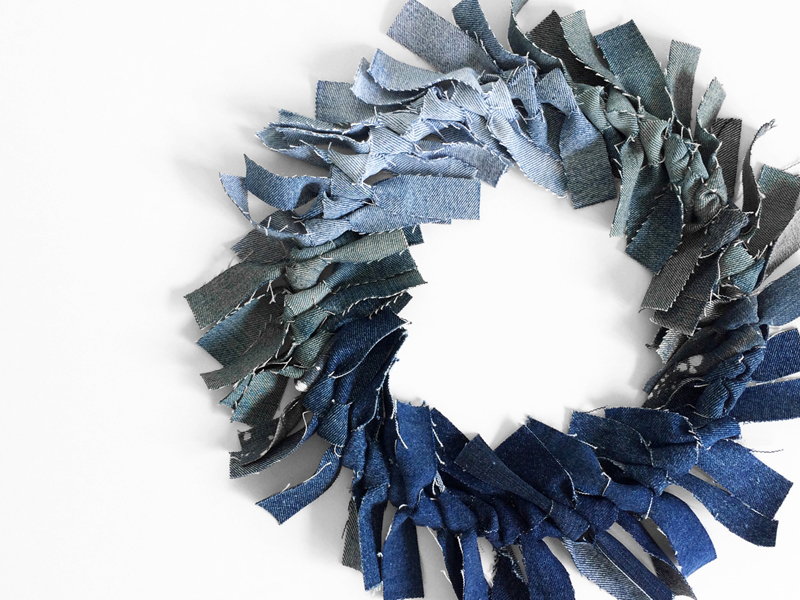
In the photo: JEANBAG christmas wreath Photo credit: JEANBAG
Q: What are some of the criteria JEANBAG looks for when sourcing its materials?
KTD: We’ve developed partnerships with some charity organisations in Australia. We buy the denim jeans they can’t sell in their stores, which supports their cause and streamlines our material sourcing. We also work directly with the community, inviting them to send their jeans to us to up-cycle. Our current product range uses 100% cotton denim in shades of blue. We’re looking for ways to use stretch denim in the future, as there is a real need to keep this out of landfill too.
Related article: “Green jeans are bluer: An interview with Jeffrey Shafer” by Mohamad Akef
Q: What do you think is the future of sustainability, particularly relating to the fabric/home décor industry?
KTD: I think all industries need to look at developing closed loop production systems and provide clear, transparent information on their products and processes. This includes taking back products at end of life to recycle, up-cycle or re-purpose.
The direction we need to move in (and I believe we are) is promoting lifestyles that are zero waste. If brands can one day say to their customers, “Do you really need another pair of jeans or another cushion?” we’ll really be doing something good for the environment.
In the meantime, at JEANBAG, we will continue to tackle the issue of textile waste by diverting denim jeans from landfill via our product range and advocacy. Hopefully, into the future, we’ll have no reason to exist. Afterall, the key to treading gently on the planet and living sustainably might just be buying less and living more.
Editors note: The opinions expressed here by Impakter.com columnists are their own, not those of Impakter.com