In 2018, 238 scientists and 100,000 persons endorsed a letter demanding that the European Union and its Member States “plan for a post-growth future in which human and ecological well-being is prioritised over GDP.” They reminded decision-makers that the growth of powerful economies comes hand in hand with a negative impact on the global environment — and threatens to go beyond the current understanding of our planetary boundaries.
But they went further than just calling for a political shift. They made a very serious affirmation:
“Today, solving social problems within European nations does not require more growth. It requires a fairer distribution of the income and wealth that we already have.” (bolding added)
What is growth, exactly?
Rather than prioritizing the well-being of people and planet, global capitalism relies on a notion of exponential growth, requiring ever-increasing industrial production amid limited energy and material resources. These processes come along with the exploitation of labor, time, materials, energy, and lands of people who never get to reap the promised positive effects.
Now, in 2023, the stakes of such “growth” are even higher. The latest IPCC report released in May 2023 warns against both the dangers of governments and industries’ gross insufficient action and the dangers of relying on problematic technologies in the face of the irreversible harm that will occur if warming surpasses 1.5°C, even temporarily.
The world has already experienced enormous biodiversity loss: 70% of the land on this planet has been altered by humanity; ocean warming is leading to a massive extinction at a level not seen in about 250 million years; and 40% of the planet’s land is already degraded due to modern agriculture, affecting half of the people alive today. In relation to land use, the world lost tropical forest in 2021 at a rate of about 10 soccer fields per minute.
Furthermore, countries that have grown the most have the largest share of the responsibility for the extent of this planetary environmental damage. Global North countries, composed of just 16% of the population, are responsible for 92% of excess global CO2 emissions and 74% of the overshoot of material resource use in the world — almost half of it extracted in the Global South for Global North consumption and use.
Amid this massive and inequitable destruction, the world is in urgent need of a strong UN that is willing to listen to scientists and experts. The IPCC report on mitigation and climate change discusses the criticism of an economic growth framework and highlights other alternatives to ensure a transition that can address “both emissions and inequality in energy and emission footprints.” The IPCC refers to degrowth, post-growth and post-development as valuable paths with solutions.
Related Articles: End the United Nations? Bad Idea | What Is Wrong With the UN?
Yet despite such evidence, all major conferences and meetings at the United Nations regularly result in resolutions (often adopted by consensus) that continue to stubbornly promote economic growth — pairing up exponential economic growth with the notion of “progress” — as one of the main priorities of the UN mandate. Economic growth is prioritized even above the other principles stated in the Universal Declaration of Human Rights (UDHR), which this year will celebrate its 75th anniversary on December 10.
The UDHR refers to “social progress and better standards of life in larger freedom,” but not to exponential economic growth. And yet, some UN bodies (such as the World Bank and the International Monetary Fund) state their sole mandate as the promotion of economic growth, but declare themselves free of the mandate of the human rights framework, under the argument it is “too political.”
Even worse, the UN has not only prioritized economic growth, but also moved steadily towards prioritizing the role of global corporations, those who profit the most from exponential extraction, as major decision-makers — even above Member States. UNDP’s partnership with fossil fuels companies contravenes its own mandate and its own recommendations of aiming at sustainability.
UN Women’s May 25 announcement of a partnership with BlackRock led to a global mobilization by civil society and social movements to call out outsized corporate influence. And, most recently, the UNFCCC partnered with corporate actors that are responsible for environmental catastrophes–such as Coca-Cola and fossil fuel-linked companies.
These political efforts to undermine the role of the UN as a democratic space and shift it towards a “networked multistakeholderism,” a euphemism that really means opening the door to outsized corporate influence over the UN, comes directly from the UN Secretary General’s “Our Common Agenda” (OCA).
The Civil Society Financing for Development Group has warned of these efforts since the beginning of 2022. Now, we face a process linked to OCA leading towards the Summit of the Future, strongly promoted by the Secretary-General, that is casting a shadow on the efforts to accomplish the Sustainable Development Goals (SDGs) — which widespread data shows will not be met by 2030.
What is at stake here is not only a conflict of interests, but an institutional project. There is a global expectation, at this sensitive historical juncture, that the United Nations should deliver in a democratic manner with the type of leadership, technical analysis and political vision that is expected of it.
Now more than ever the UN should mobilize its political capital and technical expertise to promote the type of new solutions that the IPCC report and many social movements, civil society experts and scientists have called for, like degrowth, post-growth, and post-development frameworks. At the core these should include tax, debt, trade, social and environmental justice, among others — towards structural justice.
The UN’s strong linkages with economic projects tied to exponential growth and corporate monopolies is the opposite of what the world needs. As we head towards a dangerous tipping point, it will be up to the global citizenship and Member States, especially those in the Global South, to hold the UN to account for safeguarding people-centered multilateralism in a democratic and redistributive manner.
The upcoming 75th anniversary of the UDHR is certainly one symbolic opportunity for the UN to change course — toward a real transformation in favor of humanity and the planet.
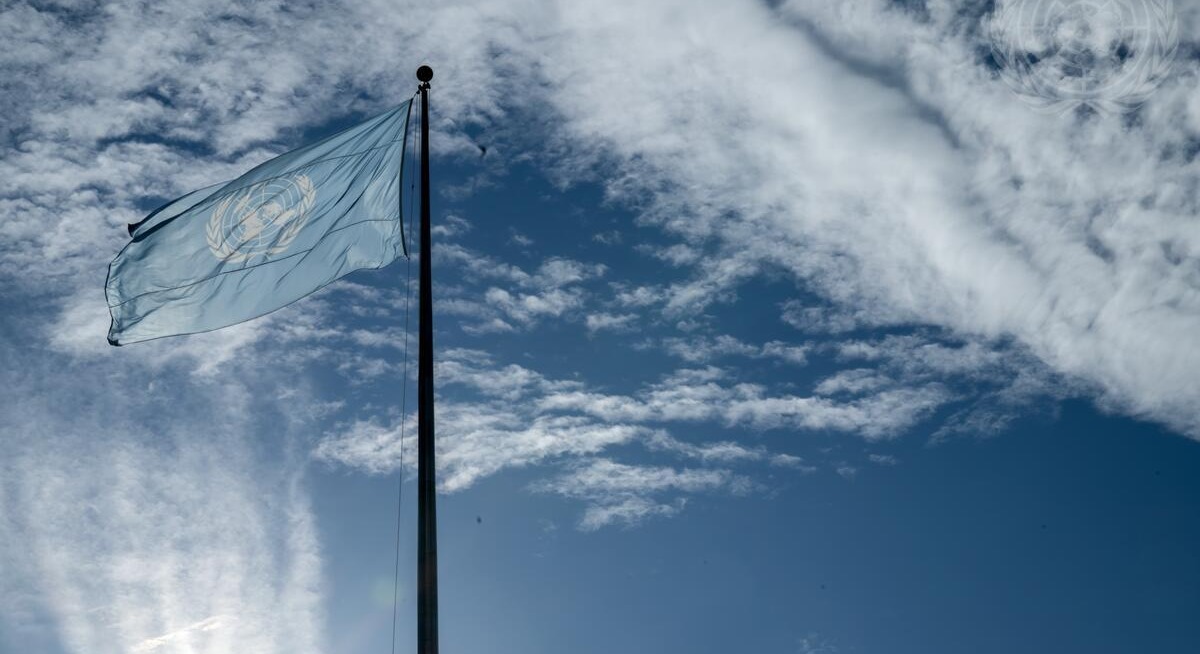
Editor’s Note: The opinions expressed here by the authors are their own, not those of Impakter.com — In the Featured Photo: A view of the United Nations flag and clouds on a blue sky at UN Headquarters during the UN 2023 Water Conference. Featured Photo Credit: UN Photo/Mark Garten.