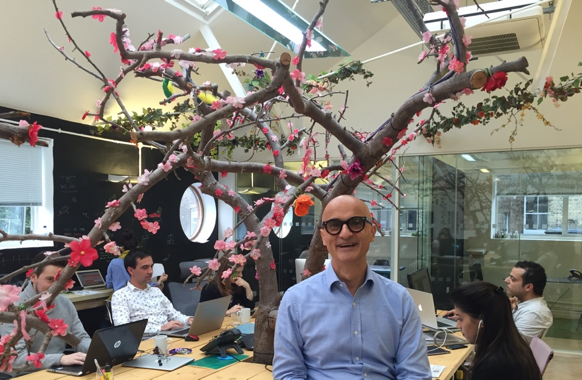
London-based startup babylon Health is changing the landscape of healthcare consultancy by bringing practitioners straight to users via its mobile app. Founder and CEO Dr. Ali Parsa spoke with Impakter about the journey growing the company and the upcoming launch of its next-generation app.
What was the main reason for you starting babylon Health?
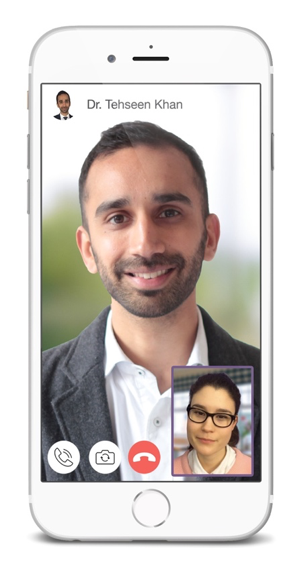
Dr. Ali Parsa: Think about how archaic our approach and access to healthcare is. You and I live in one of the richest countries in the world with one of the best health services in the world, and yet one in five of us cannot get a doctor at the time or place we need it. The problem in developing countries is much more severe—50% of the global population has almost no access to healthcare, and yet they all have one of these mobile phones in their pockets. So we thought, what if we could deliver most of the healthcare people need on their mobile phone, and that is where the idea of babylon came from.
Digital solutions have the potential to completely change the face of healthcare, so much so that it will be unrecognisable in the next five years.
PHOTO CREDIT: babylon Health
Do you actually think that it is just as effective as physically going to the doctor?
A.P.: We are able to treat 9 in 10 of our patients without the need to see them in person, so it is just as effective in the majority of cases. Our patients rate our service five out of five stars for over 90% of their appointments, so they too agree that it is just as effective. The added bonus to this, of course, is that you can gain access to a doctor in minutes, as opposed to weeks and consult with them from home, at work, or even abroad if you need to.
Related article: “THE WHITE COAT ON WHEELS“
Describe your best and worst experiences while starting this business.
A.P.: Best—starting a business gives you the opportunity to build something from scratch and make your vision a reality, like other creative processes such as films, paintings, etc.
Worst—there is only so much you can do, because there is limited time and resources to tackle it at the speed and the scale that you want. The best and worst things are essentially two sides of the same coin. Having a blank sheet to draw on is brilliant, yet it takes a long time to create a worthwhile painting.
Do you believe we are moving towards a completely mobile market when it comes to the health industry?
A.P.: The health industry is among a small number of major sectors that have not yet been fundamentally improved by technology, or become predominantly mobile based, but it is going to happen, and it will be for the best. Innovation is moving at an extremely fast pace. My mobile phone is a thousand times more powerful today than it was 10 years ago and will be a thousand times more powerful 10 years from now. Digital solutions have the potential to completely change the face of healthcare, so much so that it will be unrecognisable in the next five years.
Are there any issues with insurance/health care companies not wanting to participate?
A.P.: Of course. It always takes longer than one expects to get any new technology adopted. People often forget that the flat part of an S curve is flat. What one hopes for in early stages is not mass adoption but early adopters. The response we have had so far has been overwhelmingly positive. Around 70 businesses, including Citigroup, BNY Mellon, LinkedIn and leading employee benefits and health insurance providers have already partnered with babylon to offer its services to UK employees—enough satisfied early promoters that we’re confident for mass adoption in time.
For a full mindmap behind this article with articles, videos, and documents see #babylonhealth
What is your target market and why?
A.P.: It is quite broad as early adopters are in every social group, and obviously everyone gets sick and will need healthcare at some point. We find though that our service is particularly popular with parents, as it is a lot easier to consult with a doctor from home than packing up the kids to travel to a GP surgery. It is also extremely popular for urban populations who tend to work long hours and would rather see a GP during the evenings or weekends as opposed to arranging half a day of work to travel to their surgery in person.
Do you have any direct competitors?
A.P.: The majority of digital healthcare companies simply connect people to doctors through a mobile phone, but developments in technology mean we can now achieve a great deal more, and this is the area we are focusing on. Our next generation app will harness the powers of artificial intelligence and machine learning to not only prevent ill health but also predict it and intervene when necessary. To our knowledge, we are the only company working towards this right now.
FEATURED PHOTO CREDIT: babylon health
Have you been a part, or have any plans of participating in any specific social causes or fundraising?
A.P.: Our entire mission is a social one. Our long term goal is to democratise healthcare by putting an accessible and affordable health service into the hands of every person on earth. In order to achieve this, we are bringing together one of the largest teams of scientists, clinicians, mathematicians and engineers to focus on combining the ever-growing computing power of machines with the best medical expertise of humans to create a comprehensive, immediate and personalised health service and make it universally available.
For example, we are currently working with the government of Rwanda to provide its population with a national health service, delivered through a mobile platform. Doctors are extremely scarce in the country, so the impact of this will be significant.
What do you have planned in the future for babylon Health?
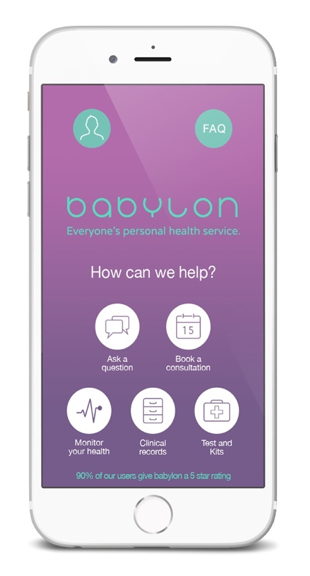
A.P.: Our next generation app, which will launch in stages during 2016 will showcase what can be achieved when you combine artificial intelligence with the best medical expertise and put it in people’s pockets. Our new service will be able to formulate a ‘health age’ based on genetics, environment, behaviour and biology. It will analyse warning signs to predict when an illness might occur and recommend preventative measures. When patients are ill, it will be able to talk users through their symptoms by using hundreds of millions of symptom variations to decide what the best course of action is, for example, picking up over the counter medicine at a pharmacy, booking a GP appointment, managing the illness from home or going straight to hospital. If it is the latter, it will provide directions to the nearest A&E or even book a taxi for you. The system will also be able to remind patients to take their medication and follow up after the course is finished to see how they are feeling to check the issue to has been resolved and if not, recommend more treatment.
Recommended reading: “COULD THIS ‘ROBOT DOCTOR” REPLACE YOUR GP?“
FEATURED PHOTO CREDIT: babylon Health
EDITOR’S NOTE: THE OPINIONS EXPRESSED HERE BY IMPAKTER.COM COLUMNISTS ARE THEIR OWN, NOT THOSE OF IMPAKTER.COM.
Interview babylon Health Instagram.com